How to manage geese in summer? Detailed technical points
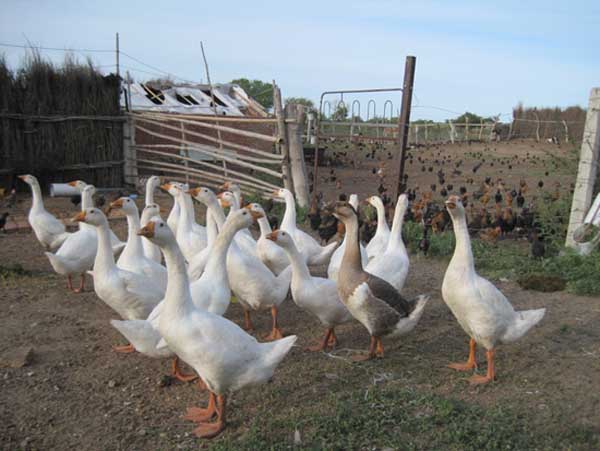
Geese are covered in feathers all over their bodies, with dense down, plus a relatively thick layer of subcutaneous fat, which determines the goose's physiological habit of being cold-tolerant and heat-intolerant. In summer, the pens are stuffy and hot, geese breathe faster, appetite decreases, and coupled with mosquito and fly harassment, the growth and fattening of meat geese are seriously affected, and egg geese also often stop laying at this time. In summergoose raisingwhat problems should be paid attention to?
Summer gosling management techniques
1. Transportation: During transportation, the temperature for goslings must not be too high, and it is best to keep it at 25--30°C. During land transportation, it should be done in the cool early morning, late evening, or at night, and more ventilation holes should be left around the boxes. When stacking the boxes, leave more gaps between the boxes to maintain air circulation. There must be rainproof facilities to prevent rain from soaking them. The density of goslings should also be reduced. For example, a box for transporting goslings normally holds about 60 goslings, but in summer it should be reduced to about 50. During long-distance transportation, the condition of the goslings should be checked midway, and problems should be dealt with promptly. Before transportation, the transport tools, including vehicles and boxes, should be disinfected.
2. Daily management
① Provide water and start feeding in time. After the goslings arrive, let them rest for a short while in the brooding house, then divide them into groups by size and strength. Place the small and weak goslings closer to the heat source and let them move around inside the pen for a while. When all the goslings can stand and move, give them their first drink. They should be supplied with 0.02% potassium permanganate cooled boiled water. For long-distance transportation, 5% glucose water should be supplied. If the transportation time is too long (more than 30 hours), before giving water, feed some tender green succulent feed chopped up, with forage length of 0.1--0.2 cm, let them eat freely, and then give water. The first drink is very important, and every goose must be ensured to drink water. If individual goslings are found not drinking, hold their head from behind the head and neck with your hand, gently fix both sides of the gosling's beak corner with your thumb and index finger with appropriate force, let it open its mouth, and dip water into it 2--3 times. After the first drink, clean and cool drinking water must always be available. After the first drink, let the goslings move around fully. When the goslings show pecking behavior, begin feeding. Generally, feeding starts 24--36 hours after hatching. If wet mash feed is used, add it in small amounts and feed frequently. In the first week, feed 12 times day and night; in the second week, feed 8 times day and night; in the third week, feed 6 times day and night. Each feeding should be mixed fresh and fed immediately to keep the feed fresh, increase palatability, ensure the goslings' feed intake, and promote growth.
② Ensure the temperature of the brooding house. In summer, the daytime temperature may exceed the temperature required for brooding, so attention should be paid to ventilation to keep the air in the brooding house fresh. At night, the temperature may be lower than the temperature required for brooding, so heating must be provided at this time. Never use natural temperature for brooding just because it is summer. Normal brooding temperatures: 1--5 days old 30--32°C, 6--10 days old 27--30°C, 11--15 days old 24--27°C, 16--21 days old 21--24°C.
③ Appropriately reduce stocking density. General stocking density: 1--5 days old 20--25 birds/sq m, 6--10 days old 15--20 birds/sq m, 11--15 days old 12--15 birds/sq m, 16--21 days old 8--12 birds/sq m. The density can be appropriately reduced according to brooding conditions, and the lower limit of density can be used.
④ Do a good job in sanitation and disinfection. The brooding house should be spray-disinfected with geese inside 1--2 times per week (for example, using Baidusha disinfectant mixed with water at a ratio of 1:600), and drinking water should be disinfected once every 2 weeks (for example, using Baidusha disinfectant mixed with water at a ratio of 1:3000--4000). Feed and water utensils should be cleaned once a day, washed once a week with 2% sodium hydroxide solution, and then rinsed clean with clean water.
Summer management techniques for growing geese and adult geese
1. Growing geese (22--70 days old)
① The general stocking density for growing geese is 4--6 birds/sq m, and the stocking density should be appropriately reduced according to environmental conditions.
② Frequently change the litter in the goose house (dry grass, fine sand, or other litter) to keep the ground clean and dry.
③ Build a shade shed in the outdoor exercise area or use natural tree shade. The ground should be flat and have a certain slope to facilitate drainage and keep the ground dry after rain.
④ Feed more clean green feed and keep drinking water clean and cool.
⑤ Open the front and rear windows during the day to ensure air circulation and freshness. At night, the temperature inside the house should still be maintained at around 15°C.
⑥ When free-range raising is used, grazing should be carried out in the cool morning and evening, and attention should be paid to weather changes to prevent rain soaking. The height of the grass in the grazing area should preferably not be higher than the goose's body. However, before the feathers on the goose's abdomen have fully grown, grazing should be done after the dew has fallen, to prevent dew from soaking the abdomen and causing diarrhea or colds in the geese.
⑦ At least once a week, spray-disinfect the pen with geese inside, and disinfect drinking water once every 2 weeks.
2. Adult geese (over 70 days old)
① Appropriately reduce the stocking density inside the house (general stocking density 2 birds/sq m). When the weather is good, the geese can be allowed to spend the night in the outdoor exercise area. Build a shade shed in the outdoor exercise area.
② Feeding can be carried out in the cool morning and evening to ensure the geese have sufficient feed intake. Also appropriately feed more green feed and ensure clean drinking water.
③ Spray-disinfect the goose house with geese inside once a week, and disinfect drinking water once every 2 weeks.
④ For northern goose breeds, after they stop laying, artificial forced molting can be considered. After molting, gradually increase feed and feed less green feed, preparing to enter the second laying period (September--October). For some southern goose breeds, in the middle and late summer, production can be stimulated by increasing the nutritional level of the feed and adding feed, and they can begin laying around September.
⑤ Breeding geese should have a bathing and mating pool (water depth about 0.5 m) or use nearby fish ponds, rivers, and lakes, and go into the water to bathe every day at 8--9 a.m. and 3--4 p.m.