How to tell male and female geese apart? A few practical methods for identification
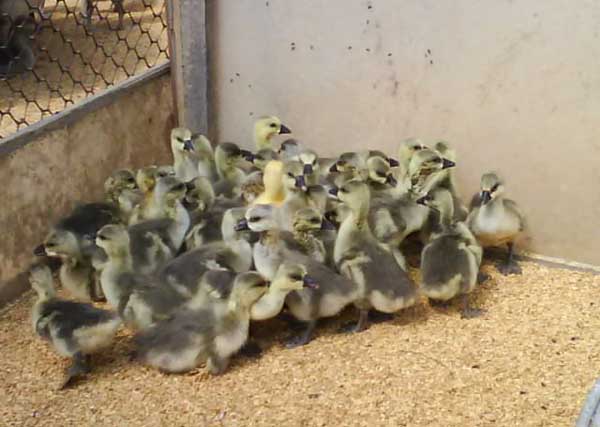
When buying goslings, identifying the sex of the goslings is important forgoose farmingproduction and has important economic significance. After separating males from females, they can be raised in separate groups, or excess male geese can be culled promptly, reducing the feeding cost of breeding geese. In commercial goose production, raising males and females in separate groups and managing them separately makes the geese grow evenly. Today, the editor will share with you how we should distinguish male geese from female geese.
Identifying goslings by appearance
Identifying goslings by appearance mainly involves three looks. First, look at the head, neck and body: those with a large head, held high, a thick and long neck, slightly greater body weight and a slightly longer body are male geese; the opposite are female geese. Second, look at the nostrils and nasal base: newly hatched male geese have narrow nostrils, linear along the beak, and a soft, flat nasal base with no undulations; by contrast, slightly larger nostrils that are somewhat oval, and a hard nasal base with obvious undulations, indicate a female goose. Third, look at the forehead feathers (the feathers between the two eyes) and the lower jaw: males have upright forehead feathers and a sunken midline; by contrast, females have forehead feathers lying flat, and this is most obvious 3 to 4 days after hatching. In addition, turn the gosling upside down so its belly faces up and examine the edge of the long feathers on the lower jaw: if it is semicircular or slightly flat and neat, it is a female goose; if it is not obviously protruding and not neat, it is a male goose.
Identification by movement
When driving goslings, if they lower their heads, stretch their necks and make frightened calls, they are male geese; generally, the calls of male geese are high, sharp and clear. Those that hold their heads high and call continuously are female geese; the calls of female geese are low, coarse and deep.
Identification by feather color
For goslings of the same breed, after the down of the newly hatched goslings has dried, those with darker feather color are mostly female geese, and those with slightly lighter feather color are mostly male geese.
Identification through the vent
Hold the gosling in the left hand so its back faces up and its vent faces the identifier's right hand. Use the thumb and index finger of the right hand to gently pinch the outside of the vent. If it is a male goose, because it has a copulatory organ, a particle the size of a rapeseed can be felt between the fingers; if it is a female goose, no foreign body can be felt.
Identifying male and female adult geese
Generally, male geese are larger in build than female geese, with a bigger head and taller legs, and stand majestically. When the vent of a male goose is opened, a spiral-shaped penis can be seen. Female geese do not have one.