What are the common breeds of egg-laying geese? A detailed guide
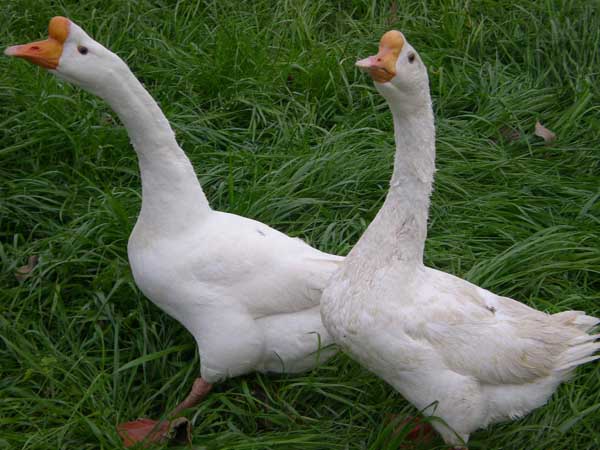
Geese are called egg-laying geese from the time the female goose starts laying until she is culled. Small goose breeds are commonly used as egg-laying geese, such as the Huoyan goose, Zi goose, Wuzong goose, Yangjiang goose and others. These geese are characterized by a light and small body, a delicate head, a slender neck, slightly long legs and high egg production. The characteristics of these egg-laying goose breeds are introduced below:
Huoyan goose
The Huoyan goose originated in the Laiyang area of Shandong and is the most productive small white goose breed in China.
1. Adult body weight. Adult ganders weigh 4-4.5 kg, and female geese 2.5-3.5 kg. Under a rearing method based mainly on grazing with supplementary feeding, the body weight is 1.4-1.8 kg at 60 days, and 2.9-3.4 kg at 120-140 days of age.
2. Slaughter performance. For ganders, the eviscerated yield is 70-72% and the half-eviscerated yield 78-81%; for female geese, the eviscerated yield is 69-71% and the half-eviscerated yield 75-81%.
3. Egg-laying performance. Age at first egg is 6-7 months, annual egg production is about 100 eggs, egg weight is 125 g, and the eggshell is white.
4. Reproductive performance. The fertility rate of breeding eggs is 85%, the hatchability of fertile eggs is 80-85%, and the survival rate of young geese is 92%.
Zi goose
The Zi goose originated in the Songnen Plain of Heilongjiang Province. It is relatively small in size, and its whole body plumage is white.
1. Adult body weight: adult ganders weigh 4.23 kg, and female geese 3.41 kg.
2. Slaughter performance: the half-eviscerated yield is 82%; the eviscerated yield is 72%.
3. Egg-laying performance: laying begins at 6 months of age, annual egg production is about 100 eggs, the average egg weight is 131 g, and the eggshell is white.
4. Reproductive performance: female geese have no broodiness. The male-to-female breeding ratio is 1:5-7, and there is no broodiness.
Wuzong goose
The Wuzong goose originated in Qingyuan County, Guangdong Province. Because there is a dark brown mane-like strip of feathers on the neck and back that gradually narrows from large to small, it is also called the Qingyuan Wuzong goose. The feathers on both sides of the neck, the chest and the abdomen are white, while the wing feathers, shoulder feathers, back feathers and tail feathers are black.
1. Adult body weight. Ganders weigh 3-3.5 kg, and female geese 2.5-3 kg. The body weight is 2.9 kg at 70 days of age and 3.2 kg at 90 days of age, and the meat-to-feed ratio is 1:2.31.
2. Slaughter performance. The eviscerated yield and half-eviscerated yield are about 87.4% and 77.4% respectively.
3. Egg-laying performance. The age at first egg for female geese is about 140 days, annual egg production is 29 eggs, and the average egg weight is 147 g.
4. Reproductive performance. The fertility rate of breeding eggs is 87.7%, the hatchability of fertile eggs is 92.5%, and the survival rate of young geese is 84.9%. Female geese have strong broodiness, becoming broody 4 times a year, and the breeding period is 5-6 years.
Yangjiang goose
The Yangjiang goose originated in Yangjiang City, Guangdong Province. It has a fine and compact body type. From the top of the head to the neck and back there is a brownish-yellow feather band shaped like a horse's mane, so it is also called the yellow-maned goose. The whole body plumage is close-fitting, and the back, wings and tail are brownish-gray. The beak and knob are black, and the shanks and webs are orange-yellow.
1. Adult body weight. Ganders weigh 4050 g, and female geese 3120 g.
2. Slaughter performance. At 9 weeks of age, ganders have a half-eviscerated yield of 82.23% and an eviscerated yield of 74.10%. Female geese have a half-eviscerated yield of 82.00% and an eviscerated yield of 72.91%.
3. Egg-laying performance. The age at first egg is about 150-160 days. Annual egg production is 26 eggs, the average egg weight is 141 g, the eggshell is white, and the egg shape index is 1.4.
4. Reproductive performance. The male-to-female breeding ratio is 1:5-6, and the fertility rate of breeding eggs is 84%.