What are the precautions for raising geese in early spring? Farmers should keep them in mind
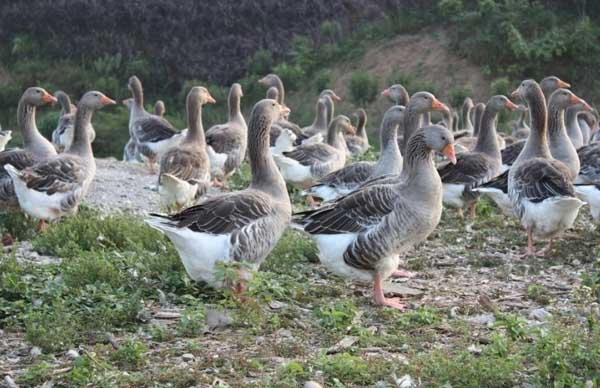
In early spring, the climate is cold and humid, and there are many disease-causing factors. Goslings that have just hatched have delicate constitutions, sparse down, and small bodies, and their ability to adapt to and resist the external environment is not strong. Therefore, in early spring, if raising is improper, goslings are prone to illness. For this reason, feeding and management must be strengthened to improve the survival rate of goslings. Among these, the following points especially need attention:
Pay attention to selecting good goslings
Healthy goslings show thick, long, clean, and glossy down. The yolk is well absorbed, and the umbilical cord is completely contracted. There is no umbilical nail, and there is no edema around the umbilicus. They are lively in behavior, with bright and spirited eyes, quick responses, and loud calls. When you hold a gosling by the neck and lift it up, its feet can quickly contract and it struggles strongly; if you place the gosling upside down on its back, it can quickly turn over and stand up. Weak, deformed, and sick goslings such as those with a large abdomen, bloody umbilicus, large navel, lame feet, blind eyes, or a crooked head must not be selected.
Pay attention to thorough disinfection
Before the goslings arrive, the brooding room must be thoroughly disinfected. Usually, for every 1 cubic meter of space, use 15 ml of formalin solution and 75 g of potassium permanganate for fumigation disinfection for 24 hours; spray and disinfect the floor with Kangduwei (or another disinfectant) at a 1:200 concentration; spray and disinfect the rearing area with 20% lime milk or 3% caustic soda water; clean the equipment and then sun-dry it or disinfect it by sprinkling with a chemical disinfectant; for brooding rooms that have previously housed poultry, the walls can be disinfected by coating them with 20% lime milk.
Pay attention to keeping warm
Goslings are very sensitive to temperature changes, especially because their cold resistance is poor. The quality of warming conditions directly affects the survival rate of goslings, so in winter and spring the suitable temperature must be strictly controlled. Generally, the temperature at the beginning is 30-28 degrees, then decreases by 2 degrees each week; when the temperature drops to about 20-18 degrees, the goslings can gradually be taken off heat and raised at room temperature. The performance of goslings at a suitable temperature is: lively, with smooth and neat feathers, evenly scattered around the brooding pen, eating and drinking normally, and able to rest quietly. If the goslings gather in piles, huddle together, or cluster densely at the heat source, with their down standing up and continuously making long, sharp calls, it indicates the temperature is too low; if the goslings stay away from the heat source, breathe faster, frequently drink water, have reduced appetite, and from time to time make high, short calls, are restless whether standing or lying down, and have difficulty falling asleep, it indicates the temperature is too high. If the above abnormal conditions are found, the temperature should be adjusted immediately. Warming methods include sawdust stoves, coal stoves, underground flues, electric heat lamps, infrared light bulbs, electric heating plates, and so on, which can be selected for application or used in combination according to specific conditions.
Pay attention to moisture prevention
Humidity and temperature both have a great impact on the health of goslings, and the two act together. Low temperature and high humidity cause body heat to dissipate quickly, easily causing colds, diarrhea, and huddling, resulting in stunted geese, culled geese, and gosling deaths; high temperature and high humidity prevent body heat from dissipating, causing appetite to decline. At the same time, high temperature and high humidity easily cause large-scale reproduction of pathogens, leading to an increase in the incidence of disease among goslings. High humidity is a major taboo in brooding, so when watering indoors, do not let water spill over; clean frequently, change bedding often to keep it dry, and keep the relative humidity in the brooding room between 60% and 70%.
Pay attention to ventilation
Goslings have a vigorous metabolism and discharge large amounts of carbon dioxide and droppings, producing harmful substances such as water vapor and ammonia gas, which need to be discharged in time to keep the air fresh; otherwise, it will cause ammonia poisoning in goslings. For this reason, ventilation of the brooding room should be strengthened. Ventilation should be carried out at noon on clear, warm days. First raise the room temperature by 1-2 degrees, then slowly open the doors and windows, and be careful not to let the wind blow directly onto the goslings, so as to avoid chilling them.
The rearing density of goslings is extremely closely related to the movement of the goslings, the air in the brooding room, and the indoor temperature. If the rearing density is too high, it is not conducive to growth and development and is prone to bad habits such as feather pecking and toe pecking; if the density is too low, it reduces the utilization rate of the brooding room. The reasonable rearing density is: at one week of age, raise 25 birds per 1 sq m; as the goslings grow, continuously adjust the rearing density; by one month of age, raise 4-5 birds per 1 sq m; at the same time, in order to prevent goslings from being crushed to death or injured from huddling and to help them grow uniformly and develop neatly, reasonably divide them into groups often according to size and strength. Generally, each group should be 50-100 birds.
Pay attention to driving away huddled birds
Goslings naturally like to gather in piles, and in the cold winter and spring seasons they are even more likely to huddle, causing death by crushing. For this reason, duty observation should be strengthened, and huddled goslings should be scattered at any time.
Pay attention to ensuring sleep
Enough sleep is one of the important conditions for ensuring the healthy growth of goslings. Insufficient sleep causes reduced appetite, indigestion, weight loss, and stunted growth and development. Therefore, apart from appropriate exercise, goslings should be allowed to rest and sleep the rest of the time. To help the goslings sleep deeply, the brooding room should be dim and the environment quiet.
Pay attention to first drinking and first feeding
Goslings are first fed 24 hours after hatching. Drinking water before first feeding is called first drinking. The water for first drinking must be clean and hygienic; add 0.05% potassium permanganate or a small amount of glucose and vitamins to the drinking water, which helps clean the gastrointestinal tract, stimulate appetite, expel meconium, and absorb nutrients. The drinking water temperature should be about 26 degrees. After first drinking, they can be fed; the first feeding is called “first feeding”. For first feeding, fresh, tender, and juicy green feed and gosling complete feed can be used, mixed at 2:1. Add an appropriate amount of water until it can be squeezed together and scattered apart when released. The goal of first feeding is not for the goslings to eat their fill, but simply to eat a little. At 1-3 days of age, feed 4-5 times a day; after 4 days of age, feed 6-9 times a day, with 2-3 additional feedings at night. Achieve fixed times, fixed amounts, small feedings with frequent additions, and each feeding should be about 70%-80% full.
Pay attention to grazing and water release
Grazing and water release can promote the metabolism of goslings, strengthen their constitution, and improve resistance and adaptability. However, before goslings have grown their large feathers, their adaptability to the external environment is not strong, and their down lacks waterproofness. Therefore, goslings in winter and spring are best started on grazing and water release training after one week of rearing, and grazing and water release should be chosen on clear, windless days, avoiding cold and rainy weather. At the beginning of grazing, the route should be short, the time should be brief, and walking should be slow.
After a few days of grazing, water release can be combined with it: drive the goslings to a clean shallow water area and let them enter the water freely, swim, and wash their down; never force them into the water, to prevent wind-cold and colds.
Pay attention to preventing animal damage
Among animal damage, the main one is rats, followed by cats, dogs, and so on. The main measures to prevent animal damage are: carry out unified rat extermination before brooding. Block all large and small holes inside and outside the room; the doors and windows of the brooding room should be properly blocked with nylon netting or wire mesh; when entering or leaving the brooding room, close the doors and windows behind you, and usually strengthen duty care.
Attention should also be paid to other issues such as epidemic prevention and disease treatment.