Detailed Explanation of Key Management Techniques for High Yield in Laying Geese in Spring
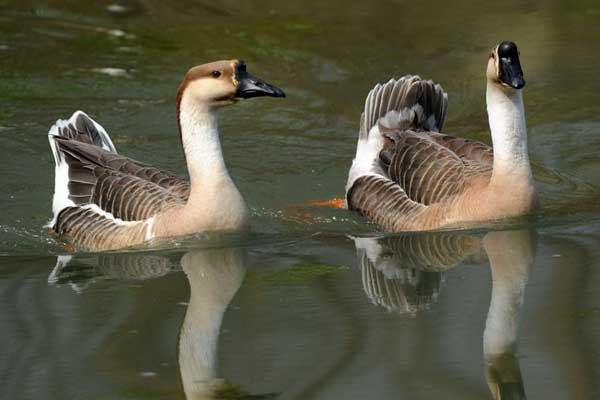
From the start of laying until culling, a female goose is called a laying goose. In terms of management, during the laying period the female goose moves slowly, so when grazing she should only be allowed to follow along and must not be rushed. Avoid slopes and uneven roads as much as possible to prevent internal and oviduct bleeding that can lead to peritonitis and other conditions; collect breeding eggs promptly. During grazing, if some geese show signs of laying, such as being unwilling to stay with the flock, calling loudly, seeking a nest, or acting restless, they should be driven back to the shed or carried back to the goose shelter promptly to let them lay, and especially the female geese in the early laying stage should be observed carefully to prevent laying eggs in the wild or in water. During the laying period, the light duration for geese should be no less than 13 hours per day, and during the peak laying period it should be maintained at 15-16 hours of light.
Do not graze too far away
Geese are herbivorous waterfowl, and even if free-range conditions are available, laying geese should not be taken too far away, because geese have the habit of returning to their nest to lay. If a female goose is seen not eating grass, stretching her head and neck, and calling, this is a sign of wanting to return to the nest, and she should be driven back to the shed to lay.
Provide sufficient feed
Starting four weeks before laying, feed a mixed feed consisting of 25%-30% grain and 70% green grass and vegetable leaves, with soybean cake added, so that the crude protein level is 15%-16%, feeding 250 g-300 g per goose per day, and fully supply enough high-quality roughage, such as blighted grain, dried grass powder, etc. If free-range conditions are available, grazing should be the main method, with a small amount of concentrate fed appropriately.
Add night feeding
Feeding at night is an important measure to increase the laying rate, especially in the early laying period and during the laying period, night feeding must be provided, 1-2 times per night, which can yield 40-80 eggs per year.
Keep good ganders
Generally a goose flock can be used for 3-4 years, and good ganders should be selected and retained. Because ganders are aggressive, grouping should preferably be done before laying (that is, in the breeding season), so as to avoid disturbance from grouping at short notice and affecting the fertilization rate of laying geese; the male-to-female ratio of geese is 1:6.
Artificial assisted mating
Geese like to mate on water, and the fertilization rate is high. An artificial assisted mating method can also be adopted: hold the female goose by both feet and wings with the hands, lure the gander to approach, and when the gander mounts the female goose's back, hold the female goose with one hand and lift the female goose's tail feathers with the other to facilitate mating. After training several times, the gander will actively approach and mate when it sees people holding the female goose. Each time the female goose lays an egg, artificial assisted mating should be performed once, so as to improve the fertilization rate of breeding geese.