Key measures for raising goslings well in winter and spring
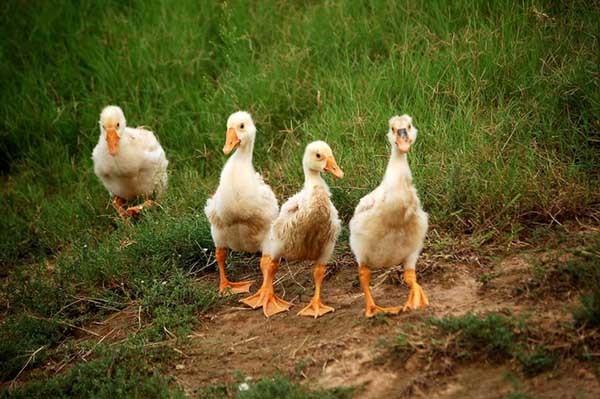
Select good goslings
Healthy goslings are lively in behavior, have big and bright eyes, respond quickly, have well-absorbed yolk, can stand firmly after their down dries, have strong calls, and when held up by the neck with the hand, quickly tuck in both feet. Weak goslings with large abdomens, crooked heads, and similar defects should be culled.
Suitable temperature
From 1 day to 5 days of age, 25°C to 28°C; from 6 days to 10 days of age, 23°C to 26°C; from 11 days to 20 days of age, 20°C to 24°C; after 21 days of age, 17°C to 20°C.
Careful feeding
Feed at fixed times and in fixed amounts, and it is best to use the method of feeding small amounts frequently and keeping them 80% full. After goslings hatch for 24 hours, give water first and then start feeding, feeding soaked broken rice and shredded green vegetables. In the first two days after starting feed, feed 4 to 5 times; from 4 days to 10 days of age, increase the number of feedings to 5 to 7 times, with concentrate making up 35% of the daily ration and green vegetables 65%. From 11 days to 20 days of age, green feed should be the main part. After 21 days of age, switch to grain-type feed and feed 4 to 5 times a day.
Separate brooding
Each batch of goslings has large, medium, and small ones or strong and weak ones, so they must be reasonably grouped to achieve uniform growth and neat development for the whole flock. Brooding should be done in small groups, with 50 to 80 goslings per group, and checks should be made group by group during both day and night, using the hand to move the goslings 4 to 5 times to prevent goslings from piling up and causing the ones on top to be cold, the ones in the middle to be hot, and the ones below to be crushed.
Timely grazing
After starting feed, they should stand up once every hour, which can help regulate temperature and release moisture. After 7 days of age, on clear and windless days, they can be released into clean shallow ponds for water, starting with short times and short distances.
Disease prevention and control
Goslings have weak disease resistance, so the pen should be cleaned often, the bedding straw should be changed and dried frequently, and the feed trough should be scrubbed once a week with alkaline water. During the brooding stage, the focus should be on preventing and controlling gosling influenza and gosling plague.