Detailed Explanation of Key Points on Feeding and Management Techniques for Laying Geese
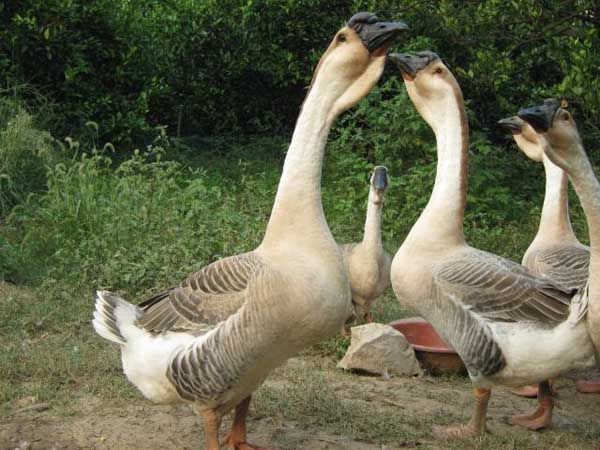
The purpose of raising laying geese is to obtain a large number of high-quality goose eggs, but geese have a long rearing period, a large feed intake, and a relatively low annual egg production. During the rearing process, how to improve egg production and the fertilization rate of eggs is the key to successfully raising laying geese. Because goose breeds differ, their maturity periods also vary: small breeds begin laying at 150-180 days, while large breeds begin at 210-240 days. The egg production of female geese changes with age; the peak of egg production occurs in the 2nd-3rd year, and egg production begins to decline in the 4th year, although a small number of geese can maintain their peak egg production for 4-5 years. Therefore, the laying goose flock should be composed in the ratio of 30% one-year-old geese, 25% two-year-old geese, 20% three-year-old geese, 15% four-year-old geese, and 10% five-year-old geese, so as to ensure a relatively high egg production for the flock and a relatively balanced egg production over the years.
In the process of raising laying geese, house feeding should be the main method, with grazing as a supplement. Use the method of feeding at fixed times but not in fixed amounts, with supply meeting demand. Feed should be diversified; the ratio of grain and cereal crops to coarse bran is 2:1. In the evening, more concentrated feed should be added. Large laying geese should be fed 0.20-0.25 kg of concentrated feed (grain and cereal crops) per bird per day, and small laying geese 0.15-0.20 kg. When feeding, the rule must be followed of feeding green feed first, then concentrated feed, and then letting the geese rest. The first feeding of mixed feed starts at 5-7 a.m., then concentrated feed is given; the second feeding is at 10-11 a.m., and the third at 5-6 p.m. At the peak of egg production, the geese must eat well and be fully fed, especially in the late laying period when even more careful feeding is required. A slight negligence can lead to cessation of laying and the start of molting. Therefore, they can be fed several more times, and night feed can be added or they can be allowed to eat freely.
Under house feeding, there should also be a certain amount of time for grazing and exercise, so that the geese can obtain sufficient foraging, light, bathing, and mating. Clean ponds should be chosen for geese to bathe, drink, and mate. To facilitate mating of breeding geese, the pond water depth should be about 1 m.
Under artificially controlled house-feeding conditions, laying goose flocks reach sexual maturity earlier and lay eggs more uniformly. Egg production is high and stable.
Female geese mostly lay eggs between 2 and 8 a.m. The duration of laying is not entirely consistent: some lay every other day, some lay on two consecutive days, and some lay 2 eggs in a row after an interval of 1-2 days. During the laying period, the temperature inside the house should be maintained above 4°C; the method is to hang straw curtains on doors and windows and set up windbreaks. Geese are sensitive to light, and supplemental lighting can increase egg production, especially in low-producing breeds, where egg production increases faster after supplemental lighting. Supplemental lighting plus natural light reaching 12-14 hours per day gives a better effect. The illumination level is 2-3 watts per sq m of goose house area. For example, if the house area is 20 sq m, one 40-60 watt electric light can be added.
During the laying period, geese can also be mainly grazed. Generally, they should be released to pasture after laying is basically finished in the morning, but supplementary feeding should be considered according to natural feed, the geese's feed intake, egg shape, and other conditions. Laying female geese move slowly, so relatively flat pasture nearby should be chosen for grazing. Grazing should be done by driving them slowly; driving them quickly can easily cause geese to fall and be injured or cause yolk to drop into the abdominal cavity and trigger peritonitis. If the weather is hot, the geese can be allowed to spend the night outdoors in the exercise area, and driven back into the house when it rains, and sufficient water should be prepared for them to drink freely. The goose house should be cleaned once a day to keep it clean, especially the bedding straw in the laying nests, which must be dry.
Before grazing every morning, the goose flock should be inspected. If individual geese are found to be restless and honking, with a full abdomen, tail feathers extended flat, cloaca swollen, and slow movement, and if they want to go to the nest, they should be caught and felt; if there is an egg, they should be kept in the pen and only go out to graze after laying. Female geese have the habit of returning to the nest to lay. If during grazing a female goose is seen not eating grass, stretching its head and neck, and honking, showing "nest attachment" behavior, the goose should be driven back into the pen to lay. In addition, some first-time laying female geese do not know how to return to the pen to lay. If they are found laying eggs in the grass, the female goose together with the eggs laid should be brought back to the laying nest in the pen. After 1-2 training sessions, the geese will become accustomed to returning to the pen to lay. During grazing, when the geese are 70-80% full, they should be driven to the pond edge to let them bathe, drink, and mate; this helps improve the fertilization rate of goose eggs.
In the late laying period, female geese lay fewer eggs and eggshell quality becomes poorer. At this time, more concentrated feed should be given, with concentrated feed accounting for 70-80% of the total daily ration, which can prevent a marked decline in egg production or cessation of laying.