Detailed explanation of design methods and key points for pigeon breeding greenhouses
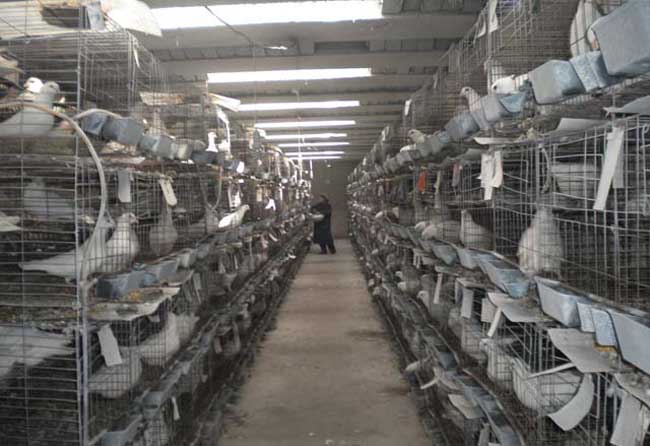
When designing a pigeon breeding greenhouse, it is not only necessary to consider fresh air, ample sunlight, dry ground, warmth in winter and coolness in summer, cleanliness, and quietness in the pigeon house, but also to orient the pigeon house favorably with a north-south facing direction, use a brick-and-tile structure, with the door facing east, so that it is convenient to operate and manage and can also prevent harm from animals. Pigeon breeding greenhouses come in many forms, mainly including group-rearing and cage-rearing pigeon houses.
Group-rearing pigeon house
Group-rearing pigeon houses are mainly suitable for young pigeons. Generally, single-row bungalows are most common, and old houses can be used for conversion. Because grass materials easily absorb moisture and become moldy, making pigeons susceptible to mold invasion and disease, straw must never be used to build pigeon houses. Newly built pigeon houses are best made of brick-and-wood structure or earth-and-wood structure.
Single-row bungalow, each building 5—5.2 m wide and 12—18 m long. The eave height is 2.5 m. The interior is divided by netting or bamboo and wood into 4—6 small compartments, and each compartment can raise 50 pairs of squabs. Front and rear windows should be opened on the front and rear walls of each pigeon compartment. The front window can be lower from the ground, with a window area of 1.2—1.4 sq m, and the front window 1—1.2 m above the ground, to facilitate the entry of seasonal winds into the house in summer; the rear window is generally 1.6—1.8 m above the ground, to avoid the invasion of north winds in winter. At the same time, about 20 cm above the ground on the lower part of the rear wall, several floor windows that open and close from side to side should also be installed (size 40 cm×60 cm or 40 cm×40 cm), so as to provide ventilation in summer and humid weather. The floor inside the house is best made of large red bricks or sandy-lime soil, and the floor should be smooth and clean, and should not seep water in humid weather. The floor should be 30—40 cm higher than the ground of the exercise yard, so that the roosting environment can remain dry. In addition, on the sunny side of each pigeon compartment, an exercise yard must also be set up, with length and width similar to the pigeon house, a surrounding height of 2.5—2.8 m, and it can be enclosed with steel, round logs, or cement posts and galvanized wire netting, with the top covered by nylon netting. To facilitate operation and management, the position of the exercise yard door should be consistent with the door of the pigeon house.
Cage-rearing pigeon house
So-called cage rearing means keeping already paired production breeding pigeons separately, one pair to one cage, allowing them to live separately, eat separately, and drink separately. Its advantages are that the pigeon house structure is simple, the cost is low, management is convenient, the pigeon flock is stable, and the utilization rate of the pigeon house is relatively high. This type of pigeon house has the following two forms.
1. Double-row pigeon house
The roof truss often adopts a gable style, with the north eave 2.5 m high and the south eave about 2.8 m high; if fiberglass tiles or asbestos tiles are used for a flat-roof style, attention should be paid to reinforcing and sealing leaks to prevent attacks from tornadoes, typhoons, and storms. The depth of the pigeon house is 2.2 m, and there must be a 0.8—0.9 m wide operation aisle in the very center, with drainage ditches around it. The pigeon cages stand facing each other, and there can be 3 tiers or 4 tiers of cages; outside the cages, it is best to use tarpaulin hanging from top to ground, which can be lowered in winter for warmth and rolled up in other seasons for ventilation and light transmission.
The outer perimeter and upper layer of the cage are wire netting, and the side near the operation aisle is provided with a wooden door or bamboo and wood. Feed troughs and health sand cups are hung on the cage doors, making feeding and observation convenient. To facilitate water supply and washing, a full-length water trough should be installed on the outer side of the cage. The cage is 60 cm wide, 60 cm deep, and 55 cm high. There is no partition between the upper, middle, and lower 3 tiers of cages, and the bottom of the lowest tier is about 20—50 cm above the ground. If each row of cages is a 3-tier cage house, the length is generally 18—21 m.
2. Single-row pigeon house
The structure of the single-row and double-row pigeon houses is basically similar. A single-row pigeon house has pigeon cages installed only on the sunny side, while the shady side is built with a brick wall with several windows opened in the wall; this is where it differs from the double-row type. The advantages of the single-row pigeon house are that it faces south, so sunlight is abundant, ventilation is good, and it is warm in winter. However, its shortcoming is that the rearing quantity per unit area is half less than that of the double-row type and it occupies more land.
Greenhouse breeding management of pigeons
1. Feed formulation: Pigeons have the habit of being picky eaters. For a daily ration made by mixing multiple feeds together, the order in which they eat the feed is: mung beans→peas→wheat→corn→soybeans→rice→sorghum, etc. Therefore, it is best to formulate pelleted feed to avoid insufficient intake of certain nutrients caused by picky eating. At the same time, certain components of the feed ingredients should be increased or decreased according to seasonal and production cycle changes. In hot summer, add mung beans to clear heat and reduce internal fire. In cold winter, add hemp seeds to increase the energy value of the feed. During the molting period, add rapeseed to shorten the molting time. When formulating feed, attention should be paid to the balance of animal protein, especially essential amino acids. Animal protein is very important to the egg production, fertilization rate, and hatchability of pigeons, as well as the weight of 28-day-old squabs.
2. Feeding method: Feed 3 times a day, at fixed times and in fixed amounts. For feeding times, it is mostly adopted at 7:30 in the morning, 2:00 at noon, and 6:00 in the evening. The feeding amount is: about 40 g per pair of pigeons during the non-nursing period. During the nursing period, it is best not to interrupt feed. If pelleted feed is not being fed, before feeding, first soak the feed in warm water (about 40°C) for 30 minutes, then dry it slightly before feeding, which is beneficial to the digestion of squabs.
3. Formulation and provision of health sand: The quality and intake of health sand directly affect the growth, development, and reproduction of pigeons. During the breeding period, the formula of health sand (%): river sand 35, yellow mud 20, shell powder 15, salt 5, lime 2, poultry multivitamin 2, gentian 0.5, gypsum powder 2, eggshell powder 2, bone meal 2, charcoal powder 6, fish meal 5, licorice 1, auxin 1.5, oxytetracycline calcium salt 0.6, yeast tablets 0.4. Pigeons like to eat fresh, dry health sand, so health sand is best provided once a day.
Daily management and disease prevention and control of pigeons
1. Daily management should achieve four observations: observe mental state; healthy pigeons are lively, excited, and sensitive. Observe eating and drinking; healthy pigeons eat relatively quickly and generally drink water after eating. Observe the color and shape of droppings; normal pigeon droppings are gray, yellowish-brown, or grayish-black, in strip or spiral shape, with white urate material attached at the end. Observe the care of squabs, observing whether the squabs are stepped on, crushed, lost, harmed by rats, etc., to ensure the squabs grow safely and healthily.
2. Management during the incubation period
When breeding pigeons are incubating, some male and female pigeons often fight over incubation, thereby breaking the eggs, while some breeding pigeons linger outside after coming out to eat, thereby affecting embryonic development and even causing embryo death. For the former situation, they should be re-paired, and the eggs in that clutch should be incubated by foster pigeons. For the latter situation, the pigeons should be promptly driven back into the nest to incubate, and the light should be shaded dark; after 3-5 days, this phenomenon can be avoided. During incubation, breeding eggs are easily soiled by droppings. Therefore, they should be checked frequently, and if polluted by droppings, the droppings should be gently wiped off with a towel soaked in warm water. This can significantly increase the hatchability. Never wash them with water, otherwise it is unfavorable to embryonic development and may even cause embryo death.
The incubation period of King pigeons is 18 days. During the entire incubation period, eggs should be candled 2 times. The 1st time is on the 5th day of incubation, mainly to remove infertile eggs. The inspection method is simple and effective: hold the egg against light for candling; if the inside of the egg is yellowish and translucent, the same as an unincubated egg, then it is an infertile egg. The 2nd candling is on the 12th day of incubation, to check embryonic development and pick out dead embryos. Some embryos are not strong enough in development; when hatching, although they have broken the shell, they are unable to come out on their own. At this time, manual assistance is needed, that is, use a needle along the pecking hole and parallel to the egg's transverse diameter to enlarge it, then wait for it to mature and shell out on its own. If the blood vessels have not fully contracted, then the blood vessels must not be forcibly broken, otherwise excessive bleeding will cause death. Through manual assistance, squabs can generally hatch safely, which is an effective measure to increase the hatching rate.
3. Management during the nursing period
For the few first-time breeding pigeons that do not know how to nurse squabs, they must be trained, that is, carefully insert the squab's beak into the parent pigeon's mouth. After repeated attempts, the parent pigeon will generally nurse, or foster pigeons can be used for nursing, to ensure the survival of the squabs. Change the position of the squabs: some parent pigeons, when nursing, always first feed the 1 outside the nest, causing the two squabs to develop unevenly and also causing the overfed 1 to develop crop impaction and indigestion. Therefore, the positions of the two squabs should be frequently swapped so that they grow evenly and the quality of the squabs is improved. For nests with only 1 egg or 1 squab, two single nests or three nests should be merged according to similar age in days. This reduces the burden on breeding pigeons, allows them to lay eggs earlier, and improves the production efficiency of breeding pigeons.