Detailed Explanation of High-Yield Breeding Technology for White King Pigeons
Breed Preservation and Purification and Rejuvenation Techniques
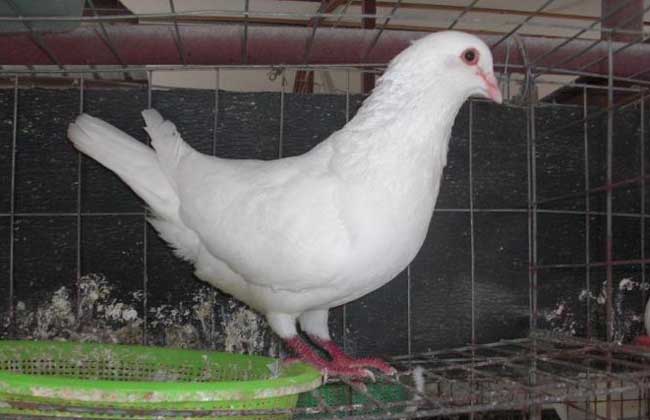
The American White King pigeon has advantages such as strong reproductive capacity, fast growth rate, large body size, high feed conversion rate, strong disease resistance, and good genetic performance. However, if breed preservation work is not done properly and strict purification and rejuvenation measures are not implemented, after several years of breeding, the core group of the breed will quickly show signs of degeneration due to inbreeding. Therefore, breed preservation and purification and rejuvenation work must be undertaken, with the following measures:
1. Appearance selection requirements: Select young pigeons with a healthy body and gentle temperament, well-proportioned structure, strong feeding ability, a broad and deep chest that protrudes forward, a flat, broad and long back, a straight and unbent keel, and pure white, glossy, smooth feathers that cling tightly to the body as reserve breeding pigeons.
2. Body type selection: Select reserve breeding pigeons with a relatively long body type, but with the tail not touching the ground, a broad and deep chest, and a moderate body size for breeding purposes.
3. Production performance requirements: Parent pigeons should have a high egg production rate, high fertilization rate, low dead embryo rate, good incubation behavior, and strong chick-rearing ability. The offspring of high-yield parent pigeons that lay up to 3 pairs of eggs per month and have a breeding cycle of less than 35 days per clutch should be retained for breeding purposes.
4. Growth speed requirements: The 30-day-old body weight of selected reserve breeding pigeons: male pigeons over 550 grams, female pigeons over 600 grams, retained for breeding purposes.
5. Grouping and mating: The core group of the entire farm is divided into groups A and B. Female pigeons from group A offspring are mated with male pigeons from group B offspring, and female pigeons from group B offspring are mated with male pigeons from group A offspring, to prevent inbreeding.
6. Management requirements: Records must be kept for all the above activities, cage numbers established, files and pedigrees formed, and regular inspections conducted. Where conditions permit, pedigree identification and pedigree analysis should be carried out to understand the quality of offspring, and problems should be dealt with promptly. Cage numbers with poor records should be eliminated.
"Combining Three Eggs for Incubation" Technique
In small and medium-sized farms (households) that have not yet mastered artificial incubation and artificial rearing techniques, the "combining three eggs for incubation" technique should first be applied to explore production experience, increase squab output, and boost profits, with quick results. The specific method:
1. Grouping of breeding pigeons: Select 30% of young breeding pigeons with good egg production performance and high fertilization rate but poor incubation behavior and poor chick-feeding ability to form the egg-laying group, as a dedicated egg-producing pigeon flock. Select 70% of mature and older breeding pigeons with good incubation and excellent chick-feeding ability as the incubation and feeding group, responsible for incubation and chick-feeding tasks. The two groups of breeding pigeons do not need to be moved to different cages; it is sufficient to mark them in their original positions for identification.
2. Combined egg incubation: The pigeon eggs laid daily by the egg-laying group are collected starting at 8 PM each evening and given to the incubation and feeding group, with three eggs per clutch incubated, hence called "combining three eggs for incubation." The one-third of egg-laying group breeding pigeons that have their eggs taken are freed from incubation tasks and dedicated to egg production, laying a clutch of eggs (two eggs) approximately every 7-13 days, greatly increasing the egg production rate of the entire farm's breeding pigeons.
3. Making incubation nests: Place a layer of linen cloth at the bottom of the incubation nest, spread straw (cut into 3 cm-4 cm lengths), rice husks, and other bedding materials on top to form a pot-bottom shape, then place another layer of linen cloth on top. The purpose of making the nest is to allow the three eggs to be kept warm together, preventing them from rolling away and getting cold, reducing egg breakage, and increasing the hatching rate.
4. Egg candling adjustment: Candle eggs once every 4-5 days. Each time infertile eggs and dead embryo eggs are identified, remove them immediately and adjust and merge at three eggs per clutch, allowing the breeding pigeons whose eggs were taken to lay the next clutch earlier. This practice has a significant effect on increasing production.
5. Hatchling adjustment: At 17-18 days of incubation, the squabs hatch. Adjust flexibly according to the daily number of hatchlings, letting those with strong feeding ability feed three and those with poor feeding ability feed two. Breeding pigeons feeding three should be given supplemental feed and water. To reduce the burden on feeding pigeons and shorten the egg-laying cycle, at 7-8 days of age, the squabs can be transferred to artificial feeding until market.
6. Handling of brooding behavior: It is the natural instinct of pigeons to incubate after laying two eggs. When pigeon eggs are taken away by humans for a long time, a few breeding pigeons will cling to the nest and brood, delaying the next round of egg laying. A simple method is: when taking the eggs, remove the entire nest at the same time (it should be a movable egg nest), forcing the incubating pigeon to have no nest and immediately break the brooding behavior. After 6 days, put the egg nest back for the second round of egg laying. This solves the problem of lazy brooding, advances egg laying, and also facilitates cleaning and disinfecting the egg nest.
Artificial Pigeon Egg Incubation Technique
Using artificial incubation instead of natural incubation: first, it frees breeding pigeons from incubation tasks, shortens the egg-laying cycle, and increases egg production; second, it avoids unfavorable factors such as broken eggs and cold-killed eggs caused by various reasons during natural incubation by parent pigeons, thereby improving the hatching rate and hatchling rate. Correctly mastering artificial pigeon egg incubation techniques can increase the hatching rate from 68% to 88%. Artificial pigeon egg incubation differs slightly from artificial chicken egg incubation in specific operations.
1. Egg collection: Collect all pigeon eggs after 8 PM each evening. It should not be too early or too late. If too early, some breeding pigeons have not yet laid eggs; if too late, some breeding pigeons have the habit of immediately starting incubation after laying, causing the egg temperature to rise and adversely affecting artificial incubation. When collecting eggs, the egg nest must be removed together to prevent breeding pigeons from clinging to the nest and brooding, which would affect the next round of egg laying. When collecting eggs, record the egg-laying time of breeding pigeons and mark the eggs, and establish files. After collection, pigeon eggs can be directly placed in the incubator for incubation or temporarily stored. The storage temperature should not be higher than 20°C nor lower than 5°C, and the air should be fresh and circulating. If conditions permit, breeding eggs can be stored in an insulated box or egg storage room at a constant temperature of 18°C.
2. Incubation: Use a small incubator, replacing the egg rack for chicken eggs with an egg rack for pigeon eggs. For ease of management, after 4 consecutive days of egg collection, all breeding eggs can be placed in the incubator at one time for incubation, and thereafter every four days is an incubation egg-entry cycle. The incubation temperature is controlled at 38.3°C-38.8°C throughout, about 0.5°C-1.0°C higher than chicken egg incubation, with a relative humidity of 50%-55%. Turn eggs 4-6 times per day. When pigeon eggs reach the 12th day of incubation, the egg tray should be pulled out once daily to cool the eggs outside the incubator, and when the temperature drops to 30°C, return them to the incubator. Newly added pigeon eggs in the original machine continue to be incubated as normal.
3. Egg candling: After each batch of pigeon eggs has been incubated for 5 days, conduct the first candling, promptly removing infertile eggs and early dead embryo eggs. Conduct the second candling at the 10th day of incubation, and the third candling at the 16th day of incubation, promptly identifying and removing dead embryo eggs to prevent rotting from affecting incubation results. At 17-18 days of incubation, squabs begin to hatch. Long-term production practice has proven that this method is reliable, with a high hatchling rate, beautiful appearance of squabs, high healthy chick rate, no large belly or navel protrusion, and clean eggshells after hatching, achieving satisfactory results.
Feed Formulation Technique
In order to ensure the different nutritional requirements of meat pigeons at various growth, development, and reproduction stages, according to the types, quantities, and quality of nutrients in feed ingredients, calculate and blend daily rations proportionally, and process or pelletize them to meet the nutritional needs of pigeons, achieving the goal of high efficiency and low cost. Some feed formulas are introduced below for reference.
Feed formulas for pigeon breeding stages (reference) 1-4 days of age: milk powder 50%, egg white 35%, vegetable oil 5%, Supai 14 5%, bone meal 2%, yeast powder 1%, protein digestive enzyme 1%, cod liver oil 1%, salt 0.1% 5-7 days of age: milk powder 40%, chick feed 25%, egg white 20%, vegetable oil 5%, Supai 14 5%, bone meal 2%, yeast powder 1%, protein digestive enzyme 1%, cod liver oil 1%, salt 0.1% 8-10 days of age: milk powder 15%, chick feed 50%, egg yolk 20%, vegetable oil 5%, Supai 14 4%, bone meal 3%, yeast powder 1%, protein digestive enzyme 1%, cod liver oil 1%, salt 0.1% 11-15 days of age: milk powder 10%, chick feed 65%, egg yolk 10%, vegetable oil 5%, Supai 14 3%, bone meal 4%, yeast powder 1%, protein digestive enzyme 1%, cod liver oil 1%, salt 0.2% 16-24 days of age: milk powder 5%, chick feed 80%, vegetable oil 5%, Supai 14 3%, bone meal 4%, yeast powder 1%, protein digestive enzyme 1%, cod liver oil 1%, salt 0.2% 25-30 days of age: milk powder 5%, chick feed 85%, Supai 14 3%, bone meal 4%, yeast powder 1%, protein digestive enzyme 1%, cod liver oil 1%, salt 0.2% Young pigeon feed formula: corn 55%, peas 20%, mung beans 5%, wheat 15%, hemp seed 5% General formula for producing pigeons: corn 45%, peas 27%, mung beans 5%, wheat 15%, hemp seed 8% General feed formula for non-producing pigeons: corn 30%-70%, sorghum 10%-15%, paddy rice or brown rice 10%-30%, wheat 10%-20%, hemp seed 3%-5%To maintain relative stability in egg laying, incubation, and rearing of producing pigeons, minimize arbitrary changes in feed, including fixed formula ratios, fixed timing, and fixed quantities. Feeders must weigh feed ingredients accurately, mix them thoroughly, and feed in solid amounts. If feed ingredients are insufficient, changes should be made gradually.
Artificial Rearing Technique for Squabs
Artificial rearing of squabs is a technique requiring strong scientific basis, high hygiene standards, and meticulous operation. The following aspects should be carried out well:
1. Tools
① Pigeon feeders: Use medical equipment such as suction bulbs or syringes (with needles removed) modified into small-capacity pigeon feeders; design larger-capacity bucket-type pigeon feeders, including hanging bucket-type pigeon feeders, pedal-type pigeon feeding machines, and pistol-type electric pneumatic pigeon feeding machines, etc.
② Brooding incubator: For brooding and keeping warm of 1-7 day old squabs.
③ Brooding pigeon cages: Generally can be made into rectangular galvanized wire mesh flat pigeon cages of 200 cm long, 100 cm wide, 50 cm high, with mesh openings of 1 cm x 1 cm, for artificial brooding of 8-16 day old squabs. For 17-26 day old squabs, design cage-type pigeon cages, with 4-6 squabs per cage.
The capacity and number of pigeon feeders, incubators, and squab cages are determined according to the scale of production.
2. Brooding: After 17-18 days of incubation, squabs hatch and immediately enter the brooding room, placed in incubators or heated rooms. Temperature for 1-4 days of age is 37°C-38°C, for 5-7 days of age is 34°C-36°C. Use suction bulb feeders or syringe-type feeders for small-scale trials to gain experience before full-scale artificial feeding. At 8-15 days of age, transfer to flat brooding cages, with a temperature requirement of 30°C-33°C, then gradually reduce to room temperature. At this point, begin using larger-capacity bucket-type pigeon feeders for feeding. At 16-26 days of age, transfer to cage-type pigeon cages for fattening and market. Throughout the brooding process, attention should be paid to keeping warm and ventilated.
3. Preparation of squab feed: Whether artificial rearing of squabs succeeds depends most critically on the preparation of squab feed. Mix the feed according to the above formulas, stir evenly, add an appropriate amount of warm boiled water, and cool to 40°C. For 1-4 days and 5-7 days of age, squab feed is in liquid form; for 8-10 days and 11-15 days of age, squab feed is in paste form; for 16-24 days of age, squab feed is in semi-moist paste form; for 25-30 days of age, squab feed is in dry-moist form for self-feeding.
4. Gradual progression: When applying artificial rearing techniques, full-scale implementation should only begin after gaining experience from small-scale trials. Parent pigeons can first rear the squabs for one week before artificial rearing begins, and after basic mastery, gradually achieve full-process artificial rearing.
5. Ensure the "five passes": Artificial rearing of squabs must ensure the healthy chick pass, temperature pass, squab feed preparation pass, feeding technique pass, and "disease entering through the mouth" pass. Among these, squab feed preparation is the key to success. Hygiene and disinfection to prevent "disease entering through the mouth" is an important part of success. Only when all five aspects are well controlled can the healthy and normal growth and development of squabs be effectively ensured.
The technique of combining artificial incubation of pigeon eggs with artificial rearing of squabs eliminates the two major tasks of incubation and feeding for breeding pigeons, shortens the egg-laying cycle of breeding pigeons, and increases egg production and squab output. According to practice, the egg-laying cycle of breeding pigeons has been shortened from the original 35-40 days to 10-15 days, the annual egg production per pair of breeding pigeons has increased from 16-18 eggs to over 48 eggs, and the annual squab output has increased from 12 birds to over 38 birds, greatly increasing the economic benefits of pigeon farms.