How to increase the low reproduction rate of meat pigeons? Practical methods shared
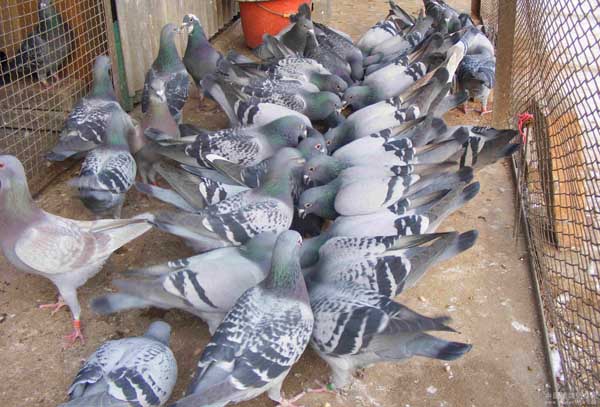
Meat pigeons have the advantages of early maturity, a long service life, strong disease resistance, fast growth (body weight can reach more than 500 grams 23 to 28 days after hatching), and high feed conversion efficiency. Raising meat pigeons has low cost and high benefits; pigeon meat is nutritious and has good health-care and medicinal value. Therefore, meat pigeon farming has broad prospects.
Raising squabs
Young pigeons kept for breeding, from leaving the nest and being raised in groups until sexual maturity and pairing, are called young pigeons. When raising young pigeons, first pay attention to keeping them warm and preventing them from getting chilled. Young pigeons begin molting at about 2 months of age, and energy feed can be appropriately increased to promote feather growth. Chinese herbal medicines such as gentian can be added to the health grit, and antibiotics can be appropriately added to the drinking water to prevent respiratory and paratyphoid diseases. For 3-month-old young pigeons, a selection process can be carried out once to keep the superior and remove the inferior; to prevent early mating, males and females should be raised separately, dewormed regularly, and supplied with sufficient health grit, with 3 to 4 grams per bird per day. Most 6-month-old young pigeons begin sexual maturity, and preparations before pairing should be made well.
Pairing, reproduction and precautions
1. Preparation for pairing: First, to enhance the disease resistance of pigeons, Newcastle vaccine immunization and elimination of internal and external parasites should be carried out about 15 days before pairing. Second, prepare the pigeon house, pigeon cages and tools; 3-layer or 4-layer pigeon cages can be used, generally rectangular, and water troughs, feed troughs, health grit cups and laying nests should be fully equipped. Third, about 1 week before introducing the pigeons, carry out a comprehensive disinfection of the environment inside and outside the house.
2. Pairing methods: One is free pairing. After young pigeons are raised to about 6 months of age and reach sexual maturity, they are allowed to pair freely. The advantage is that it is convenient and saves labor; the disadvantage is that it easily causes inbreeding and early mating, which is not conducive to obtaining excellent offspring.
The other is artificial pairing. Select excellent male and female pigeons and put them in the same cage to pair and reproduce. This method can overcome the disadvantages of free pairing and is especially suitable for cage-raised meat pigeons.
3. Precautions “First, prevent breeding pigeons from being too fat or too thin. Scientifically formulate the daily ration and master the appropriate feeding frequency and amount. Second, identify male and female to prevent mismatching. If no eggs are laid after half a month, or if two eggs are found in the nest on the same day, the male and female should be re-identified. Third, during the first 3 days of forced pairing, observe more; if fighting is found, separate them and pair again.
Incubation and egg candling
The incubation period of pigeon eggs is 17 to 19 days, with an average of 18 days. Generally, after the female pigeon lays 2 eggs, incubation begins, and both male and female participate together, taking turns sitting on the nest. During incubation, egg candling is generally carried out 2 times. The 1st time is carried out 4 to 5 days after incubation; if red-brown blood vessels distributed in a spider-web pattern are found inside the egg, and the shape is stable, it is a fertilized egg; if no blood vessels can be seen inside the egg, it is an infertile egg and should be picked out in time. The 2nd time is carried out 9 to 10 days after incubation; if most of the area inside the egg appears dark black, and one end forms a transparent blank area due to the enlarged air cell, it indicates that the embryo is developing healthily; if black and white inside the egg are not distinct, there is a feeling of fluctuation when turning the egg, and the eggshell appears gray, it is a dead embryo egg and should be removed in time.
1. Causes of infertile eggs: First, the daily ration is not nutritionally complete. The feed lacks methionine, lysine, vitamin E, B2, B12 and minerals, etc. Second, inbreeding can reduce the egg production rate of offspring and increase infertile eggs and dead embryo eggs. Third, mating is abnormal. The feathers around the cloaca of breeding pigeons are too thick, so the cloaca cannot be exposed and normal mating cannot occur. Fourth, breeding pigeons are old or too young.
2. Causes of dead embryos: First, the daily ration lacks essential vitamins and mineral elements. Second, the nest bowl is nonstandard; the nest bottom is too flat, too large, or too hard. Third, management is poor, and feces stick to pigeon eggs; if breeding pigeons that are incubating are disturbed and frightened by sudden noises and invasions by cats, rats, etc., incubation is often stopped, resulting in dead embryos. Fourth, the nesting performance of parent pigeons is poor. Fifth, humidity is too low in the late incubation period, and water evaporates too quickly.
Feeding and management of parent pigeons
1. Careful management to reduce broken eggs: There are many causes of broken eggs. First, the egg nest structure is poor, with no bedding or a bottom that is too flat, so the two eggs are not concentrated and are easily trampled and broken by parent pigeons. Second, male and female pigeons are incompatible, especially newly paired pigeons, which often peck each other and trample the pigeon eggs. Third, strangers interfere or the keeper moves roughly, and the pigeons are startled and trample the pigeon eggs. Fourth, the daily ration of breeding pigeons is not nutritionally complete, and the keeper should adjust it in time according to the specific situation.
2. Strengthen feeding and pay attention to keeping warm: The feed intake of breeding pigeons raising squabs gradually increases with the age of the squabs, and they should be fed 2 to 3 times a day. After squabs are 10 days old, their growth speed accelerates, and the nest bowl should be adjusted in time to keep the nest box warm and clean. Parent pigeons begin molting from late summer to early autumn each year, lasting 1 to 2 months; the protein content in the feed can be appropriately reduced and the feeding amount decreased, and in the late molting period the daily ration formula should be adjusted in time and the feeding amount increased to promote breeding pigeons to lay eggs as soon as possible.
3. Adjust the pigeon flock and keep good records: Young pigeons kept for breeding should be taken away from parent pigeons at about 1 month of age, and squabs not kept for breeding can be sold on the market at 20 to 25 days of age. The keeper should conscientiously keep file records of the production situation of parent pigeons. Adjust the pigeon flock 1 to 2 times each year, cull breeding pigeons with poor production performance and old breeding pigeons, and supplement excellent breeding pigeons.