What are the characteristics of the living habits of hares
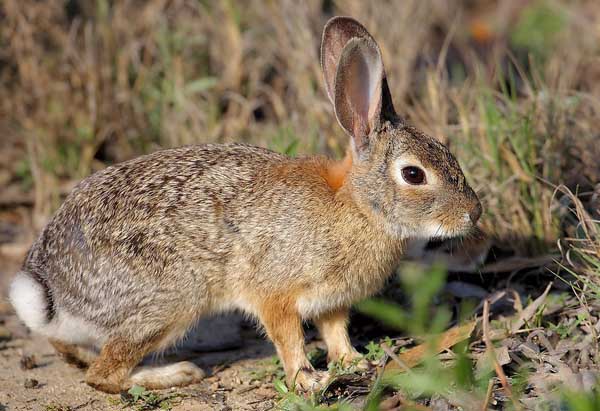
The hare has a small head and a pair of ears much smaller than those of the domestic rabbit; compared with the European rabbit, the ears are slightly longer, with black tips. An adult hare usually has ears about 13 cm long, which is 1/5 of its body length. Its limbs are slender and sturdy, and the hind limbs are very strong and powerful, also longer than those of an ordinary domestic rabbit. It is agile, timid, and good at running. Its body size is much smaller than that of the domestic rabbit, generally 35-43 cm in body length and 7-9 cm in tail length. An adult hare is generally about 2.5-3 kg.
Habitat habits
Wild hares generally feed once every two days and prefer dry conditions. They like to live in low, dry shrub thickets. Late at night or in the early morning, they come down from their habitat along small mountain paths to the sparse shrubs at the foot of the mountain, orchards, and roadsides to feed. Hares have almost no fat on their bodies.
Hares are highly camouflaged. When they stay still, their fur color blends with the surrounding weeds, and even if a person approaches within one meter, it is not easy to notice them. Moreover, hares seem to know this, suddenly darting out from under people's feet when they are not paying attention, which instead gives them a fright. Whether wild hares or domestic rabbits, their calls are usually not heard, and we may even think rabbits do not call, but this is not actually the case. When frightened or captured, they emit screaming sounds, especially when captured, when they make sounds similar to a baby's crying, which can frighten timid people.
Hares generally live alone and do not have burrows. They rely on fast running to escape danger, and their running speed can reach 50 km per hour.
Feeding habits
Hares feed on plants such as wild grasses and leaves. In artificial breeding, feed sources are extensive; various pasture grasses, green vegetables, straw, and so on can all be used for feeding. Generally, green feed and succulent feed are given in the morning and at midday, and green feed and a small amount of pelleted feed are given in the evening.
Reproductive habits
Hares live alone or in pairs. They are generally shy animals and will change their behavioral patterns in spring. Male rabbits will chase each other during the day to show their superiority. Female rabbits will “box” male rabbits, apparently to indicate that they are not ready to mate, or to test the male rabbit's determination.
Hares are alert by nature, with keen hearing and vision, rapid escape, tight concealment, and strong reproductive capacity. Although there are many enemies, few animals can catch them. They hide by day and come out at night, and especially like to follow fixed old paths they have traveled repeatedly. They begin activity at dusk and remain active throughout the night, sometimes not returning home until dawn. On dark days or when there is a fine drizzle and few people are on the roads, they also come out during the day. Their diet is complex and depends on the habitat environment. They generally like to eat tender grass, wild vegetables, and the leaves of certain shrubs. In winter they eat grass roots. Hares active near farmland steal sweet potatoes, vegetables, and newly emerged bean seedlings, with soybean seedlings, broad bean seedlings, and soybean seedlings suffering especially severe damage. Each year they give birth to three or four litters in shallow, concealed hare nests, with 5—6 young per litter. Young hares can run within a few hours after birth.
Growing environment
Hares like to live in mixed forests with water sources and trees, grassland areas, and sandy desert areas. They especially like to inhabit young spinous Chinese scholar tree groves. In areas that meet the following three conditions, hares are numerous; otherwise, they are few.
Young spinous Chinese scholar tree groves that provide hiding places, barren beaches with small trees, and so on.
Areas that allow observation of enemy burrows without greatly affecting escape. Dense tall forest belts and tall grass hinder their observation and escape, and steep slopes are unfavorable for their movement.
There is a water source near food. On barren slopes near bean fields and radish and cabbage plots, hares are often numerous. Water has a very important effect on hares, so there are few hares in water-scarce areas. Hares do not have a fixed habitat, except during the rearing period. At ordinary times they live a wandering life. In spring and summer they live in dense young forests and shrub thickets. In autumn and winter, when the grasses wither, hares like to hide in clods of earth or other places they consider suitable. They use their front paws to dig shallow little burrows to hide in. These little burrows are about 30 cm long and less than 10 cm deep, just enough to place the front and hind limbs inside while the body is left outside. They are shallow at the front and deep at the back, in the shape of a winnowing basket. The back is slightly higher than the ground level, and they become invisible by means of protective coloration. If startled and fleeing, or leaving to forage, this makes it convenient and quick.