What are the breeding behaviors of the Chinese giant salamander? A comprehensive analysis of Chinese giant salamander breeding habits
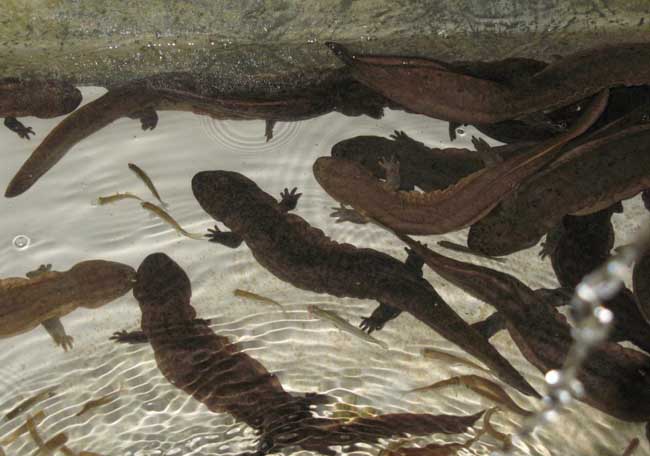
The female salamander lays eggs between July and August each year, depositing them inside rock cavities, with each female laying more than 300 eggs; the remaining task of rearing is left to the male salamander. The male curls his body into a semicircle to surround the eggs, preventing them from being washed away by water or harmed by predators, until the young salamanders hatch 2 to 3 weeks later. After 15 to 40 days, the small "baby fish" disperse to live on their own, and only then does the male leave. The Chinese giant salamander also has the longest lifespan among amphibians; under artificial rearing conditions, it can live as long as 130 years.
Male and female identification of the Chinese giant salamander
Distinguishing male from female Chinese giant salamanders is mainly done by the characteristics of the cloacal opening, and this is especially obvious during the breeding season. During the breeding season, the cloacal glands of the male form a plump, large broad-bean shape, creating a raised longitudinal elliptical ring that is very distinct, wrapping the cloacal opening within it, and the outer edge of the cloacal opening has a ring of irregular fleshy small protrusions. The genital opening of the female is mostly round, with a relatively smaller aperture; there are no white protrusions on either side of the genital opening, the outer edge of the opening is smooth, and on the inner edge the skin layers on both sides can be seen forming folds that protrude toward the cavity surface. Outside the breeding season, the cloacal openings of male and female Chinese giant salamanders differ little and are not easy to distinguish. Dissection around the cloacal opening reveals that beneath the raised area in males there is a pair of valve-like glands -- the cloacal glands -- whereas in females there is only a small amount of connective tissue beneath the skin around the cloacal opening. In Chinese giant salamanders that are outside the breeding season or not yet sexually mature, males have no obvious swelling around the cloacal opening, and the cloacal glands are smaller, appearing as flat strips that do not form a ring. In addition, in terms of behavior, females are more aggressive and males more docile during the breeding season.
Male-to-female sex ratio of the Chinese giant salamander
Statistically analyzing the sex ratio during the breeding period can, in a sense, predict the reproductive capacity of the Chinese giant salamander. According to statistics from Bian Wei and others, under natural conditions the sex ratio of the Chinese giant salamander is close to equal, which is favorable for the proliferation of natural resources. According to another study by the Chenggu County Chinese Giant Salamander Research Institute in Shaanxi, which captured and dissected specimens without selection, males are slightly more numerous than females during the breeding period.
Gonadal development and annual cycle of the Chinese giant salamander
Sexual maturity indicators of the Chinese giant salamander. After hatching, the Chinese giant salamander grows in the natural environment for five years, reaching a body length of about 400mm and a body weight of more than 360g, at which point the gonads are basically mature.
Relationship between egg-carrying capacity and body weight of the Chinese giant salamander
The Chinese giant salamander lays eggs once a year. The number of eggs carried directly determines the reproductive capacity of the Chinese giant salamander; the number of eggs carried is generally not large, is closely related to age and nutritional conditions, and varies greatly. Results from the Chenggu County Chinese Giant Salamander Research Institute show that Chinese giant salamanders of 1.5 to 2.5kg carry 400 to 600 eggs. Observation results show that the absolute number of eggs carried by the Chinese giant salamander increases with body weight, while the relative number of eggs carried decreases with increasing body weight; Chinese giant salamanders weighing 615 to 1000g have the highest relative egg-carrying capacity.
Breeding behavior of the Chinese giant salamander
According to field observations, before the Chinese giant salamander lays eggs, the two parent salamanders bite mouth to mouth, with the male actively biting the female's upper lip and the female biting the male's lower lip; the two salamanders' bodies are roughly in a straight line, swaying left and right continuously at a frequency of about 35 to 40 times/min, and they do not separate even when illuminated with a flashlight. If a sound or vibration causes them to separate, they immediately bite again, at which point they twist their bodies violently, and this can last 3 to 4h before they let go. After letting go, no wounds are seen on the lips, ruling out the possibility of fighting, and this is preliminarily identified as pre-spawning sexual behavior. Before the Chinese giant salamander lays eggs, the male swims to the female's habitat and selects a tunnel-shaped cavity at a water depth of about 1m, into which clear water can flow from the entrance. The male enters the cavity and cleans the inside of the entrance with its feet, tail and head. Zhou Dinggang observed that when the Chinese giant salamander lays eggs, the female adheres one end of the egg string to an attachment such as a rock or a piece of wood, and lays eggs while crawling. At this time, the male goes to fertilize the eggs and then wraps the egg string around its body to incubate them, or remains in the cavity to protect the fertilized eggs. According to my observations, the Chinese giant salamander exhibits egg-guarding behavior; the parent salamanders guard the eggs in the cavity and come out to attack when encountering enemies, being much more alert and ferocious than usual. In the field, a parent salamander of about 1kg has been seen attacking an individual twice its size. During the egg-guarding period, if bait (a frog or small fish) is used to pull it outward, the Chinese giant salamander immediately lets go and will not be pulled out of the cavity, which is completely different from the non-breeding period. The other parent salamander lives in a cavity near the spawning site and sometimes also exhibits egg-guarding behavior.
The incubation period of Chinese giant salamander eggs in the field is 35 to 42d, and eggs in the same clutch also hatch on different dates, which can differ by several days. In that year, the young salamanders enter hibernation once they grow to 4 to 5cm; dozens of young salamanders can be seen living together in the same cavity, and sometimes parent salamanders and young salamanders can be seen hibernating together.