When do Chinese giant salamanders spawn? A detailed explanation of the spawning season timing
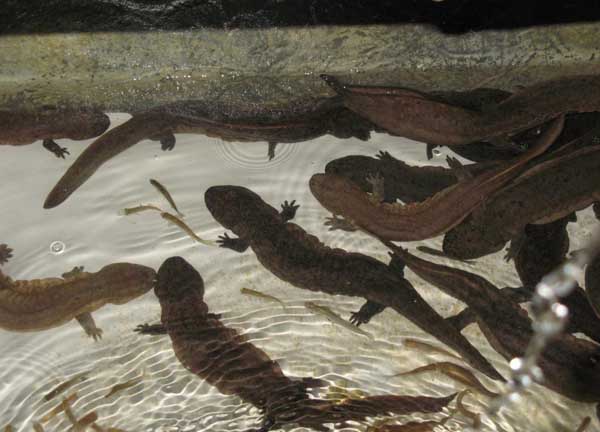
The spawning season of the Chinese giant salamander is between July and August each year. The eggs are laid inside rock caves, with each female laying more than 300 eggs, and the remaining task of rearing is left to the male salamander. The male salamander curls its body into a semicircle to enclose the eggs, so they are not washed away by water or harmed by predators, until the young salamanders hatch after 2 to 3 weeks. After 15 to 40 days, the small "baby fish" disperse to live on their own, and only then does the male salamander leave. The Chinese giant salamander also has the longest lifespan among amphibians; under artificial rearing conditions, it can live as long as 130 years.
The Chinese giant salamander is fierce by nature and carnivorous, feeding on aquatic insects, fish, crabs, shrimp, frogs, snakes, soft-shelled turtles, rats, birds and so on. Its hunting method is to "wait idly for prey to come to it." Its teeth cannot chew, so it simply opens its mouth and swallows food whole, then slowly digests it in the stomach.
The Chinese giant salamander generally hides in the crevices of mountain streams, with its cave located below the water surface. At night it quietly waits among the rocks at the stream mouth, and once it finds prey passing by, it launches a sudden attack. Because the teeth in its mouth are sharp and densely packed, prey finds it very hard to escape once inside its mouth. The baby fish has a strong ability to endure hunger; kept in cool water, it will not starve to death even without eating for two or three years. It can also gorge itself, and a full meal can increase its body weight by one fifth. When food is scarce, cannibalism may occur, and it will even eat eggs to stave off hunger. It usually hides away, liking to make its body color the same as the surrounding stones so that natural enemies do not notice it.
The natural distribution of the native range of the Chinese giant salamander is mainly concentrated in five major regions of China:
1. Zhangjiajie, Jiangyong, Yueyang and the Xiangxi Autonomous Prefecture in Hunan; Wuyishan in Fujian.
2. Fangxian, Shennongjia, Macheng Guifeng Mountain and Luotian Tiantangzhai in Hubei.
3. Hanzhong, Ankang and Shangluo in Shaanxi.
4. Zunyi in Guizhou and Yibin, Xingwen, Weiyuan Hulukou and Bazhong Nanjiang in Sichuan.
5. Jing'an in Jiangxi.
6. Other scattered distributions include Hefeng, Lichuan and Enshi in Hubei; Liuzhou and Yulin in Guangxi; Tianshui and Wenxian in Gansu; Luanchuan County, Lushi County and Hao County in Henan; Neixiang Baotianman in Nanyang; Yuanqu County in Shanxi; Qingyuan in Zhejiang; Qiandongnan in Guizhou; and Tianchi on Fenghuang Mountain in Chaozhou. Among these, Jing'an County was the first in the country to issue a public notice protecting the Chinese giant salamander starting in the 1970s, then established the country's first Chinese giant salamander nature reserve and built the country's first county-level baby fish research institute. In 2001, it designated the Chinese giant salamander as the county mascot. Jing'an County's achievements in artificial breeding technology for the Chinese giant salamander lead the country, and having passed appraisal by relevant experts of the Chinese Academy of Sciences, it possesses the technical conditions for large-scale development and utilization of the Chinese giant salamander. In August 2005, it was awarded the title of "Home of the Chinese Baby Fish" by the China Aquatic Products Processing and Marketing Association.