Is the Chinese giant salamander poisonous? Read this one article to understand the toxicity of the Chinese giant salamander
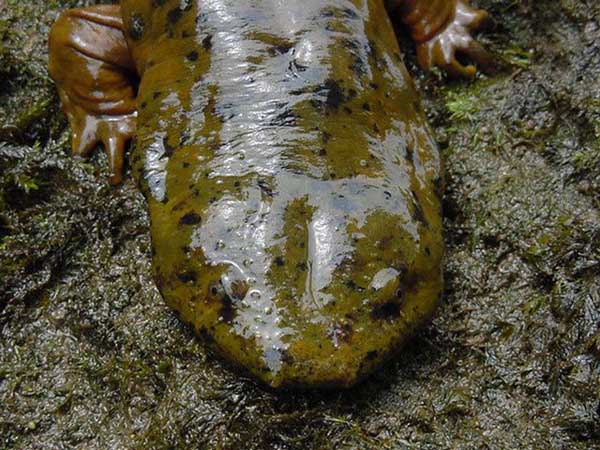
The Chinese giant salamander is non-toxic. Its scientific name is Andrias davidianus. It is a precious wild animal native to China. Because its call at night sounds like a baby crying, it is commonly known as the "baby fish" (Chinese giant salamander). It is actually not a fish; though named a fish, it is not one. It is the largest amphibian in China. Its appearance somewhat resembles a gecko. Its body length is generally about 1 m, with the longest reaching up to 2 m. Its weight is 20-25 kg, with the largest reaching 50 kg.
The head of the Chinese giant salamander is broad, large and flat, with obvious warty granules on the surface. The eyes are small, located on the top of the head, and have no eyelids, which is the result of degeneration from long-term adaptation to underwater life. The curved mouth opening is very wide, and the upper and lower jaws have many similar-sized fine teeth, which are beneficial for feeding. The body is broad, flat and sturdy. The laterally flattened tail is very long, accounting for one-third to one-half of the body length, and there are fin-like structures above and below the tail. The limbs are short and thick, much like a baby's arms, which is said to be another reason it is called the baby fish. The forelimbs have 4 fingers, and the hindlimbs have 5 toes. There are slight webs between the fingers (toes), and no claws.
The skin on the body surface of the Chinese giant salamander is relatively smooth, scattered with small warty granules. When stimulated, it can secrete a white, milky, sticky fluid with a Sichuan pepper-like smell. Along the sides of the body, between the armpit and the crotch, there are longitudinal skin folds. Its body color varies with the color of its habitat, with the back being brown, reddish-brown, blackish-brown, etc., marked with irregular darker spots, and the belly being light brown or grayish-white. It can breathe with its lungs, but because the lungs are not fully developed, it also needs to use its moist skin for gas exchange as auxiliary respiration, just like frogs, so it must live in water or near water areas. From the perspective of biological evolution, it is a transitional type in the evolution from aquatic fish to true terrestrial animals.