Key Technical Points for Winter Breeding Management of Giant Salamanders
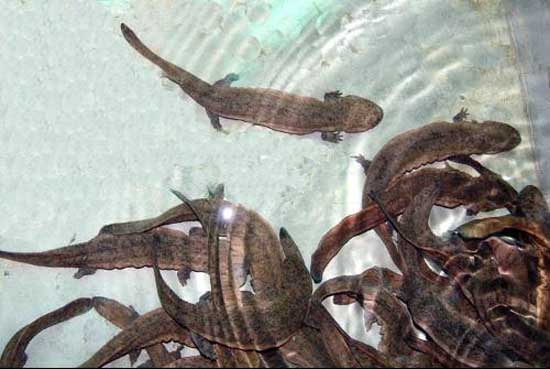
A Few Management Suggestions for Giant Salamander Farmers in Winter
As midwinter arrives, all flowers wither. Nowadays, with heavy snow falling, ice formation on the surface of breeding ponds is widespread. Many breeders are more or less worried about whether the giant salamanders have been harmed by the cold. Plenty of people are feeling anxious and unsettled. How can we ensure that young salamanders, parent salamanders and breeding stock safely make it through this cold winter?
1. Increase the total water inflow of the flowing water in the breeding ponds.
2. Raise the height of the water outlet of each breeding pond, and keep the water level of each pond between 30-40 cm. The higher the water level, the more stable the water temperature.
3. Add a drip trough to the water outlet of each pond, so that the water in the trough drips onto the pond surface. The advantage of this approach is that the dripping water creates waves on the pond surface, so the pond naturally will not freeze over a large area.
By the same principle, indoor breeding ponds can also follow the breeding management model. When the temperature is low at night, doors and windows should also be closed and the tap turned on, so that the pond surface will not freeze.
If the long period of low temperature suddenly turns into the high temperature of summer, the fish of farmers and breeders go from low temperature straight to high temperature, and the giant salamander's response to such a temperature will certainly not necessarily be adaptive. The possibility of illness is not out of the question. So in the cold winter season, how should farmers and breeders go about dealing with the shift from low temperature suddenly rising to high temperature? I think farmers should not recently try every possible way to artificially raise the temperature to promote growth just so that the giant salamanders grow fast in winter. I think we should let nature take its course. If the temperature is low, then let it be low. Everyone should follow the laws of nature, and acknowledge the effects of day and night on living things; there is no need to explain one by one the effects of the arrival of the four seasons on living things.