Detailed Explanation of Key Technical Points for Identifying the Quality of Giant Salamander Fry and Fingerlings
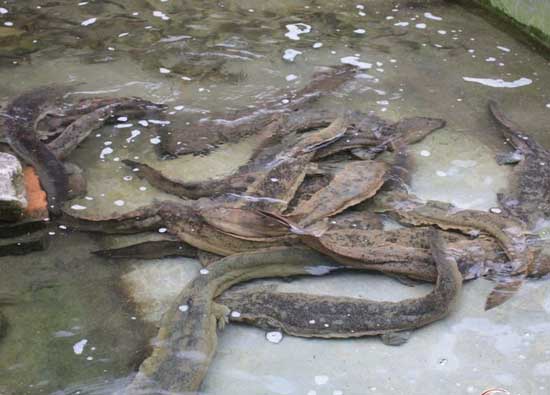
The giant salamander is commonly known as the baby fish. Because giant salamander fry and fingerlings are relatively expensive, many prospective breeders worry about the quality of the fry and fingerlings. In particular, the current giant salamander fry and fingerling market is not well regulated, and driven by high profits, some people deceive breeders with non-giant-salamander fry and fingerlings such as small salamanders. Therefore, mastering the techniques for identifying the quality of giant salamander fry and fingerlings is of great significance to the success of giant salamander farming and to improving farming efficiency. Based on many years of practical experience in artificial breeding and fry and fingerling cultivation of giant salamanders, the author offers some views on the external morphology, external reactions, and size specifications of giant salamander fry and fingerlings.
Basic External Morphological Characteristics of the Giant Salamander
The basic morphology of the giant salamander is as follows: for one-year-old juvenile salamanders that have not yet lost their gills, good quality is shown by external gills that are dark red or the same as the normal body color, with no damage. If fry and fingerlings with damaged external gills are found, they are prone to bacterial infection and difficult to keep alive. Excellent giant salamanders over 1 year of age are required to have no external injuries and no deformities, but attention must be paid to distinguishing them from several other caudate amphibians with similar morphology. Table 1 lists their morphological identification methods.
External Reactions
When stirred by hand, the limbs of giant salamander fry and fingerlings crawl vigorously on the bottom of the water, and the tail swings quickly in the water. After draining the water and letting them crawl in a basin, those that move agilely are excellent salamander stock.
Size Specifications
Look at the uniformity of the salamander fry: if the same batch of fry and fingerlings grows uniformly, those with similar specifications can be preliminarily judged as relatively good quality, while weak and small fry and fingerlings will appear smaller than the rest of the same batch. In particular, giant salamander fry and fingerlings with longer heads grow slowly and should not be selected. Those with thick, sturdy trunks are better, but it is necessary to distinguish whether they have conditions such as abdominal bloating or ascites.
Observe Whether There Are Signs of Disease
Some giant salamander fry and fingerlings have been affected in quality because of poor feeding and management and infection with diseases. The specific observation method is: the limbs of the giant salamander are not swollen, the abdomen is not enlarged or bloated (abdominal bloating is ascites disease), the 3 pairs of gill filaments of juvenile salamanders that have not yet lost their gills (1 to 10 months old) are intact, there is no water mold parasitizing the gills, there are no white spots on the body surface, and the body shape is not emaciated. Fry and fingerlings with these characteristics can be preliminarily judged as excellent stock.
The quality identification of giant salamander fry and fingerlings should comprehensively consider the above factors. In addition, the rearing level and rearing conditions of the supplier should also be considered. Based on fry and fingerling cultivation experience, it is recommended that breeders purchase giant salamander fry and fingerlings of about 50 to 250 g for rearing, as this makes it easy to identify quality and the survival rate can reach as high as 100%.