What to Do When a Giant Salamander Suffers Dystocia? A Detailed Explanation of Handling Techniques
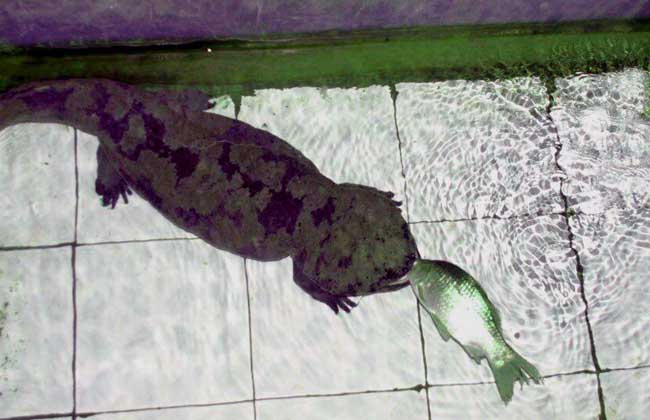
Observation of Egg-Laying in Giant Salamanders
After injecting exogenous hormones into sexually mature female giant salamanders, the mature yolk granules detach from the ovary (i.e., ovulation); after falling into the abdominal cavity, they need to be moved upward by the movement of the abdominal wall muscles to the ostium of the oviduct near the thoracic membrane at the forelimbs, then enter the oviduct for a series of physiological processes that wrap the yolk granules and form them into a gelatinous band, finally being laid outside the body. When "internal laying" occurs, there is an optimal time window for the process of mature eggs moving from the oviduct to being expelled from the body; eggs laid during this stage are of better quality and have better fertilization capacity. Through years of induced-spawning trials, we have worked out a set of artificial spawning-promotion methods for giant salamanders, overcoming the technical difficulty of delayed egg-laying caused by insufficient stimulation from the external ecological environment under fully artificial induced-spawning conditions, and significantly improving their fertilization rate. After induced spawning, female giant salamanders with well-developed gonads will show abdominal swelling after about three days, which is a sign of imminent spawning. After artificial spawning promotion, most female giant salamanders like to crawl along the edge of the pond, then stop and remain motionless in a corner near the pond wall, with the head slightly extended above the water surface, breathing rapidly and frequently; just before the gelatinous band is about to be laid, the cloacal opening becomes relaxed and open, and some even show violent side-to-side swaying of the body, finally laying the yolk-containing gelatinous band outside the body.
Handling Techniques for Dystocia in Female Salamanders
During artificial induced spawning, some female salamanders show dystocia, with only abdominal swelling observed and no egg-laying for a long time; or even if an egg band is laid, it tends to break automatically. These all belong to cases of dystocia. Such cases should be discovered in time, and artificial spawning-promotion measures should be taken. The specific operating techniques are: the technician carefully enters the brood salamander pond, gently presses the abdomen with the hand to expel accumulated urine from the bladder, then gently strokes the dorsal and ventral surfaces, the lateral folds, and around the cloacal opening with the hand. The female salamander can also be gently lifted out of the water, then gently stroked along the head, trunk, and abdomen. This achieves the purpose of overcoming tension and relaxing the female salamander awaiting spawning, facilitating smooth spawning. Do this once every 1 hour, generally for more than 3 times in succession; with proper handling, it can prompt the female salamander to lay eggs. But note that during spawning promotion, the technician should first trim the fingernails, then disinfect with 0.05% potassium permanganate, so as not to scratch the giant salamander. In addition, increasing water flow stimulation can also play a certain role.
Post-Spawning Management
After the brood salamanders finish laying eggs, the female and male brood salamanders should be promptly moved separately into brood salamander ponds with the same water temperature as the original pond for careful rearing, because during the egg-laying process the brood salamanders often chase each other, causing damage to the body surface such as the mucous membrane and skin; moreover, brood salamanders that have just finished laying eggs are relatively weak in constitution. When moving them out of the spawning pond or when changing water afterward, ensure that the giant salamanders are not harmed; if injured brood salamanders are found, promptly apply anti-inflammatory drugs to the wounds. When feeding, also be careful and cautious, and observe their activity and appetite. Start with less feeding, and feed some bait with good palatability; after their constitution returns to normal, then feed according to standards and carry out normal management. In particular, after brood salamanders reproduce, due to improper technical handling, or excessively high hormone doses, sudden changes in water quality, and other reasons, mass death of brood salamanders sometimes occurs. This is an extremely distressing problem, and the author believes prevention should be carried out from the following 4 aspects.
1. Water temperature issue: after brood salamanders lay eggs, their constitution is relatively weak, and they cannot be arbitrarily scooped from the rearing pond into the spawning pond; as a result, often because the water temperature difference is too large, the giant salamanders catch cold and become ill, and in severe cases the brood salamanders die. For this reason, after spawning, the female and male brood salamanders should as far as possible be put back into the original pond to rest and recover.
2. Feeding issue: after intense reproduction, giant salamanders are weak in constitution, their digestive function is also affected, and their appetite is poor. Under such circumstances, reduce feeding and feed easily digestible bait; only after the brood salamanders' activity and appetite return to normal can normal feeding be resumed.
3. Injury issue: during the reproduction process of giant salamanders, manual handling causes skin abrasions and shedding, and since the temperature is relatively high at this time, which is the season for pathogen reproduction, bacteria and parasites can take advantage of the wounds on the body surface and enter, very easily causing the brood salamanders to be infected with disease and die. For this reason, a small amount of gentamicin is usually added to the brood salamander pond (at a concentration of 1 gram/cubic meter) for soaking, 1 hour each time, used 5 times in succession.
4. Water quality issue: because giant salamanders suffer dystocia, or their gonads are not yet mature enough, but after the reproduction period ends, the reproductive glands of both female and male giant salamanders gradually mature. Whenever stimulated by new water and when foraging, some female salamanders will still lay eggs, and male salamanders also secrete male hormones and even release sperm. Thus, although this is not formal egg-laying, these secretions or sperm dissolve in the water, making the water whitish; if the water is not changed in time, it will become foul and deteriorate. Therefore, promptly observe the post-spawning reactions of the brood salamanders, and promptly remove the egg bands or egg granules. For those without flowing-water rearing conditions, adopt the method of changing water 3 times a day; for those with flowing-water rearing conditions, keep the water flow unobstructed to ensure good water quality.