Detailed Explanation of Key Points for Intensive Rapid-Culture Technology of Giant Salamanders in Dedicated Ponds
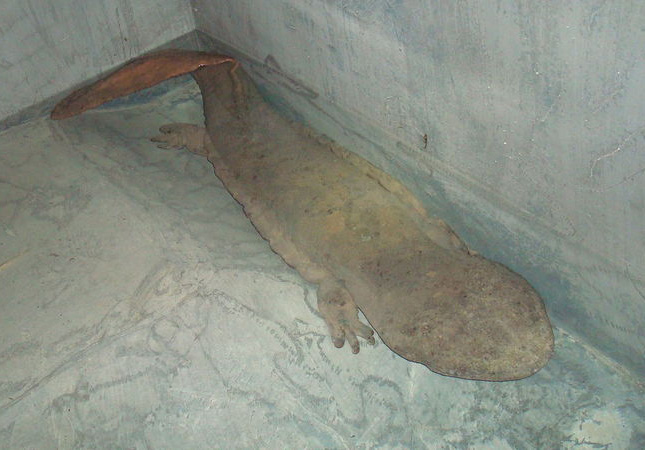
The giant salamander, commonly known as the baby fish, is also called the salamander fish, dog fish, and four-legged fish. It is a large amphibious aquatic animal unique to China. Its meat is tender and delicious, highly nutritious, and serves as a fine dish for banquets and a health tonic for postpartum women, the elderly, the young, the sick, and the weak. Its meat and skin are used in medicine to treat anemia, neurasthenia, liver and stomach pain, joint pain, dysentery and diarrhea, and burns and scalds.
Under natural conditions, because the giant salamander matures late sexually and has a low reproduction rate, and due to repeated geological and geomorphological changes in history, its ecological environment has suffered severe damage, and its wild resources have been increasingly depleted. In 1989, the Chinese government listed the giant salamander as a Class II nationally protected animal. Therefore, artificially breeding giant salamanders can not only protect and increase giant salamander resources but also meet the needs of domestic consumers and earn foreign exchange through exports.
In recent years, relevant domestication trial results show that the giant salamander can quickly adapt to an artificial ecological environment and, under conditions of sufficient bait, has the notable characteristic of rapid growth. The intensive rapid-culture technology for giant salamanders in dedicated ponds is introduced as follows:
Salamander Pond Construction
Giant salamander breeding ponds should be built in sites with a quiet environment, shade and coolness, abundant water sources, and good water quality. The water temperature is required to remain within the range of 10°C to 25°C year-round. If conditions permit, it is best to equip facilities for heating in winter and cooling in summer, which helps improve breeding results.
1. Juvenile salamander ponds: Cement structures are mostly used. The area of each pond is preferably 8 sq m to 10 sq m, the pond wall height is 50 cm to 60 cm, and the water depth is about 20 cm. A layer of mud and sand should be spread on the pond bottom. The pond walls should be smooth. Stone piles, rockeries, and islands should be set up in the pond, and anti-escape boards should be installed at the pond edges, allowing juvenile salamanders to climb onto land for activity and preventing escape.
2. Adult salamander ponds: Cement structures are mostly used. The area of each pond is preferably 50 sq m to 70 sq m, the pond wall height is 1.2 m to 1.3 m, and a rectangular pond shape is preferable. Water inlets and outlets should be provided, and the water depth should be maintained at about 30 cm. Burrows should be built around the pond bottom or in the middle, using materials such as bricks and cement slabs. The burrows should be built in a rectangular box shape, with a height of 15 cm to 20 cm, a depth of about 50 cm, and a width of 30 cm to 40 cm. Under artificial breeding conditions, giant salamanders often live together in one burrow, so the burrow width can be correspondingly expanded according to the scale of breeding. The inner walls of the burrows need to be smoothed with cement mortar to make them smooth and avoid scratching the giant salamanders. A resting platform can be set up in the center of the pond for the giant salamanders to move on. A shed should be built over the pond or trees, gourds, and beans should be planted on the pond banks for shade to prevent harm to the giant salamanders from intense sunlight and high temperatures.
Fry and Seedling Stocking
A suitable stocking density is beneficial to the growth of giant salamanders and reduces the feed conversion ratio. Production practice has shown that 25 to 30 juvenile salamanders can be stocked per square meter of water body, and 10 to 15 adult salamanders with a size of 500 g each to 1000 g each. The stocking size should be uniform to avoid the weak being preyed upon by the strong due to differences in individual size. Newly built cement ponds must be soaked in water for 15 days to 20 days, and only after the pond water pH stabilizes below 8 can fry and seedlings be stocked. One week before stocking, both new and old ponds should be disinfected with bleaching powder or other drugs to kill harmful organisms. Before the fry and seedlings are put into the pond, soak them in water with 0.2 g of furan drugs or 0.5 g of methylene blue for 5 minutes.
Bait Feeding
During the initial feeding period of juvenile salamanders, live bait such as chironomid larvae and aquatic earthworms is mainly fed, with satiation as the standard. After 15 days of rearing, some small shrimp, earthworms, minced meat, and so on can be appropriately fed, with bait given at night. After about 8 months of rearing, when juvenile salamanders reach a body weight of more than 20 g, the bait can be minced small miscellaneous fish or chopped beef and mutton, and artificial compound feed can also be fed. When juvenile salamanders are reared with artificial compound feed using fish meal and α-starch as the main raw materials and with a crude protein content of 42.3% to 45.6%, their growth rate is 33.3% faster than with fresh live bait.
For feeding adult salamanders, fresh low-value fish or artificial compound feed can be used (reference formula: fish meal 55%, oil cake 8%, wheat bran 5%, silkworm pupae 5%, bone meal 1.2%, α-starch 17.3%, premix 8.5%). If live fish are used, the bait fish should be cut into pieces before feeding. Artificial compound feed is generally in powder form and can be mixed with water into a soft dough before use. Fresh animal offal can also be used as salamander bait after being boiled in water, but its nutritional value is inferior to fresh live fish and artificial compound feed. Generally, the daily feeding rate for fresh live bait is 10% to 15%, and for artificial compound feed it is about 10%. Bait is generally put into the water, usually around dusk before and after dark. Within the suitable temperature range, adult salamanders consume the most food within 3 hours after dark; when the weather is hot and muggy, food intake decreases significantly and may even stop. Therefore, the specific feeding time and feeding amount should be flexibly controlled according to weather, water temperature, water quality, and the activity of the adult salamanders.
Routine Management
In intensive rapid culture of giant salamanders in dedicated ponds, the stocking density is relatively high, and water quality is difficult to balance naturally. Therefore, juvenile salamander ponds should be changed with new water once a day, and residual debris and leftover bait in the pond should be removed cleanly, so that the pond water transparency is clear to the bottom at a glance and the pH remains between 6.5 and 8.5. Adult salamander ponds are generally changed with water once every 2 days to 3 days, and once a week in winter. The specific number of water changes should be determined according to the temperature and water quality conditions, with the aim of maintaining fresh water quality. Breeding ponds should be inspected frequently to prevent giant salamanders from escaping. Regardless of whether they are juvenile or adult salamanders, after being put into the pond, records should be kept every day on air temperature, water temperature, bait type, feeding amount, feeding conditions, growth conditions, and activities, so as to summarize and accumulate experience and further improve giant salamander breeding.
Disease Prevention and Control
Giant salamanders have relatively strong stress resistance and generally have no diseases. However, in intensive rapid culture in dedicated ponds, with high density, high bait input, and rapid growth, disease prevention and control for giant salamanders should still be strengthened. During the rearing process, once a month, a mixture of 0.7×10⁻⁶ copper sulfate and ferrous sulfate (ratio 5:2) should be splashed over the whole pond regularly to kill pathogens and parasites in the pond. If giant salamanders develop skin ulceration or are bitten, they should immediately be caught out for isolated rearing and treatment. Penicillin can be injected at 50,000 international units per kilogram, once a day for 4 consecutive days, and then once every 4 days for 2 to 3 consecutive times, after which they can be cured.