Classification and Distribution of the World's Giant Salamanders Explained in Detail
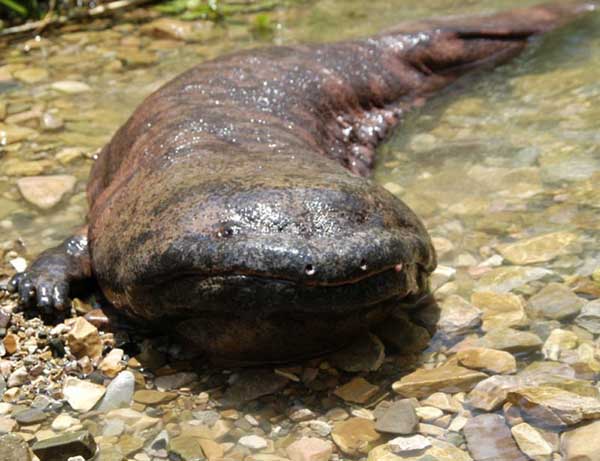
The giant salamander, commonly known as the baby fish, belongs in taxonomy to the phylum Chordata, class Amphibia, order Caudata, family Cryptobranchidae. The family Cryptobranchidae includes 2 genera and 3 species: the genus Andrias and the genus Cryptobranchus. In the genus Andrias, Japan has the Japanese giant salamander (Andrias japonicus, also called the giant pepper fish), and China has the Chinese giant salamander (Andrias davidianus), while the genus Cryptobranchus is represented by the North American hellbender (Cryptobranchus alleganiensis), commonly known as the Hellbender.
Chinese Giant Salamander
In China, the giant salamander is mainly distributed in the mountain streams and rivers of the upper and middle tributaries of the Yangtze, Yellow and Pearl Rivers, especially in Sichuan, Hubei, Hunan, Henan, Guizhou, Shaanxi, Chongqing and other provinces and municipalities. Among the 3 species of giant salamander, the Chinese giant salamander is the largest individual, with a body length of up to 1.8 m and a weight of more than 100 kg; the giant salamander originated in the Devonian period 350 million years ago and has long been known as a “living fossil”. It is the largest individual amphibian known to date, is a Class II protected wild animal in China, and has high value for scientific research, nutrition, food and medicine.
Japanese Giant Salamander
The Japanese giant salamander is mainly distributed in the mountain rivers of Honshu as far west as Gifu, and in parts of Shikoku and Kyushu. It is large in size, with a total length generally of about 60 cm, a body length of up to 1.5 m and a weight of 45 kg; the dorsal surface of the body is usually grayish brown, mostly with mottling, and the eyes are very small; the mouth opening is large; there are many warty granules on the back; the trunk is long and cylindrical, with very thick skin folds on both sides; the limbs are thick and short, and flattened; the tail is short. It lives in the upper reaches of rivers and in clear mountain streams. The spawning season is from late August to late September each year, and a mature female Japanese giant salamander generally lays 400-500 eggs. The eggs are yellow, with a diameter of 5 mm. According to reports, Japan has succeeded in artificial breeding and semi-natural breeding of the Japanese giant salamander.
American Hellbender
The American hellbender is mainly distributed in the eastern United States from New York to Mississippi, and westward to the streams of Missouri, the Appalachian Mountains and the Ozark Mountains. The American hellbender is the smallest individual, with a maximum body length of 0.74 m and a weight of 1.8-2.3 kg. Its structure is similar to that of the Japanese giant salamander and the Chinese giant salamander; the main difference in appearance is that it has a pair of gill slits, or one gill slit on the left side; the dorsal surface of the body is brown or gray, with many dark markings on it, the ventral surface is lighter in color, and the head is large and flat. It feeds on animal bait such as river crabs and fish, and the spawning season is around September, when a mature female hellbender generally lays about 300 eggs. At present, there are no reports on artificial breeding of the American hellbender.
Comparison of the Characteristics of the Three Giant Salamanders
Comparative characteristics Chinese giant salamander Japanese giant salamander American hellbender Head warty granules In pairs Single granules / Dorsal color markings Large patches Black spots Dark markings Eyes Outside the skin fold, small but clearly visible Retracted within the skin fold, difficult to see / Adult head gill openings No gill slits No gill slits A pair of gill slits Breeding period May-October Late August to early September Late summer Embryonic development period (days) 35-40 40-60 70-84 Larval length (mm) 28-31 / 30 Age at sexual maturity 5 10 / Total length (cm) 100-200 70 75 Maximum body weight (kg) 100 / 5