What precautions should be taken when raising giant salamander fry
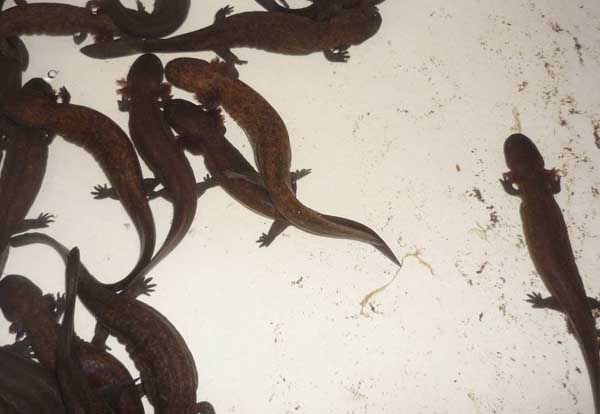
The giant salamander belongs to the class Amphibia, order Caudata, family Cryptobranchidae, commonly known as the baby fish, and is unique to our country, hence it is also called the Chinese giant salamander. The giant salamander is distributed across 18 provinces and cities in China, mainly produced among the mountain streams of the deep forests of South China and Southwest China. Common individuals weigh 2-5 kg, with a body length of about 50-150 cm, and the largest individuals can reach 10-20 kg. Because giant salamander meat is tender, delicious, nutritious and has high food and medicinal value, it has always been a healthy high-end nutritional food deeply loved by people. In recent years, due to excessive hunting and killing by humans, combined with severe damage to the natural ecological environment, giant salamander resources have been declining day by day, and it is an endangered animal, so it has been listed by the state as a Class II key protected wild animal. With in-depth research in giant salamander ecology and reproduction, artificial breeding has made a breakthrough, solving the bottleneck of fry supply and demand, and giant salamander artificial breeding farms have sprung up like bamboo shoots after rain. For example, Wangcheng District in Changsha is not originally a native place of the giant salamander, but according to statistics, the district already has more than 100 giant salamander farmers, with more than 50,000 giant salamanders raised annually, and in just 7-8 years, it has formed an aquaculture industry with an output value of over 100 million. Due to rapid development, farming levels vary greatly, with one-sided pursuit of profit, high-density intensive farming, artificial overfeeding, excessively fast growth promotion, abuse of drugs, and artificial control of the ecological environment, leading to an increase in giant salamander farming diseases such as swollen head and swollen feet disease, enteritis, and skin rot disease. Some farmers, due to weak technical strength, suffer total loss once disease occurs. Especially at the fry breeding stage, inadequate measures such as farming management and disease prevention and control cause mass mortality, bringing serious economic losses to farmers. How to do a good job in fry breeding has become the key to giant salamander farming. The author visited many farmers and, summarizing the experience of success and failure, believes that to do a good job in giant salamander fry breeding, attention should be paid to the following key matters.
Licensed farming
According to Article 17 of the Wildlife Protection Law of the People's Republic of China (adopted at the fourth meeting of the Standing Committee of the Seventh National People's Congress on November 8, 1988): “Those who domesticate and breed wild animals under special state protection shall hold a license.” The giant salamander is a national Class II protected aquatic animal, so newly added farmers must first apply to the relevant department for a farming license before raising giant salamanders. The specific procedure is that the farmer submits an application to the fishery administrative department of the county and city (prefectural administrative office) government, and after review, it is reported to the fishery administrative department of the provincial government for approval, and only after obtaining the license may farming begin; otherwise it is regarded as illegal.
Construction of fry ponds
Giant salamander fry ponds are generally best made as cement-structured ponds, with an area of 1-2 sq m being suitable and a water depth of 20-30 cm. Because the skin of giant salamanders at the fry stage is relatively delicate, the pond bottom and walls are required to be covered with ceramic tiles to reduce injury to the giant salamander from friction with the rough pond surface. The breeding pond should be thoroughly disinfected one week before use. Newly built breeding ponds have strong alkalinity, and strong alkali strongly irritates giant salamanders, causing damage to their skin and body, so newly built breeding ponds should be soaked in water for two months, with the water changed 2-3 times during that period; if a shorter time is required, they can first be soaked with oxalic acid for about 10 d, then soaked twice with clean water, and fry can be placed after one month.
Selection and transportation of fry
For the purchase of giant salamander fry, it is best to buy nearby naturally bred fry from a familiar breeding farm, and the breeding farm is required to have the “Giant Salamander Aquatic Wildlife Business Utilization License”, and quarantine work should also be done well. When purchasing, attention should also be paid to the following matters:
1. First check the health condition of the fry or breeding salamanders, requiring no disease and no injury, and normal activity patterns. For fry from artificial breeding and natural breeding, naturally bred ones are preferred, because they have good disease resistance and strong immunity. Before buying, they should first be fasted for 2 d, so that during transportation the fish will not vomit food and burst their bellies, especially small fry. If buying fry with gills, not only should oxygen be filled into the oxygen bag, but during periods of higher temperature, methods such as bottled ice should also be used in the packing box to lower the temperature.
2. Before transportation, the best transportation plan should be formulated, such as the choice of traffic routes and transportation time. Choose the nearest route and avoid the transportation peak period, and complete the transportation task in the shortest time.
For young salamanders transported back, do not rush to open the bag and put them into the pond. The fish and the transport bag should first be placed together in the pond to soak for a while, and the bag should be opened only after the temperature inside the bag is the same as the temperature in the pond. Before the young fish enter the pond, they can be soaked for a few seconds in a potassium permanganate solution of a certain concentration to disinfect and sterilize them before entering the pond. In the first 2 d, do not rush to feed them; let them starve for 2 d, and feed them after they adapt to the environment.
Feeding of fry
Newly hatched young salamanders have a body length of about 2.0 cm, lie on their sides in the water, have very little activity, and have weak swimming ability, relying on the tail to swing in the water, generally swimming once every 1-2 h. For newly hatched young salamanders, after about 30 d, the yolk has been almost completely consumed, and at this time the young salamanders begin to feed. The timing of feeding is very important. If feeding is too early, the young salamanders have not yet opened their mouths and do not have feeding ability, and the bait organisms in the water will not only consume a large amount of oxygen in the water, affecting the growth of the young salamanders, but their excrement will also cause pollution; if feeding is too late, the yolk energy of the young salamanders is exhausted, their predation ability declines, they cannot catch bait, or they have already closed their mouths and stopped eating, and finally die. At present, the commonly used opening bait for young salamanders is artificially cultured bloodworms. The requirements for the opening bait are: first, the individual size is suitable; second, the activity ability is weak, and the swimming speed is slower than that of the young salamanders, making it easy for the young salamanders to capture; third, it must be clean, with no mud and no filth; fourth, it is best to be live; fifth, the amount of bait must be sufficient.
In the early stage, because the young salamanders have poor activity ability, in order to facilitate management and cleaning of the breeding pond, they are generally placed in plastic baskets for rearing, with no more than 5 tails per square decimeter. As the giant salamanders grow, they should be thinned out in a timely manner. When they reach 6-7 cm, they can be directly placed in cement ponds for rearing. During the rearing process, the water is required to be filtered to ensure fresh water quality with no pollution. The water should not be too deep; it is enough that it can cover the fish body and the fish can swim freely. Keep slight running water in the pond, and clean the fish pond every day.
Feeding amount
Giant salamanders are gluttonous, and their living habit in nature is to hide by day and come out at night. For farming, feeding in the evening is better, and the feeding amount should be such that the young salamanders eat until 70-80 percent full. In the young salamander stage, sometimes a small number, due to eating too much, have abdomens swollen too large, cannot swim, and float on the water surface unable to sink underwater. These young salamanders should be placed separately in plastic baskets and placed in shallow water areas, allowing them to lie flat and minimizing their activity. After 2-3 d, once their abdomens have reduced in swelling, put them back into the pond.
Diet conversion
After about 5 months of rearing, the fry can reach a body length of 10-12 cm. At this time, the diet should be converted in a timely manner, changing to feeding on small fish and shrimp. The specific method is: choose fresh fish meat, remove the fish bones, mince it into fish paste and feed it together with bloodworms. At first, mix in a small amount of fish paste and correspondingly reduce the amount of bloodworms. After 3 d, gradually increase the amount of fish paste and reduce the amount of bloodworms, ultimately reaching the point of feeding all fish paste. After 15-20 d, the diet of the fry can be completely converted to eating fish meat. Young salamanders that have undergone diet conversion can be fed suitable live fish and shrimp.
Disinfection management
In giant salamander fry breeding, disinfection management work is crucial, and to do this work well, the following points should be done:
1. Disinfection of breeding ponds and tools: fry breeding tools should be dedicated to a specific pond. After each use, they must be soaked in table salt or potassium permanganate. At the same time, every 10 d, the breeding pond and fry should be soaked for 0.5 h with an appropriate amount of fish disinfectant such as povidone-iodine.
2. Bait disinfection: the bait fed should be fresh. Whether bloodworms or fish meat, before feeding they should be soaked in 5% salt water for 15 min, rinsed with clean water, and then fed.
3. In daily breeding, special attention should be paid to trying not to touch the young salamanders. If operations such as dividing ponds are needed, use a small dip net. Young salamanders with mechanical injury, bite wounds, or pathological changes should be isolated and treated in a timely manner.
4. At the same time, by all means minimize cross-contact between farms. If you have touched sick fish from another farm, both hands and other items must be strictly disinfected, and it is best not to enter your own breeding area that day, to prevent diseases from infecting each other.