What food do newly opened giant salamander fry eat?
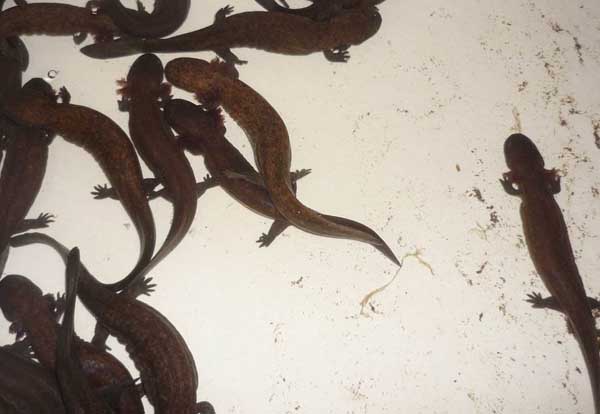
The giant salamander fry at the tadpole stage is the newly opened giant salamander fry. What does it eat? From the time the giant salamander fry first starts to open and eat, through metamorphosis (changing from gill breathing to lung breathing), until it reaches the adult stage and finally dies of old age, the giant salamander is carnivorous throughout its entire life. The giant salamander is not an animal that eats plankton and aquatic plants during the larval stage and then shifts to carnivory during the adult stage. The giant salamander is not an animal that changes from herbivory to carnivory; rather, it is carnivorous from youth to old age, only the body size of its food differs. For example, newly opened giant salamander fry prefer to choose small-bodied food (referring to chironomid worms, mayfly larvae and other larvae of aquatic insects); adult giant salamanders love to eat large-bodied food (referring to fish, frogs, snakes, birds, rats).
Now that we know newly opened giant salamander fry love to eat chironomid larvae and mayfly larvae, some misleading ideas are avoided, but where can chironomid larvae or mayfly larvae be found? Three methods are introduced here for reference:
Method one
Because chironomid larvae and mayfly larvae are both benthic animals in water, you can go to the shallow waterside of mountain streams, small rivers, ponds, lakes and reservoirs to catch mayfly larvae (black) and chironomid larvae (red).
Method two
The market sells mass-produced frozen pure red bloodworms (chironomid larvae). You can go to the flower and bird markets in major and medium-sized cities across the country to buy frozen chironomid larvae, thaw them in warm water and feed them to the salamander fry.
Method three
If you have neither the time to go to the waterside in the wild to catch chironomid larvae and mayfly larvae, nor the money to go to the flower and bird market to buy frozen chironomid larvae, then you have no choice but to breed chironomid larvae yourself. The method of artificially breeding chironomid larvae is simple and easy to carry out.
In your own front yard or backyard, fill containers such as washbasins, foot basins, buckets and manure buckets with water, put in a small amount of green grass, and place them under the eaves or in the shade of trees. No introduction work is needed. Every spring, when the water temperature reaches above 14°C, chironomids will fly over and lay eggs on the water surface of the containers in the already rotted and fermented green grass fertilizer water. After ten days to half a month, red chironomid larvae can be seen, and you can catch the worms at any time to feed the salamander fry.