Causes of and Prevention Methods for Frequent Food Spitting in Giant Salamanders
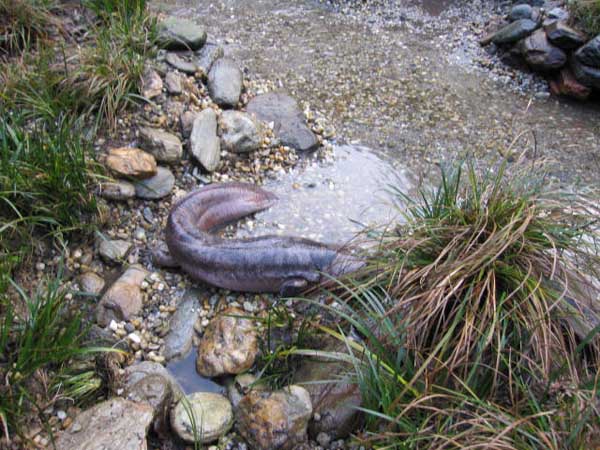
In artificial breeding, why do giant salamanders spit food after eating? Production practice has proven that if corresponding preventive measures are not taken when giant salamanders spit food, it can become a habit, which not only wastes bait and pollutes water quality, but more seriously leads to loss of appetite, inhibited growth and development, emaciation and weakness, and increased susceptibility to other diseases. For example, when parent giant salamanders exhibit food spitting behavior, it can delay the maturation of the gonads and directly affect the fertilization rate and hatching rate. Therefore, in the process of artificially breeding giant salamanders, the causes of food spitting should be promptly identified and corresponding countermeasures taken.
Causes of Food Spitting in Giant Salamanders
1. Environmental Causes
① Impact of water quality: In nature, giant salamanders often live in streams in relatively humid deep mountain forests, where the water source is mountain spring water without any pollution, and the water quality is fresh, lively and tender, most suitable for the growth and development of giant salamanders. However, in artificial breeding of giant salamanders, the water source is generally water from ponds, reservoirs, or lakes, or aerated tap water. The water temperature, pH value, dissolved oxygen, and transparency differ to some extent from mountain stream water, especially the mineral content in the water, which is difficult to reach the standard of mountain spring water. In some places, due to water source limitations, the breeding pond water is recycled, which more easily leads to a large amount of residual bait and excrement polluting the water quality, accompanied by the production of toxic and harmful gases such as NH3 and H2S. According to relevant data, when the H2S content in the water reaches 0.035mg/, the food intake of giant salamanders significantly decreases and their activity weakens; when the H2S content exceeds 0.15mg/, giant salamanders stop eating, or even a small amount of food intake causes vomiting, and in severe cases leads to poisoning and death of giant salamanders.
② Unreasonable construction of salamander ponds: Based on the giant salamander's living habit of preferring darkness and fearing strong light, people habitually build giant salamander breeding ponds in basements. Although the humidity and temperature can meet the requirements for the growth and development of giant salamanders, the poor ventilation and air permeability of basements, as well as the poor degree of air convection and exchange, directly affect the dissolved oxygen and pH value in the water. The light intensity in the basement is too dim, which restricts the growth and reproduction of beneficial microorganisms in the salamander breeding water, such as photosynthetic bacteria, blue-green algae, etc., disrupting the ecological balance in the breeding water, causing disorders in the physiological mechanisms of giant salamanders, and inducing food spitting. Some build giant salamander ponds in densely populated residential areas, and do not build artificial dark caves in the ponds, so giant salamanders are often startled by passing pedestrians and vehicles
2. Human Causes
① Improper stocking density: Giant salamanders live in natural environments where the unit density in water bodies is relatively sparse, fully ensuring the optimal water space for survival of giant salamanders. In artificial breeding, the stocking density of giant salamanders is dozens or even hundreds of times the natural population density, and the most basic survival space of giant salamanders is restricted. According to tests, when the stocking density of giant salamanders reaches 8kg/m3 or above, it can cause food spitting in giant salamanders.
② Poor bait quality: Since giant salamanders are carnivorous animals, in natural environments they often feed on live bait such as small fish and shrimp, tadpoles, aquatic insects, snails and mussels. In artificial breeding of giant salamanders, due to limitations of live bait sources and consideration of economic benefits, in addition to feeding a certain amount of live bait, they are mainly fed cheap animal carcasses, internal organs, blood offal, etc. These baits are extremely prone to rotting and deteriorating in high-temperature seasons and polluting the pond water quality, causing food poisoning in giant salamanders, with mild cases experiencing food spitting and severe cases resulting in death.
③ Improper feeding methods: During artificial feeding, the feeding amount varies from more to less. Especially during the peak growth period of giant salamanders, when the feeding amount is too small, it will inevitably cause mutual cannibalism among giant salamanders. During the fighting process, food spitting and physical injuries in giant salamanders are more likely to occur. When the feeding amount is too much, giant salamanders often overeat, and food spitting occurs with slight stimulation or fright.
3. Disease Causes
① Parasitic diseases: Giant salamanders suffering from parasitic diseases are usually caused by parasites such as Pseudamphistomum, Orientocreadium, and Acanthostomum parasitizing in the abdominal cavity of giant salamanders. When these parasites multiply in large numbers in the body of giant salamanders, diseased salamanders also exhibit food spitting behavior.
② Gastroenteritis disease: During artificial feeding, if moldy, deteriorated, or unclean bait is fed, it is extremely easy to cause gastroenteritis disease in giant salamanders. The symptoms are: lying prone and motionless, greatly reduced food intake, dilute feces accompanied by a large amount of purulent and bloody mucus, often accompanied by signs of vomiting.
Measures to Solve Food Spitting in Giant Salamanders
1. Strengthen Feeding Management
① Conditions of salamander ponds: The basic conditions for building salamander ponds are: sufficient water source, convenient drainage and injection, and a quiet environment. It is best to choose a forest area with high mountains, dense forests, and murmuring springs to build a salamander breeding farm, and build a 2m high wall around the breeding pond to prevent theft, escape, and human disturbance to giant salamanders, and build several artificial caves in the salamander pond for giant salamanders to inhabit. Trees and aquatic plants can be planted around the pond to simulate the wild ecological environment.
② Reasonable stocking: The density of artificially stocked giant salamanders is relatively much greater than the natural population density. Reasonable stocking can fully utilize the water body, implement intensive fine breeding, and avoid inducing food spitting in giant salamanders due to high density. Generally speaking, the stocking density of giant salamanders can be determined according to factors such as water source, water body, bait, and salamander fry. For example, if the water source is good and bait is abundant, 5-6 tails of 50-80g salamander fry can be placed per 10m3 of water body.
③ Scientific feeding: Artificial feeding should do well in the "four fixeds". First, fixed time: according to the living habit of giant salamanders foraging at night and hiding during the day, feeding is mostly carried out in the evening. Second, fixed location: build a bait platform in the salamander pond, and regularly rinse the bait platform with disinfectant solution, always keeping the bait platform clean. When feeding, place the bait directly on the bait platform. Third, fixed quality: giant salamander bait is required to be fresh, with live small fish and shrimp and tadpoles being best. A certain number of crucian carp, common carp, tilapia and other highly reproductive fish can also be placed in the salamander pond for giant salamanders to prey on freely. The artificial compound feed fed is required to be comprehensive in nutrition and free of mold. Fourth, fixed quantity: the feeding amount can be flexibly controlled according to water temperature and the individual size of giant salamanders. Feeding in the evening should be finished before dawn the next day.
④ Regulating water quality: Requirements of giant salamanders for water quality
2. Prevention and Treatment of Diseases
To prevent the occurrence of diseases, regularly splash 0.3-0.4g/m3 of strong chlorine or 0.2-0.3g/m3 of chlorine dioxide solution into the salamander pond. When giant salamanders suffer from gastroenteritis, food should first be stopped for 2-3 days, and bait should be fed after giant salamanders are in a semi-starved state. The formula for medicated bait is: sulfaguanidine 5g + oxytetracycline 3g + ofloxacin 5g evenly mixed into 5kg of animal meat paste to feed giant salamanders, once a day, used continuously for 3-5 days as one course of treatment. When giant salamanders suffer from parasitic diseases, 15g of trichlorfon (90% crystal) + 3g of furapromide can be added per 5kg of bait, once a day, used continuously for 2 times to cure.