Detailed Explanation of the Basic Technical Points of Giant Salamander Breeding
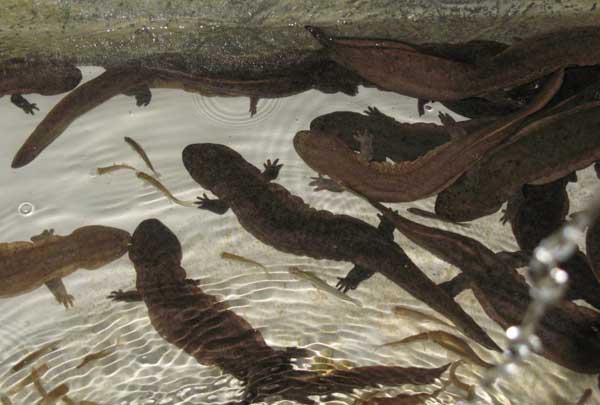
In nature, giant salamanders live in mountain streams at altitudes of 300-800 m. They prefer shade and fear wind, prefer quiet and fear disturbance, and prefer cleanliness and fear dirt. Artificially built giant salamander breeding ponds should best imitate the natural living conditions of giant salamanders.
Water Resource Requirements
Based on the results of water sample analysis collected over many years by our institute, the overall requirements of giant salamander breeding for water are: sufficient water source, non-toxic and harmless, and meeting fishery water standards. In detail, regarding water source, clear, cool, and flowing water such as mountain streams, reservoir water, and groundwater is preferable, and drainage and irrigation should be possible freely; regarding water temperature, it should be strictly controlled within 0-28°C, with 10-22°C being preferable; regarding water quality, dissolved oxygen should be abundant, above 3.5 mg/L, and pH should be 6.5-7.5. The total hardness, total alkalinity, chlorides, sulfates, silicates, ammoniacal nitrogen, etc. in the water must not exceed fishery water standards.
Environmental Requirements
The surroundings of the breeding pond should be quiet, shady, and have fresh air. It is preferable to be surrounded by mountains, with dense trees, few inhabitants, and a relatively independent environment. In addition, transportation should be convenient, and bait resources such as local fish, shrimp, crabs, or animal offal should be abundant.
Design and Construction of the Breeding Farm
The growth of giant salamanders has clear stages and includes a metamorphosis process. Artificially breeding giant salamanders requires the breeding ponds to be designed and built in stages. The area of the breeding ponds should depend on the size of the giant salamanders. The larval salamander pond (tadpole stage, within 1 year of age) should be 0.5-1 sq m, the juvenile salamander pond (juvenile stage, 1-2 years of age) should be 1-2 sq m, the adult salamander pond (adult stage, 2-4 years of age) should be 2-4 sq m, and the brood salamander pond (over 4 years of age) should be about 5 sq m. For the breeding ponds at each stage of the giant salamander, the shape is best rectangular or oval, with a length-to-width ratio of 3:2, and the height should be two to three times the total length of the giant salamanders being bred. The surroundings and bottom of the farm ponds should be smooth, and escape-prevention facilities or escape-prevention nets should be built or installed on top. Multiple caves can be designed inside the ponds to facilitate concealment and hiding by the giant salamanders. Each breeding pond should be built with independent drainage and irrigation facilities, so that the water level can be effectively adjusted, water can enter and exit freely, and sewage discharge is convenient. The entire breeding farm should establish complete facilities for preventing escape, theft, and harm to the giant salamanders.