Beekeeper Reaps a Life Sweeter Than Honey from Four Mu of Land
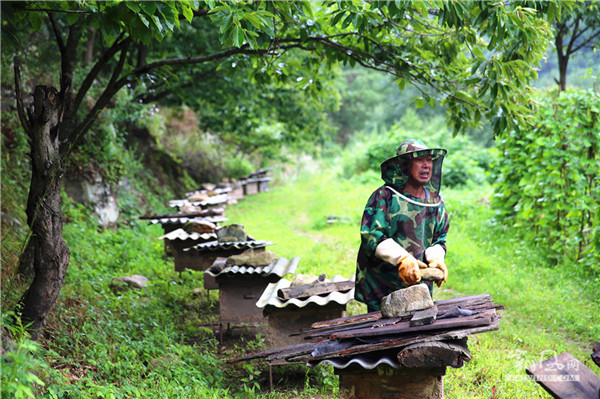
Taishanba Village has a long tradition of beekeeping. According to local beekeepers, in past years nearly every household in the village kept a few hives of bees, for entertaining guests at the end of the year or for their own consumption.
In its poverty alleviation work, Taishanba Village identified beekeeping as the leading industry, and it is the main industry through which villagers escape poverty and become prosperous.
With the help of town and village officials, beekeeper Chen Fengwu took out a loan of 50,000 yuan to keep 103 hives of bees, which can produce more than 1,000 jin of honey. At current market prices, that brings in at least 40,000 yuan, which is more than enough to lift the whole family out of poverty.
With his wife's help, Chen Fengwu is full of confidence in beekeeping.
During the interview, Chen Fengwu enthusiastically opened a beehive and asked his wife to bring a knife and a basin. He cut off a large piece of honeycomb covered in honey and invited the reporter to taste it.
Beekeeping with traditional hives
The honeycomb is covered in glistening, crystal-clear honey.
In midsummer, wild flowers of every kind are in full bloom in the deep mountains of the Qinling range. Walking into Taishanba Village, Simudi Town, Ningshan County, the air is filled with the fragrance of flowers. Everywhere along the roadside, beehives meet the eye, and passersby cannot help stopping to take in this sweet scent.
Taishanba Village has a long tradition of beekeeping. According to local beekeepers, in past years nearly every household in the village kept a few hives of bees, for entertaining guests at the end of the year or for their own consumption.
"In recent years, as society has advanced, many young people have gone out to work, leaving only us older folks. For us, beekeeping counts as fairly light work!" beekeeper Chen Fengwu told the reporter with emotion.
It is understood that in its poverty alleviation work, the village's director Chen Wei called the villagers together to discuss poverty alleviation plans and identified beekeeping as the leading industry of Taishanba Village. At the same time, beekeepers can also enjoy subsidised-interest loans based on the number of hives they keep.
The environment and air in the mountains are simply wonderful. The reporter learned that beekeeper Chen Fengwu is now over 70 and has more than ten years of beekeeping experience. In earlier years he kept only a small number, never reaching a large scale; his beekeeping skills had long since matured, and it was mainly a lack of funds that held Chen Fengwu back.
"With the help of town and village officials, I got a 50,000-yuan subsidised-interest loan. This year I'm keeping 103 hives of bees, which should produce more than 1,000 jin of honey. At current market prices, that sells for more than 40,000 yuan, which is more than enough to lift the whole family out of poverty!" beekeeper Chen Fengwu told the reporter proudly.
During the interview, Chen Fengwu enthusiastically opened a beehive and asked his wife to bring a knife and a basin. He cut off a large piece of honeycomb covered in honey and invited the reporter to taste it. "This freshly cut honeycomb with honey can be sliced into small pieces and eaten directly. This all-natural product is sweet to the core and leaves you with an endless aftertaste," introduced Tan Kangning, Party secretary of Simudi Town, who accompanied the visit.
Up to now, the town has developed 2,350 hives of bees, with 1,630 hives kept in Taishanba Village alone. The whole town can produce more than 80,000 jin of honey a year, with an output value of more than 3 million yuan.