Snow Mountain roses are especially red; one person getting rich does not count as getting rich
Most women like flowers, especially delicate, dewy roses. Held in the hand, placed on a table, set in the home, even a casual glance can make one become intoxicated by its beauty; it is the darling of the modern city. Greenhouses and conservatories are the warm breeding grounds where roses grow and bloom, and their rich fragrance makes them even more pleasing to view.
But the rose story told in this article has nothing to do with greenhouses, and even less to do with fashionable dance halls. It unfolds in the mountain hollows of Xiaojin County, Aba Prefecture, Sichuan, far from the romantic city, blooming passionately in a secluded place and becoming an important magic weapon for local people to escape poverty and become rich.
Rose cultivation forced out by wild boars
Red Jiajin Mountain, the holy Siguniang Mountain, Bawang Mountain, Mengbi Mountain; in the east of the Qinghai-Tibet Plateau and the west of the Sichuan Basin, mountain ranges rise and fall in endless succession, tall and towering. Xiaojin County of Aba Prefecture nestles in the embrace of the mountains of western Sichuan. Cloud-deep villages, snowy fields, alpine lakes; this is a place of tranquility.
With transportation cut off and no large factories or mines built, the five grains and miscellaneous crops planted by local villagers could basically only sustain their livelihood; getting rich and earning money was a dream that constantly lingered in their hearts.
In 2011, villagers of Maoshui Village in Xiaojin County, as before, planted potatoes, corn and other food crops in the mountain fields. Just as they were looking forward eagerly to the harvest, the crops of several households were destroyed by marauding wild boars. Wild animals are protected by the state and cannot be killed casually. With no way out, the villagers of Maoshui Village could only keep going to village chief Chen Wanghui.
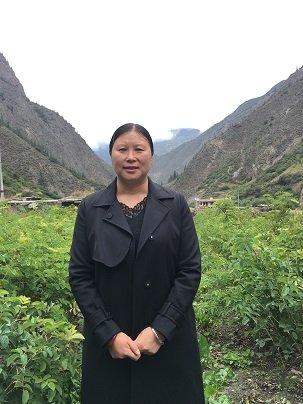
Chen Wanghui is a typical Tibetan woman, simple and honest, straightforward, and from her manner of speaking it is not hard to see her capability. She is the village director of Maoshui Village in Dawei Township and was elected village chief in 2010.
"The wild boars can't be killed, the crops can't be harvested; what will we common people eat to live?"
Seeing the neighbors who came to pour out their grievances flush red in the face, with tears in their eyes, Chen Wanghui ran alone to the damaged crop fields, and before her eyes was a scene of chaos. Casually, she noticed two roses at the edge of the field blooming most joyfully, delicate and dewy. In her boundless desolation, a flash of inspiration came to Chen Wanghui's mind: "Is it because roses have thorns that wild boars don't eat them? Could we use them to replace crop planting?" And just like that, the idea of developing rose cultivation was forced out by wild boars.
Was Maoshui Village really suitable for rose cultivation? Chen Wanghui was also uneasy in her heart, and she resolved to leave the mountains and go to more places to investigate and study.
The arduous road of investigation alone
In May 2011, after weighing things over repeatedly, Chen Wanghui paid out of her own pocket and chose relatively nearby Lanzhou, Gansu as the first stop of her investigation. She flew to Lanzhou, and seeing a vast wilderness, for Chen Wanghui, who had spent years in the mountains, it was somewhat unsettling, and she worried about being cheated. Just like that, she braced herself and ventured out alone, and that year she also went to Yunnan to investigate.
In 2012, Chen Wanghui went successively to six provinces including Henan, Shandong, Shaanxi and Hubei to investigate. While learning about rose cultivation techniques in many aspects, she also conveniently bought 10 to 30 rose seedlings from each base and brought them home for trial planting.
After the trial-planted roses bloomed, she took the picked petals to Lanzhou for processing and purified rose essential oil. Carrying the product, she found experts to appraise it. The rose quality of Maoshui Village received high affirmation from the experts: good oil quality, strong fragrance, and no pesticide residue.
"Rose cultivation requires little investment and brings quick results. Once planted, the rose seedlings do not need to be replaced for many years, so the cost is relatively low. Moreover, it can be sold for money in the first year of blooming, and after a few years when it reaches full production, the yield is even greater and income increases progressively. From elderly people in their seventies or eighties down to children of a few years old, everyone can pick rose flowers; the physical demands are not high..." As she calculated in her mind, she discovered more and more advantages of growing roses.
But were the natural conditions of Maoshui Village and even Xiaojin County suitable for rose growth? Chen Wanghui asked herself silently and further consulted agricultural experts.
After investigation, the experts told her that Xiaojin County is one of the few places in the world suitable for developing Damask roses. Xiaojin County is located relatively far south, has a fairly high altitude, large temperature differences, a relatively dry climate, and soil acidity stronger than alkalinity, giving it very excellent conditions for rose cultivation. Especially because winter temperatures are low, the rose trees shed their leaves and enter dormancy, and the flowers bloom larger the next year with more branching, which can increase rose yield.
Besides being delighted, she also reported to the local government and received related poverty-alleviation support. In 2015, with the help of the Meishan Tibet-aid working group, the cooperative built a greenhouse seedling-raising shed of more than 1,000 sq m, capable of raising more than 200,000 seedlings each year. Each hectare of rose field could save at least 30,000 yuan in costs, and more farming households could also realize rose cultivation as quickly as possible.
Industrial linkage from a single point to the whole area
"If one person gets rich, that doesn't count as getting rich. I want more people to grow roses and become rich."
Before this, villagers of Maoshui Village had also tried growing fruit and vegetables to explore ways to get rich, but in the end all failed because of blocked information, inconvenient transportation and poor sales channels. Chen Wanghui wanted to change the tradition of neighbors planting grain for generations and develop roses, a species they had never encountered, but for a time the villagers could not change their mindset.
"They have planted crops for most of their lives, and suddenly growing flowers is something they cannot accept." As village party secretary, Chen Wanghui well understood that more patience and more reliable examples were needed; only then would ordinary people dare to follow and "take the risk."
In 2011, Chen Wanghui bought rose seedlings out of her own pocket and distributed them to some villagers in Maoshui Village to plant. When they bloomed, she again took the initiative to visit their homes to buy fresh rose flowers. Gradually, the villagers tasted the sweetness of being able to earn money from growing rose flowers without leaving home, and for farming households located in high mountain areas, this was something they had never even dreamed of before.
While using her own rose-growing example to do ideological work among the villagers and gradually overcome their fear of difficulties, she also adopted various means to promote the cultivation of edible roses.
In 2012 she took the lead in establishing the Qingduoxiang Rose Planting Professional Cooperative, exploring a development path of "company + cooperative + farming households + base" to solve key issues such as the market. The cooperative also signed planting agreements with villagers, stipulating a guaranteed minimum purchase price and a purchase price that fluctuates with the market, while also agreeing with villagers that rose cultivation must guarantee an original ecological approach: no spraying pesticides, no applying chemical fertilizers, and only using farmyard manure. In this way, it both relieved the villagers' worries about sales and ensured the original ecological quality of the roses.
She also carried out investigations and explorations in many directions, introducing various rose products suitable for different altitudes and different environments in Xiaojin County. The current rose varieties have developed from Damask alone to the coexistence of multiple varieties such as Pingyin and Kushui. Through grafting with other varieties, she also cultivated a rose variety belonging to Xiaojin County, Jinshan Rose, and registered it.
"Now more and more fellow villagers come to the cooperative to find me; they also want to grow roses." More and more people had tasted the sweetness, and Chen Wanghui's face also brimmed with smiles and joy.
From more than 50 mu of roses in Maoshui Village in 2012, over four years it radiated to more than 4,000 mu planted by 1,107 farming households in 13 villages across the county, among them driving along 105 poor households and 88 "disabled family" households, and around 2019 it will expand to a planting area of 10,000 mu, forming a ten-thousand-mu rose garden industrial base.
To realize localized processing, a rose deep-processing factory building of more than 4,000 sq m will be completed and put into production next month, and by then it will have the capacity to process the output of a ten-thousand-mu rose garden. The cooperative will independently process rose buds and produce rose essential oil, rose vinegar beverage and rose liqueur, combining basic planting with commercial product production and research and development, exploring a path of sustained and stable income growth and becoming richer, and forming a relatively complete industrial chain.