What are some practical tips and methods for catching rice field eels
The rice field eel is also known as yellow eel, snake fish, blood eel, changyu, and so on. It is yellowish brown, scaleless, and snake-shaped, usually weighing 250 to 400 grams, with large ones reaching over 1,000 grams. Its flesh is delicious and nutritious. For fishing enthusiasts, experiencing the fun of catching eels in mountain pond burrows and savoring the delicious taste of eel is truly killing two birds with one stone. Let us take a look below at the tips and methods for catching eels!
When to catch rice field eels
The rice field eel is a fish of tropical and warm temperate zones that lives on the bottom. It has strong adaptability and can survive in rivers, lakes, ditches, and rice paddies. It is generally active in spring, summer, and autumn, and likes to inhabit mud holes and rock crevices along the edges of ponds, small rivers, and rice field ridges. In winter it retreats deep into its hole to hibernate. In spring, after lying dormant through the winter, the rice field eel has used up a great deal of energy and needs to eat heavily, so spring is a great time to catch rice field eels. In summer, when the weather is hot, rice field eels come out of their holes one after another and burrow into water plants, rock crevices, and under dead trees to “cool off”, and they are also easy to catch. In autumn, rice field eels begin to enter their holes and are not easy to hook.
Hooks for catching rice field eels
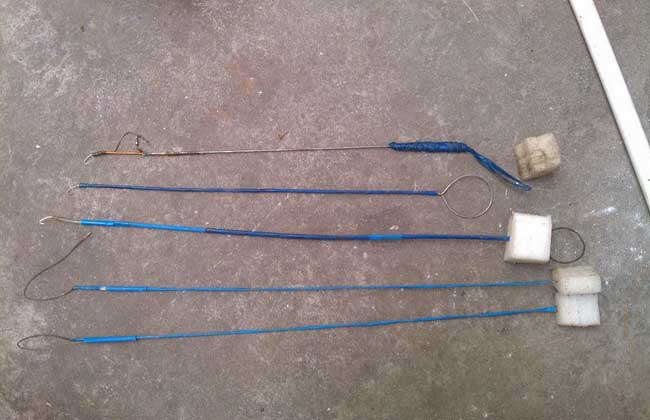
The tackle for catching eels in burrows must be made by yourself. Use a short bamboo pole 50 cm long and sharpen the handle end (to insert into the soil beside the burrow). Use an old bicycle spoke, grind one end sharp and bend it into a No. 3 long-shank hook, and bend the other end into a ring. Then use 2 m of No. 3 strong nylon line, tie one end to the tip of the short bamboo pole and the other end to the ring of the spoke. You can make 10 to 20 sets of this kind of tackle.
Where to catch rice field eels
Eels are afraid of chemical fertilizers and pesticides, so in plain areas it is very hard to find traces of eels in fields, reservoirs, and ponds. They can only be found in mountain ponds in valleys and muddy fields at the foot of mountains. Because the pond water is formed by water seeping in from the mountain ridges and groundwater springs gathering together, the water quality is clear, making it a good place for eels to hide, reproduce, and grow. Eel burrows are generally 10 to 20 cm from the water surface at the bank, round in shape, either upright or slanted, and damp or watery inside. The soil around the entrance is smooth in color and has a fishy smell. You can see the traces of eels going in and out. From the size of the entrance, you can tell the size of the eel. When fishing, as long as you find a fresh eel burrow, you can catch one with near certainty.
Methods for catching rice field eels
1. Multi-hook method: The angler inserts the short bamboo pole into the soil at the mouth of the burrow, and puts the line, hook, and bait into the burrow. This fishing method is suitable for choosing large mountain ponds or muddy fields at the foot of mountains where there are many burrows hiding eels, because only one set of tackle can be used per burrow. With many burrows, more than 10 sets of tackle can all be put to use. The angler puts the hook and bait into one burrow after another, then after inserting the rods, can walk back and forth, lifting the lines and hooks one by one by hand as he goes. As soon as he finds that an eel in a burrow has swallowed the hook deeply, he can lift the rod.
2. Single-hook method: The angler holds the long-shank spoke hook in his hand, attaches an earthworm or maggot bait, and inserts it directly into a burrow hiding an eel. The movements must be gentle, slowly jiggling up and down to lure the eel into biting the hook. Generally speaking, eels are greedy feeders; as soon as they smell the fishy scent, they will raise their heads and bite the hook and bait in one bite and drag it downward. At this time the angler will feel it in his hand, and should immediately push the long-shank hook forward, twist the angle of the hook, firmly hook the eel, and lift it out of the burrow to capture it.
3. Baiting the hook: There is also a trick to baiting the hook when catching rice field eels. Thread the whole earthworm onto the long-shank hook; be sure not to expose the hook point or leave a section of earthworm outside the hook. Otherwise the eel will only eat the earthworm without taking the hook, making it hard to catch. Rice field eels rely on smell to feed. After the angler inserts the long-shank hook with bait into the burrow, he must pull it up and down, about one minute each time, to lure the eel into biting. When he feels the eel has taken the hook, he must not lift the rod with force. Because the long-shank spoke hook has no elasticity, if too much force is used, the eel can easily slip off the hook and escape.
Note: The eel's body is slippery with mucus. After it is hooked, it is best to wear gloves and use the index and middle fingers to grab the eel by the neck, then remove the hook and put it in the basket. Moreover, because rice field eels live alone, after catching one in a burrow, no more eels will bite there, so you must move to another burrow with an eel, and seal the burrow where an eel was caught with soil, so as to avoid dropping a hook into this empty burrow next time.