What are the characteristics of the rice field eel's living habits?
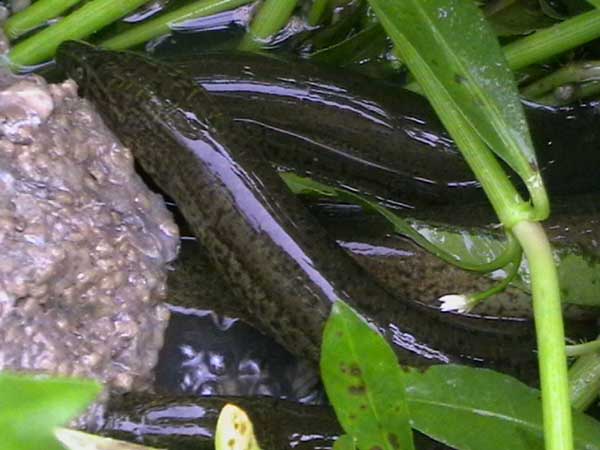
The rice field eel is a fish of tropical and warm temperate zones and a bottom-dwelling fish with strong adaptability, able to survive in rivers, lakes, ditches and rice paddies. During the day it likes to burrow into mud rich in decaying organic matter or to live in holes in water-filled crevices along embankments. It is rarely active by day and comes out of its hole at night to feed. Its gills are underdeveloped, and it uses the inner lining of the mouth cavity and throat cavity as an auxiliary respiratory organ, allowing it to breathe air directly; it can also survive when the oxygen content in the water is extremely low. After leaving the water, as long as its skin stays moist, it will not die for several days. The rice field eel is an omnivorous fish that feeds on various small animals; it is greedy by nature, feeds most actively in summer, and in cold seasons can go without food for a long time without dying. The rice field eel is generally active in spring, summer and autumn. It likes to inhabit mud holes and stone crevices by ponds, small rivers and the edges of rice paddy ridges. In winter it retreats deep into its hole to hibernate. In spring, after lying dormant through the winter, the rice field eel has used up too much energy and needs to eat heavily, so spring is a great time to fish for rice field eels. In summer, when the weather is hot, rice field eels come out of their holes one after another and burrow among aquatic plants, stone crevices and under dead trees to “cool off”, and they are also easy to catch. In autumn, the rice field eel begins to enter its hole and is not easy to hook.
The breeding season of the rice field eel is about May to August. In its individual development it has the characteristic of sex reversal, that is, from the embryonic stage until its first sexual maturity it is female (that is, the gonads of individuals with a body length under 35 cm are all ovaries); after spawning, the ovaries gradually become testes; at a body length of 36 to 48 cm, partial sex reversal occurs, with male and female individuals being almost equal in number, making it a hermaphroditic animal; those growing to more than 53 cm are mostly testes. Young fish of the year can only grow to 20 cm, and female fish of 2 winters of age reach maturity, with a body length of at least 34 cm. The largest individual can reach 70 cm and weigh 1.5 kg. In May 2013, someone in Huzhou caught a rice field eel 3.6 jin in weight and 1.5 m long. The rice field eel lays its eggs near the entrance of its burrow; before spawning it spits out foam from its mouth to pile up into a nest, and the fertilized eggs develop on the water surface within the foam, relying on the buoyancy of the foam; both male and female fish have the habit of guarding the nest.
The body of the rice field eel is cylindrical, suited to a burrowing life and very helpful for entering and leaving its hole and reducing friction. It really has a bit of a “hermit” air about it: it has no special attacking skills and no powerful defensive weapons, and its only skill is “of the thirty-six stratagems, running away is the best”. It has neither pectoral fins nor pelvic fins, and even the dorsal fin and anal fin are so degenerated that only a tiny skin fold remains, while the scales have disappeared to the point that they are hard to see with the naked eye; however, its whole body can secrete extremely slippery mucus, and with one careless moment it can slip away from your hands. The main functions of the mucus on the rice field eel's body are: preventing bacteria and pathogens from invading the body and reducing disease; blocking the entanglement of parasitic animals and plants, which is beneficial to growth; and making its surface smooth and slick, which helps it move through mud without obstruction.
When the rice field eel embryo develops to its first sexual maturity it is female, but from the beginning of its second sexual maturity it becomes male again. That is to say, the rice field eel is both mother and father in its lifetime. This process of yin-yang transformation is called sex reversal in biology. Fish mostly breathe with gills, but the rice field eel is unique: its gills have degenerated, and it absorbs air directly through fine blood vessels on the surface of its throat, so if we want to keep rice field eels alive and fresh, we must keep them moist and store them in a cool place.
When a pregnant rice field eel faces the threat of death such as being steamed or boiled, it will instinctively arch up its belly, making a final effort to protect its children!