What scientific methods are there for raising yellow eels in an idle pond?
A farmer has asked for advice: he has a clear-water hill pond with a water surface of about 2 mu, and now wants to use it to raise yellow eels. Since he has never raised yellow eels before, he does not know how difficult it is to raise them, nor what preparatory work should be done. Also, roughly how much is the initial cost input? Is the risk great? Where can good eel fry be supplied?
According to consultations with experts and technical reference materials, yellow eels have strong environmental adaptability, and some abandoned water bodies unsuitable for raising other fish, as well as water pits and ponds unsuitable for growing crops, can all be used as yellow eel ponds. So artificial yellow eel farming is not very difficult, and on the premise of doing a good job in disease prevention and escape prevention measures, the farming risk is not very great either.
For a hill pond, first of all, it must be ensured that it does not leak, to prevent the yellow eels from escaping, and the water inlet, drainage outlet, and overflow outlet must also be built for changing water and draining water. Each water outlet must also be fitted with fish-blocking facilities to prevent the eels from escaping when the pond water rises in heavy rain. To help the yellow eels grow, the natural environment can also be artificially imitated for the yellow eels to inhabit, such as placing stones, tree roots, etc. in the pond, and aquatic plants such as water hyacinth and arrowhead can also be planted in the pond to improve water quality.
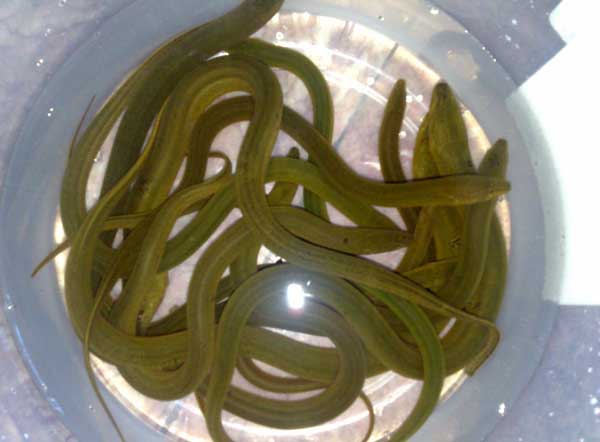
The eel fry selected for stocking must be free of injury and disease, robust, and smooth on the body surface; body colors of golden yellow and light yellow are best, while those with too dark a color do not grow very fast. Generally, eel fry of about 30 per kilogram are selected. The stocked eel fry must be neat in size and uniform. The suitable stocking density is about 100 eel fry of 25 grams each per square meter (about 66,700 per 1 mu of water surface). Before the eel fry enter the pond, they must be disinfected with 3% salt water; this is a relatively simple method. In addition, stocking eel fry in early spring gives better results, helping the yellow eels start feeding earlier and extending the growth period.
The yellow eel is a carnivorous-based omnivorous fish with a wide range of feed sources, such as small fish and shrimp, earthworms, animal offal and scraps, tadpoles, silkworm pupae, snail meat, rice, melon rind, vegetable scraps, and so on. The daily feed amount is about 6% of the yellow eels' weight, and it is best if a little remains after feeding, and leftover food must be cleaned up in time. Generally, feed twice a day: at 9 a.m. first feed one third of the daily food amount, and at 6 p.m. feed the remaining two thirds of the daily food amount. Feeding must not be sometimes more and sometimes less, or sometimes given and sometimes stopped, otherwise it will affect the growth of the yellow eels.
The pond water quality must be adjusted well, and good work must be done in heat protection and overwintering for the yellow eels. The suitable water depth of a yellow eel pond is between 15-25 cm, and in high-temperature seasons the pond water can be deepened further. When the weather changes suddenly (rain turning to clear or clear turning to rain) and when the weather is muggy and hot, new water must be injected in time to prevent the yellow eels from frequently floating to the surface due to lack of oxygen. The suitable water temperature for yellow eel growth is between 15°C-28°C. In summer, some shade crops can be planted around the yellow eel pond, and the pond water should be changed frequently, with well water or spring water, etc. injected in time (the water temperature must not differ too much). When the water temperature is below 10°C, the yellow eels are in a dormant state. So when the air temperature drops to around 15°C, high-quality feed should be given to the yellow eels. When the yellow eels overwinter, care must be taken to keep the pond mud moist and warm, to prevent the yellow eels from frostbite and freezing to death. In addition, attention must also be paid to preventing harm from rats and the like.
According to actual conditions, grouped cage farming can also be considered; the stocked yellow eel fry are best at 20-30 grams per fish, stocked all at once in sufficient quantity, at 3-5 kg per square meter. At present, the market price of eel fry is around 24 yuan per kilogram, and one can also purchase wild eel fry oneself. Yellow eels in natural waters generally do not suffer from disease.