What to Do When Rice Field Eel Egg Production Is Low? Effective Methods to Increase Egg Production
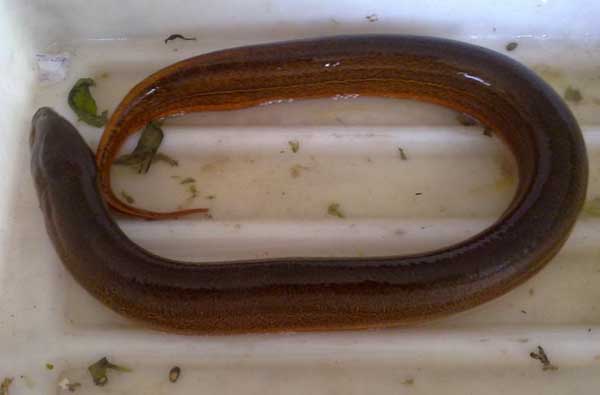
To achieve good returns from raising rice field eels, you must raise your own breeding eels. The breeding technology for rice field eels is quite difficult, and in practice the author has worked out several key measures for increasing rice field eel egg production.
Create a Good Environment
Plant aquatic plants in the rice field eel pond, such as rice, water hyacinth, alligator weed, etc., and place some stones and bricks on the bottom of the pond to simulate the natural ecological environment and help the parent rice field eels spawn.
Adjust Water Quality and Water Level
The water in the parent rice field eel breeding pond must be non-toxic river water, lake water or groundwater, with a pH value between 6.2 and 7.8 and a water depth of 20 cm to 30 cm. New ponds must undergo dealkalization treatment.
Stocking Density Must Be Appropriate
The individual parent rice field eels should be of moderate size. It is best to choose rice field eels of 100 g to 150 g as spawning parents, with a female-to-male ratio of 1:3 to 4, and a stocking density of about 10 per sq m.
Feed Must Be Provided Reasonably
The breeding season for parent rice field eels is from April to September. Feed them with feed high in protein, such as fish paste, earthworms, etc., while also supplementing with complete compound feed for parent rice field eels. After sexually mature parent rice field eels are fed high-protein feed, they generally spawn within 5 to 7 days. The eggs are laid beside grass or stones. As long as there is white foam, it is the spawning nest of the parent rice field eels.
Master the Water Temperature Well
During the spawning season, patrol the pond every morning. If spawning nests with white foam are found, they should be gently moved into the hatching pond and incubated with slight flowing water. After the fertilized eggs absorb water, they expand to about 4 mm. The hatching time varies with the water temperature, generally 1 to 7 days. At a water temperature of 25 degrees C, hatching can be fully completed in 6 days. After the fry hatch, at a water temperature of 28 degrees C, after about 10 days, the body length reaches 26 mm and the yolk sac has not yet completely disappeared; after another 7 to 10 days, the yolk sac will be completely absorbed, and they begin to feed on plankton in the water. A small amount of small aquatic earthworms can be appropriately fed. After about 35 days, the young eels grow to 5 cm to 6 cm and can be placed in rearing ponds for raising. They must be stocked separately by size.
Feed at Fixed Times and in Fixed Amounts
Whether they are parent rice field eels used for spawning or newly hatched fry, they must be fed at fixed times and in fixed amounts. Spawning eels are fed 2 times a day, once at around 8 a.m. and once at around 6 p.m., with each feeding amount being 2% to 3% of the total body weight of the parent rice field eels. Fry are fed once a day from 5 p.m. to 7 p.m.