What food does the rice field eel like to eat most? The answer is here
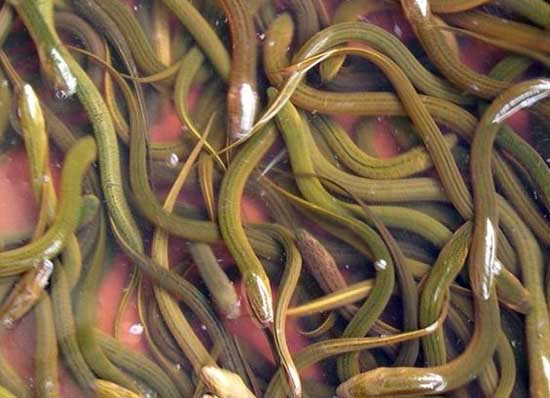
The order of foods that the rice field eel is sensitive to and likes to eat most is: earthworms, river mussel meat, snail meat, fly maggots, fresh fish meat, etc. The rice field eel is an omnivorous fish that mainly feeds on animal-based feed, and its food composition differs somewhat at different growth stages.
Fry eels eat egg yolk, tubifex worms and earthworms.
Young eels eat tubifex worms, earthworms, rotifers, cladocerans and mosquito larvae.
Adult eels mainly feed on earthworms, small miscellaneous fish, snail meat, mussel meat, small shrimp, tadpoles, small frogs and insects, etc.
Now that we have seen what the rice field eel likes to eat most, in rice field eel farming, in order to solve the problem of feed sources and increase weight gain, young eels and adult eels should be domesticated as early as possible to be fed artificial compound feed. Let us now look at the preparation and use of rice field eel feed.
Preparation of artificial compound feed for rice field eels
1. Selection of feed ingredients
The selection of ingredients should follow the principles of good quality at low price, stable supply and convenient transportation. Where conditions permit, the more kinds of ingredients, the better, so as to maximize the satisfaction of the rice field eel's needs for various essential amino acids. Specifically, when choosing feed ingredients, you can adapt to local conditions; for example, near a slaughterhouse, you can mainly use animal offal and add an appropriate amount of feed.
When raising rice field eels in cages, you can use abundant and cheap small miscellaneous fish and mussel meat as the main ingredients, plus an appropriate amount of feed to feed the rice field eels. We can also make full use of the idle winter time and idle winter land to plant some ingredient crops, such as wheat and rapeseed, to supplement the shortage of ingredients for the coming year and further reduce feed costs.
2. Reasonable design of feed formula
When designing the formula, the relationship between feed nutrition and bulk density must be considered, so as to ensure that the rice field eel can take in sufficient nutrition while also getting enough to eat.
Animal-based feed generally accounts for 50%-70% of the rice field eel's daily ration. Although ingredients such as rapeseed meal are cheap and relatively high in protein, they contain anti-nutritional factors such as glucosinolates, and excessive use will affect the growth of the rice field eel. Therefore, its dosage should preferably not exceed 10%.
Here, we introduce a self-prepared feed formula: 65% fresh livestock and poultry scraps, 20% wheat bran, 10% rapeseed meal, 3% yeast, 1% salt, and 1% additives.
3. Processing of rice field eel feed
Using mainly livestock and poultry scraps to make self-prepared compound feed, we introduce the process flow for producing self-prepared feed: the process flow for producing self-prepared feed generally includes crushing, mixing and pelletizing.
Crushing can increase the contact area between the feed and animal digestive enzymes, improve the digestion and absorption of dry matter, nitrogen and energy, and reduce the feed conversion ratio. The method is: wash fresh meat and livestock and poultry scraps, cut them into small pieces, and crush them with an electric meat grinder with 3-4 mm die holes. During crushing, add a small amount of garlic, which can help prevent and control diseases.
Next is mixing, which is to fully mix and stir the crushed fresh meat, livestock and poultry scraps, various additives, meal and wheat bran. We should note that in relatively humid weather, the ingredients themselves have a high water content, so when pelletizing, the amount of water added can be appropriately reduced; in relatively dry weather, more water can be added appropriately. The general principle is: after adding water, the mixed material forms a ball when squeezed in the hand and falls apart when released.
Finally, use an electric pelletizer to form pellets. Here, we should also remind farmers that self-prepared feed has a short storage time and is best prepared and used on the spot.
Use of rice field eel feed
In the process of rice field eel farming, feeding should adhere to the "four fixed" principles of fixed time, fixed quantity, fixed quality and fixed location.
1. "Fixed time" means that, based on the rice field eel's habit of hiding by day and coming out at night, feed once each day at 10 a.m. and 6 p.m., with feeding in the afternoon as the main one.
2. "Fixed quantity" means determining the daily feeding amount according to the relationship between the rice field eel's feeding intensity and water temperature. Generally speaking, when the water temperature is around 15°C, start feeding, and the daily feeding amount accounts for about 3% of the body weight of young eels; when the water temperature is 15-20°C, the daily feeding amount can increase to 6%-10% of body weight; when the water temperature is 20-28°C, the daily feeding amount accounts for 10%-20% of the rice field eel's body weight; when the temperature reaches above 30°C, feed less or do not feed. After feeding, the breeder should check promptly 1 hour later. If the feed has been eaten up, it means the feed amount is insufficient and should be appropriately increased; if it has not been eaten up after 1 hour, it means the feed is excessive and should be appropriately reduced.
3. "Fixed quality" means that, based on the rice field eel's habit of liking fresh bait and disliking spoiled food, it is necessary to ensure that the feed given is definitely fresh and not spoiled.
4. "Fixed location" refers to feeding at a fixed place. This can help the rice field eel develop the habit of concentrated feeding, and also makes it convenient for farmers to observe the rice field eel's feeding situation and adjust the bait feeding amount in time.
Practice has proved that using compound feed to feed rice field eels can not only save feed costs, but also speed up the growth rate of rice field eels and significantly improve farmers' economic benefits. Friends in the audience, you might as well give it a try.