How to tell male from female in rice field eels? Accurate methods for distinguishing female and male
Appearance
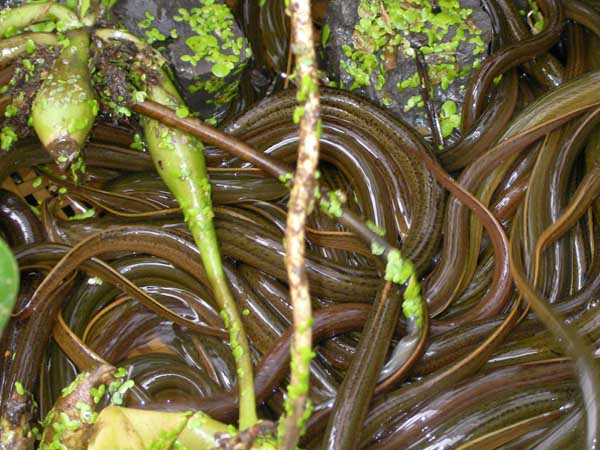
The female has a small, non-protruding head, and the back is greenish-brown without speckled markings; sometimes 3 parallel brown pigment stripes can be seen, and the color on both sides of the body gradually becomes lighter from top to bottom, with fine brown spots that are evenly distributed; the belly is light yellow or pale bluish-green, and the abdominal muscles are relatively thin. The male has a larger head than the female, slightly protruding. The back generally has 3 parallel band-like stripes formed by brown spots, and along the midline on each side of the body one row of pigment bands is visible, while the other pigment spots are evenly distributed; the belly is earthy yellow, and in large individuals it is orange-red, and when the belly faces upward, the swelling is not obvious.
Growth cycle
The rice field eel undergoes sex reversal; the young fry are all female at first, and after spawning they become male; when the body length reaches 24 cm, sex reversal begins, and they are hermaphroditic.
Characteristics during the breeding season
The female eel's belly is semi-transparent pink, the eggs inside the belly are visible and swollen, and the genital pore is red and swollen, enlarged, and slightly transparent; the male eel's belly has a network of blood threads distributed over it, with no protruding feel, and the genital pore is red and swollen, slightly protruding.
Individual differences
Individuals of the rice field eel with a total length below 24 cm are all female; among individuals of 24-30 cm, 30-36 cm, and 36-42 cm, males account for 5.2%, 41.3%, and 90.7% respectively; individuals with a total length above 50 cm are all male.
Age
Due to abundant nutrient supply and differences in variety, farmed rice field eels may reach unusual body lengths, so age should be used as the basic criterion for judgment: generally, those within two years of age are all female eels, and those over 3 years of age are generally all male eels.