How should you choose the size and material of yellow eel (Monopterus albus) breeding cages?
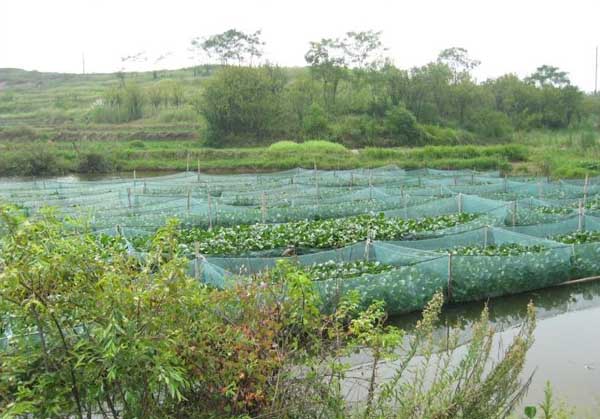
I have been engaged in yellow eel farming for nearly ten years, and I have some insights into the differences in cage size and materials used in yellow eel cage culture. I am writing them here to discuss with everyone.
In 2003, I learned to raise maggots and also raised more than a dozen yellow eel cages. At that time, most farmers in our area used 6 sq m cages, and I also used 6 sq m ones. At that time, most netting was knotless netting, and it was relatively cheap; almost everyone used 6 sq m cages made of knotless netting. Some people also used 8 sq m cages, and 10 sq m cages could even be seen in breeding ponds. In 2006, Kabu netting began to become popular. Compared with knotless netting, cages made from this netting had neat four corners and flat netting panels, and when hung in ponds they were neatly arranged and looked very nice. After using them for a few years, I found that cages made from this netting could still be easily repaired with a thin rope tied around the hole even if a rat bit a hole in them, and then could continue to be used. There was one relatively big disadvantage: this netting is also called seven-strand cloth netting. If during the breeding process the water quality in the cage is poor, or the yellow eels are not given deworming medicine orally in time, then the yellow eels will feel uncomfortable in the cage and will drill some holes the size of cigarette butts in the bottom of this kind of cage, and those small yellow eel fry will mostly all escape. Some cages can even be drilled with a whole row of nearly ten small holes.
In 2010, as the profit from yellow eel farming gradually increased, the farming scale also became larger and larger, there were more and more farmers, and seedlings became more and more expensive, so everyone's requirements for breeding cages also became higher and higher. At this time a kind of netting appeared, called knotted netting. This netting is a type of knotted net, and it is a dead knot, so no matter whether the yellow eels are raised well or not, this netting will not be drilled through by yellow eels, and the yellow eels will not escape. But this kind of netting is too expensive; a 6 sq m cage costs about 43 yuan.
In recent years, with the maturity of farming technology, cage materials have gradually reached the optimal standard. Previously a 6 sq m knotted cage weighed more than 3 jin and sold for 43 yuan; now the drawn wire is a bit thinner, and after being made it is about 2 jin 7 liang, and it is no problem to use it for more than 5 years. But the selling price has dropped to about 36 yuan.
Now about size. Since 2010 I have started using 4 sq m cages, and I always feel that 4 sq m cages are easier to handle. For example, when cleaning the cage, make a small net bag, with the rim made of steel wire into a circle 40-50 cm in size; use one hand to push aside the aquatic plants in the cage, and with the other hand use this small net bag to scoop out all the debris at the bottom of the cage in one go.
There are many farmers around me, and they have both 6 sq m cages and 4 sq m cages. When harvesting yellow eels, 4 sq m cages are much easier than 6 sq m cages. The farmers around us all harvest yellow eels by exchanging labor. Everyone is willing to harvest 4 sq m cages.
In terms of yield, taking 2012 as an example, a 6 sq m cage stocked with 20 jin of seedlings generally yields about 65 jin, while those using 4 sq m cages stock 13 jin of seedlings and generally yield about 46 jin. I always feel that the yield of 4 sq m cages is slightly higher.