What are the key techniques for farming loaches on rural rooftops?
Construction of loach farming ponds
The rooftop on which the loach farming pond is built is a reinforced concrete floor slab, with waterproofing treatment applied on top. The pond walls are "24 cm thick on the outside and 12 cm thick on the inside", with a height of 0.7 m to 1.0 m. The mortar ratio used in construction should be above 1:2.5, and 8 mm iron wire is added as reinforcement every 4 to 6 bricks in thickness. At the four corners of the rooftop, 2 to 3 vertical iron wires are installed, forming a warp-and-weft distribution with the horizontal iron wires. The loach farming pond is sized according to the rooftop area, with the four corners rounded off, and reserved drainage channels and insertion holes for support poles for protective shading materials. The loach farming pond should be consistent with the building foundation to avoid displacement that would reduce the safety factor for use.
The supporting facilities of the loach farming pond include three aspects: First, the water inlet and drainage system. Because unexposed underground well water and tap water are not suitable for direct use, a reservoir or large iron tank with a drop and a height of 1.5 m to 2 m should be set up beside the loach farming pond on the main house, so that the water source can mix and buffer before flowing into the loach farming pond by itself. The main house pond is the fry and first-stage grow-out pond, and the side house pond is the second-stage grow-out pond. Since the main house is higher than the side house, the first-stage pond flows by gravity into the second-stage pond, and after multiple uses it is discharged into the pigsty or the water channel outside the house. Second, protective netting. Protective netting is set up 40 cm to 50 cm above the pond surface to prevent direct sunlight and damage by rats and birds. Third, a simple temperature shed. According to the characteristic that the suitable growth temperature for loaches is 20°C to 30°C, in low-temperature seasons, an easily removable or roll-up simple temperature shed is built to keep the temperature inside above 20°C, so as to ensure normal growth of the loaches and shorten their market period.
Stocking fry and grow-out
1. Sources of fry
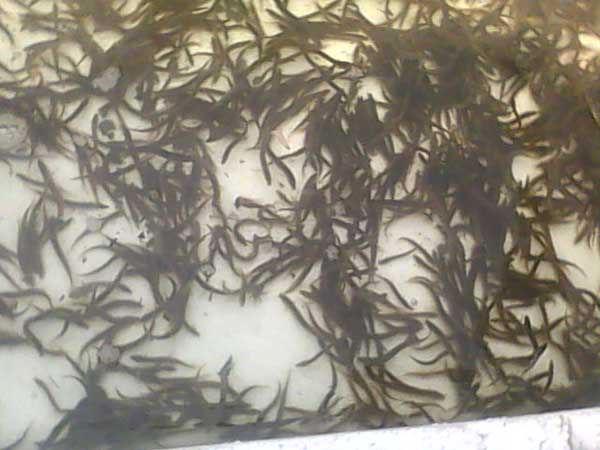
There are two channels for fry sources: one is collecting wild natural fry. In shallow waters such as wild ponds and ditches where loaches like to inhabit with relatively deep bottom mud and rich humus, choose in the evening to catch wild fry using bamboo cages baited with roasted soybean cake, animal offal, and the like. The captured wild fry should be screened to remove the weak and keep the strong before use. The second is semi-artificial breeding. During the breeding season, from the captured wild broodfish, according to a female-to-male ratio of 1:2 to 3, select individuals with regular body shape, normal color, no disease or injury, fully 2 years old, and body weight above 30 g, keep them temporarily for several days, and place them in a spawning pond to spawn naturally. The spawning pond should be disinfected first, then covered with 15 cm to 20 cm of fertile mud, fertilized with organic fertilizer to enrich the water, and the water temperature controlled above 18°C. For the obtained egg masses, tie them into bundles with willow roots, palm fiber, polyethylene fiber thread, and the like, disinfect them, and hang them evenly in the pond water. After spawning, move the egg masses into a hatching pond for hatching, obtaining seedlings in batches and stages. During hatching, keep the water still or slightly aerated. After the fry hatch out of the membrane, quickly remove the egg masses and begin feeding and rearing. Suitable baits include egg yolk, fish meal, small algae, rotifers, silkworm pupa powder, soybean milk, and the like. When the seedlings grow to 1 cm, divide them into ponds, and when they reach 3 cm, put them into large ponds for grow-out.
2. Stocking of fry
The stocking time depends on the source of the fry. Wild fry are stocked from late April to mid-May, and semi-artificial fry 15 to 30 days earlier. The stocking density is 2000 to 4000 fry per sq m for those within 1 cm in body length; 300 to 500 fry per sq m for those within 3 cm; and 50 to 85 fry per sq m for those above 3 cm. Before stocking, old ponds are disinfected with disinfectant, and new ponds are first soaked and then disinfected. The pond bottom is covered with 20 cm to 40 cm of fertile mud or fine sand, water is filled to 30 cm to 50 cm, and sufficient base fertilizer is applied to breed basic biological bait. The pond water transparency is kept between 15 cm and 25 cm. At this point, the loach fry are screened and disinfected, and stocked into the ponds for grow-out according to the stocking requirements for different sizes.
Feeding management
Loaches have omnivorous feeding habits and no strict requirements for food. In the early stage of farming, the main focus is on fertilizing the water and breeding plankton bait, supplemented with an appropriate amount of egg yolk, earthworms, silkworm pupae, soybean milk, and the like. Different baits are slightly processed depending on the degree to which the loach fry have opened their mouths, and the daily feeding amount is controlled at 2% to 5% of the fish body weight. In the middle and late stages of farming, mainly artificial baits such as rice bran, fish meal, livestock and poultry offal, wheat bran, and soybean residue are fed. During this period, because the water temperature rises, the loaches enter a peak growth period, and the daily feeding amount needs to be increased to 5% to 10% of the fish body weight. Because the loach farming pond is built on the rooftop, with open air above and a house below, the pond water temperature varies greatly, and sudden cold and heat can easily cause management to get out of control, resulting in imbalanced growth of the loaches. Therefore, in the early stage of farming and during overwintering management, a simple temperature shed is used as a supplement, and when a cold wave lowers the temperature, soil heating or a coal stove is used for artificial temperature control. The middle stage of farming is in the peak summer season, so shade sheds should be built, the frequency of water changes increased, and the water temperature kept relatively stable. Attention should be paid to preventing snakes, rats, and birds to avoid harm.
Disease prevention and control
Common diseases include red fin disease, saprolegniasis, gas bubble disease, and parasitic diseases, among others. Their causes and treatment methods are as follows: red fin disease is mostly caused by fish body injury, deterioration of the water body, and infection by pathogenic bacteria, and it is quite harmful to loaches and has a relatively high incidence rate. Soak with 10 ppm tetracycline for 24 hours or splash diseased fish with 1 ppm available chlorine; in severe cases, add 1% to 2% antibiotic medicated bait, and the effect is quite good.