Detailed Explanation of Key Points in Loach Fry Rearing Technology
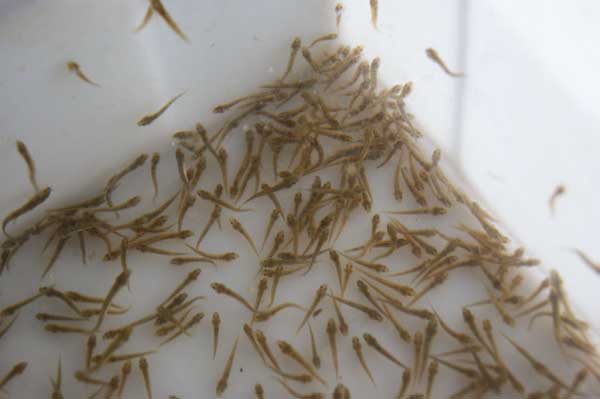
Three days after the loach fry break through the membrane, the yolk is fully absorbed, and they can swim freely and feed; at this point they can be moved into fry ponds for rearing.
The stocking densities for loach are as follows: 1200-1500 fry per sq m in slight-flow water ponds, and 750-1050 fry per sq m in still-water ponds; the fry in the same pond must be of uniform size.
During the rearing period, still-water ponds can be fertilized only without feeding; the water level should be kept at 50-80 cm, and urea should be applied every other day at 1.8-2.2 grams per sq m each time, for 3-4 consecutive applications, then paused for a few days.
When the fry grow to about 4 cm, they should be divided into separate ponds promptly to reduce density.
Before dividing, it is best to first seine and exercise them 2-3 times. Handle them carefully when catching; place fingerlings of the same size in the same pond, and after dividing, a density of 45-75 per sq m is sufficient.
After another 3 months of rearing, when the fingerlings reach a body length of 10 cm and a body weight of about 10 grams, they can be divided into ponds for grow-out culture.