The flying saucer gourd, also known as disc gourd, dish-shaped gourd, toothed-edge gourd, and flat-round zucchini, is both ornamental and edible.
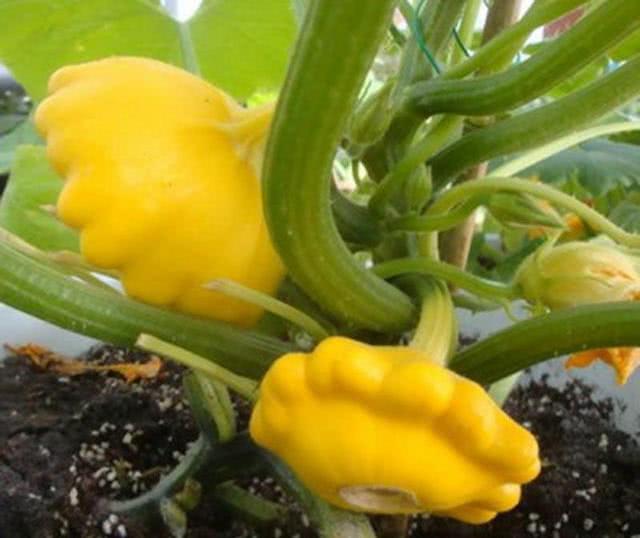
Flying saucer gourd (garden plant)
The flying saucer gourd, also known as disc gourd, dish-shaped gourd, toothed-edge gourd, and flat-round zucchini, is a variety of Cucurbita pepo in the Cucurbitaceae family. Its fruit is both ornamental and edible, making it a rare dual-purpose garden plant. The history of cultivating flying saucer gourd in our country is very short. It was first introduced and cultivated as a specialty vegetable from Russia, Korea, the United States and other places successively in the 1990s.
Morphological characteristics
The flying saucer gourd has a well-developed root system. The stem is shortened, trailing, semi-trailing or dwarf. The true leaves are nearly pentagonal and palmately shaped, shallowly to deeply lobed, alternate, green. It is monoecious with separate male and female flowers. Generally, female flowers are solitary, and male flowers are clustered. The flowers are yellow, axillary, with a flower diameter of about 10-12 cm.
The pepo comes in three basic colors: white, yellow and green. The fruit margin has ridged teeth, and it is flat-round, dish-shaped or bell-shaped, so Russians call it disc gourd, dish-shaped gourd, and toothed-edge gourd. Because the fruit shape is beautiful and resembles a flying saucer, it was named flying saucer gourd. The flying saucer gourd is an insect-pollinated plant, mainly grown for its fruit.
Distribution range
Central and South America
Cultivation techniques
Cultivation points
The flying saucer gourd prefers a warm environment.
The suitable growing temperature is 13°C-28°C. If the temperature is too high, the fruit is prone to aborting. If the temperature is below 10°C, growth stalls and the fruit does not swell. It likes light, but can tolerate a certain degree of weak light. Therefore, it is suitable for both open-field cultivation and protected cultivation.
It likes moisture and is not drought-tolerant. Because the leaves are large and transpiration is strong, special attention must be paid to water management during cultivation. The air humidity should be maintained at 70%-80%. If the humidity is too high, powdery mildew is likely to occur. It likes fertilizer. Cultivation in sandy loam or loam is preferable. The suitable soil pH is 6.5-7.0.
Raising seedlings
Use paper tubes or nutrient pots to raise seedlings. Select plump seeds free from pest and disease damage and soak them at 28°C-30°C for 8-10 hours, then germinate them at 25°C-28°C. During germination, keep the germination bag moist and change the water 1-2 times a day. When more than 50% of the seeds have sprouted, sow them in a pre-prepared sowing tray. The bottom layer must be at least 5 cm thick.
Water thoroughly. Cover with pesticide-treated soil to a thickness of 1 cm, then cover with plastic film or a small arched shed to keep warm and moist. It is best to keep the soil temperature above 25°C, as this helps the seedlings emerge. After the seedlings emerge, remove the covering and lower the temperature appropriately to prevent leggy growth. After the cotyledons have flattened out, transplant the seedlings into seedling pots (10×10 cm).
During the seedling stage, maintain sufficient light, keeping the light period at about 10 hours per day, which is beneficial for female flower differentiation. Use variable temperature management. That is, on sunny days keep it at 23°C-28°C during the day and lower it to 12°C-15°C at night; on cloudy days keep it at 20°C-25°C during the day and lower it to 10°C-12°C at night, with a day-night temperature difference of 10°C-15°C. Harden the seedlings 5-7 days before planting.
Land preparation and planting
After the frost period, plant when the minimum temperature steadily exceeds 10°C. Use bed planting or ridge planting. For bed planting, the bed spacing is 40-50 cm, the bed width is 120 cm, and the plant spacing is 80-100 cm, with 2 rows per bed; for ridge planting, the ridge spacing is 70 cm and the plant spacing is 100 cm. The plant and row spacing can be determined specifically according to the characteristics of the variety. Prepare the land before planting, applying 4000-5000 kg of decomposed organic fertilizer, 30 kg of diammonium phosphate, and 50-100 kg of superphosphate per mu.
Field management
After planting and seedling recovery, water once together with topdressing to promote vine growth, and increase the water supply during the flowering and fruiting period. During the period of continuous strong light and high temperature in midsummer, water twice a day if necessary. During the growth period, apply topdressing 3 times: after seedling recovery, at full flowering stage, and at full fruiting stage. Avoid weed overgrowth. Before flowering, hoe and loosen the soil 2-3 times and cultivate and weed to promote root development. Tie the vines in time and remove old and diseased leaves. Artificial pollination can be carried out from 6-9 a.m. to help fruit set. At the same time, pay attention to pest and disease control. A 2000-3000 times solution of 20% fenvalerate emulsifiable concentrate can be sprayed on the leaves to control aphids, a 2000 times solution of 25% buprofezin wettable powder can be used to control whitefly, and a 2000-2500 times solution of 25% triadimefon wettable powder can be used to control powdery mildew.
Pot cultivation
Raising seedlings: For pot cultivation, plant when the plant has unfolded 1-2 true leaves.
Planting: The planting pot should have a top diameter of 40-50 cm. Fill it with nutrient soil. The nutrient soil formula is: field soil: decomposed livestock and poultry manure: sawdust (or decomposed horse manure) = 7:2:1. Plant 1 flying saucer gourd per pot, and set up 1 support stake 1 m high and 2-3 cm thick. Water thoroughly after planting. Keep the soil moist during the growth period. Because the flying saucer gourd is a light-loving plant, the pot should be placed in a well-ventilated place with sufficient light.
Management: For dwarf types, keep 2-3 fruits per plant, and for trailing types, keep 3-5 fruits per plant. Keep the soil moist. Tie the vines once each time the plant grows 20 cm. During the growth period, mainly prevent aphids and powdery mildew. Pick the fruit after it is fully ripe.
Main value
The flying saucer gourd not only has high ornamental value, but also has high edible value and medical and health care value. Its young fruits, young flowers, young shoots, leaf stalks and seeds are all edible. According to measurements, the flying saucer gourd is rich in vitamin C, B1, B2, carotene, nicotinic acid and various mineral elements such as potassium, calcium, phosphorus and iron. It can be eaten cold-dressed or stir-fried.
Eating flying saucer gourd helps bile secretion and the reduction of glycogen (liver starch) in the liver. Therefore, it is beneficial for treating obesity, atherosclerosis, liver and kidney diseases, and regulating microcirculation. The fruit is rich in pectin, which can protect the gastric mucosa and intestinal tract from harm or promote the healing of ulcer wounds. The seeds also contain components that can be used as an anthelmintic. In addition, the flying saucer gourd is also a very good honey source plant.
Treating obesity, atherosclerosis, liver and kidney diseases, regulating microcirculation.