Detailed Explanation of Key Technical Points and Management Methods for Crystal Shrimp Breeding
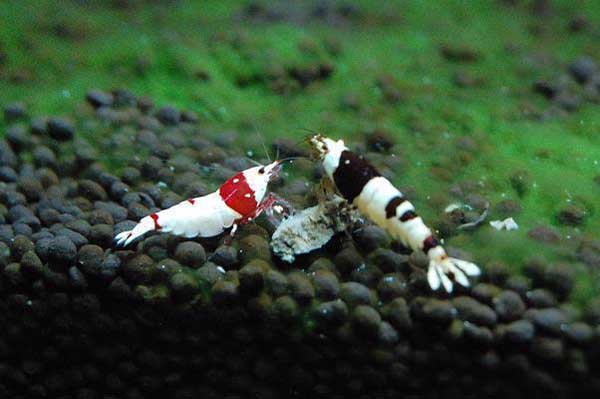
Crystal shrimp are a new species developed through genetic improvement of bee shrimp, and because of their red-and-white or black-and-white body coloration, they have become an aquatic organism with extremely high ornamental value. At present, the genes of crystal shrimp are already very stable, so red crystal shrimp give birth to red offspring, and black crystal shrimp give birth to black offspring. Crystal shrimp have a lifespan of about 18 months, and it takes about 4 months for young shrimp to become adults. A mature female shrimp carries about 20 to 30 eggs at a time (a large female shrimp 3 cm long can even carry 60 eggs), but they cannot hatch 100% of them. The hatching period for the young shrimp is about 3 weeks.
Breeding Equipment
It is recommended to use a tank of 60 cm or more for keeping them (because a small tank has less water and water quality deteriorates very quickly). A filter is essential, and it is best to use undergravel filtration to make it easier to remove leftover food and excrement from the substrate. In addition, install an air-driven sponge filter (commonly known as a sponge filter) to increase dissolved oxygen. For the substrate, generally use sand or soil with a certain fertility or aquatic plant soil, and change 1/4 to 1/3 of the water every week.
Water Quality Environment
Ordinary bee shrimp do not have very high requirements for water quality, but crystal shrimp are very sensitive. They need clean water quality and absolutely must not have ammonia present, which is often one of the main causes of their death. A pH of 5.0 to 8, a KH of 1 to 6, and a water temperature of 15 to 28 degrees are their survival conditions. A pH of 6 to 7, a KH of 1 to 2, and a water temperature of 24 to 26 degrees are their breeding conditions. At a water temperature of 25 degrees, it is the most suitable temperature for hatching eggs. High temperatures will reduce the lifespan of crystal shrimp, because for every 1 degree decrease in temperature, the dissolved oxygen in the water will increase. In other words, keeping crystal shrimp at low temperatures will help extend their lifespan. If the pH is higher than 7.5, it will also cause immediate danger, and this point must also be noted. If crystal shrimp are found swimming around everywhere, it is after a rapid large water change, and residual chlorine in the water and pH fluctuations cause shock, or poor health can also cause this phenomenon, and they will die after several hours to several days! Therefore, special care must be taken when changing water! If the body color of crystal shrimp is found to become pale, it is also a sign that water quality is beginning to deteriorate! At this time, siphon the substrate to remove organic matter and feces from the bottom, and then change 1/3 of the clean water! Under weakly acidic soft water conditions, crystal shrimp molt frequently, grow quickly, and have thin coloration. Under weakly acidic hard water conditions, crystal shrimp are less likely to molt, grow slowly, and have deep coloration. However, water that is too hard can also cause crystal shrimp to fail to molt and die, and this point requires special attention.
Food Selection
You can feed crystal shrimp special feed, frozen bloodworms (there is a risk of carrying bacteria, not recommended), kelp (seaweed), or cooked spinach. Spinach is one of the foods that crystal shrimp like most. Feed 1 to 2 times about every three days. If they do not eat, it means the water quality has changed, and you must change the water quickly! In daily feeding, plant-based food should still be the main diet, since in the natural environment crystal shrimp basically cannot eat meaty foods.
Aquatic Plants and Driftwood
Tying MOSS to driftwood and placing it in the shrimp tank helps young shrimp hide and avoid attacks! In addition, after crystal shrimp molt, the fishy smell they produce themselves also makes them prone to attacks by their companions, so densely planting aquatic plants and placing an appropriate amount of driftwood is necessary!
Mixed Keeping of Fish and Shrimp
Basically, in nature, shrimp are food for fish, so it is only natural that shrimp dislike fish. If there are no fish in the shrimp tank, young shrimp do not need to worry about being eaten, and crystal shrimp after molting will not suffer attacks either, so keeping shrimp alone in a shrimp tank is the safest! However, without the presence of fish, various other organisms will breed, such as planarians, hydra, snails, algae, and so on! Over time, they will multiply in large numbers and affect the appearance, and removing them one by one is quite troublesome and painful, so fish have to be used to control them!
The choice of fish species is a major test. More aggressive fish can naturally effectively drive away pests, but relatively speaking they will also strongly attack the shrimp! Therefore, choose fish species that are not interested in shrimp and also will not eat the artificial feed left over by the shrimp, because after eating the feed, they will not go on to eat other organisms. The most suitable choice is a fish species with a small mouth, a gentle temperament, and no territoriality!