Detailed Explanation of Key Technical Points for Crayfish Farming in Lotus Root Paddy Fields
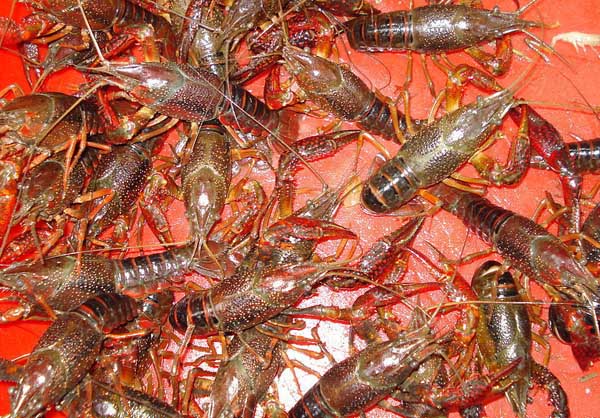
For farming red swamp crayfish (Procambarus clarkii) in lotus root paddy fields, from April to mid-June, the lotus leaves are relatively small, sunlight is abundant, and due to the large amount of fertilizer applied, the field water is very fertile. At this time, releasing red swamp crayfish fry can make use of the abundant plankton in the water body. After mid-June, lotus leaves cover most of the water surface, the field water turns clear, and there are more benthic animals and aquatic plants in the lotus root field. This provides abundant natural feed for the red swamp crayfish, which is in its peak growth season.
Lotus Root Paddy Field Construction
The construction of lotus root paddy fields for crayfish farming mainly involves 3 items, namely reinforcing and raising the field ridges, excavating shrimp ditches and shrimp pits, and building anti-escape fences.
1. Reinforce and raise the field ridges: Tamp the field ridges solid. The reinforced field ridges should be 40-50 cm above the water surface. Build anti-escape walls around the field ridges using plastic film or calcium-plastic boards. Then cover the inner slope of the field ridges with plastic mesh cloth, burying the lower part 20-30 cm into the soil, with the upper part extending 70-80 cm above the ridge surface. The base of the field ridge should be 80-100 cm wide. Use wooden stakes or bamboo poles for support and fixation every 1.5 m, and sew agricultural film about 30 cm wide onto the inner side of the upper part of the mesh.
2. Excavate shrimp ditches and shrimp pits: The excavation of shrimp ditches and shrimp pits is generally carried out in late winter or early spring, and should be completed in one go. Excavate one shrimp pit per mu of lotus root field. The shrimp pit should be 50 cm deep with an area of 3-5 sq m. Between shrimp pits, excavate shrimp ditches with a depth of 50-60 cm and a width of 30-40 cm. Generally, shrimp ditches in small fields are dug in a "cross" shape, while those in large fields are dug in a "well" shape. The shrimp ditches and shrimp pits must be connected and linked to the water inlet and outlet.
3. Install anti-escape fences such as wire mesh at the water inlet and outlet, with a height that should be 20 cm above the field ridge.
Fertilization and Disinfection
For lotus root paddy fields used for farming red swamp crayfish, base fertilizer should be the main approach, preferably organic fertilizer. Apply 1500-2000 kg of organic fertilizer per mu. Chemical fertilizers can also be added, with 20 kg of ammonium bicarbonate and 20 kg of superphosphate applied per mu. 10-15 days before releasing shrimp fry, apply 100-150 kg of quicklime per mu of lotus root field, dissolved in water and splashed over the entire field, to thoroughly disinfect the lotus root field, shrimp pits, and shrimp ditches.
Shrimp Fry Stocking
Stock 25,000-45,000 red swamp crayfish juveniles per mu at a size of 250-600 individuals per kg. Alternatively, stock 30-75 kg of red swamp crayfish broodstock per mu at a size of 20-30 individuals per kg. Before stocking, disinfect the shrimp bodies; you can soak the shrimp fry and shrimp seed in a saltwater solution at a concentration of about 30% for 3-5 minutes.
Feed Feeding
For adult shrimp farming, you can directly feed minced rice bran, soybean cake, wheat bran, miscellaneous fish, snail and mussel meat, silkworm pupae, earthworms, animal offal, or compound feed, etc., maintaining the feed protein content at about 25%. Feed feeding should follow the principle of "less at the beginning, more in the middle, less in the later stage." June to September is the peak growth season for red swamp crayfish. Feed 2-3 times a day, at 9-10 AM and around sunset or at night. The daily feeding amount should be 5%-8% of the shrimp body weight in the field. In other seasons, feed once a day, around sunset, with a daily feeding amount of 1%-3% of the shrimp body weight. You can also supplement feed once the next morning based on the shrimp's feeding situation. When feeding, note that more should be fed in fine weather, and less should be fed during high temperature and muggy weather, continuous rainy days, or when the water quality is too dense. Feed less when a large number of shrimp are molting, and feed more after molting.
Daily Management
For farming red swamp crayfish in lotus root paddy fields, shallow water should be irrigated initially, with a water depth of about 10 cm. As the lotus roots and shrimp grow, the field water should be gradually deepened to 15-20 cm to promote lotus root flowering and growth. During the peak growth season of lotus roots, deep water should be irrigated, up to a maximum depth of about 1 m. Regulate water quality by regularly adding water and draining part of the old water, maintaining the dissolved oxygen content in the field water above 4 mg/L, pH 7-8.5, and transparency at about 35 cm. Change the water every 15-20 days, with each water change amounting to about 1/3 of the original water volume. Splash quicklime water once every 20 days, using 10 kg of quicklime per mu each time.