Detailed Explanation of Key Points for High-Yield Crayfish Farming Techniques
Pond Selection
The water source should be fresh, well-oxygenated, and free of pollution. Loamy clay is preferred. The pond bank should be more than 3 m wide, with a slope of 1:2.5-3 m, and a water depth of 0.8-1.5 m, with a pH of 7.5-8.5. The pond area should not be too large; generally 3-8 mu is suitable, rectangular, oriented east-west. When adding new water to the pond, filter it through 20-40 mesh gauze to prevent wild fish and fish eggs from entering the pond with the water flow. Following the layout of high irrigation and low drainage, build inlet and drainage channels well, so that water can be let in and drained out. Crayfish have a strong ability to escape, so escape prevention facilities must be properly built. Usually plastic film, mesh, calcium-plastic board, or cement board is used to set up escape prevention facilities around the pond bank, to prevent entry of harmful organisms and escape of crayfish.
Pond Clearing and Disinfection
Pond clearing and disinfection can effectively kill harmful organisms in the pond (catfish, loach, snakehead, snakes, rats, etc.), wild miscellaneous fish that compete for food (carp, crucian carp, etc.), and pathogens. Quicklime and bleaching powder can be used, which are economical, affordable, and safe. The specific operation methods are:
1. Quicklime disinfection. Dry method disinfection: use 70 kg of quicklime per mu, dissolve in water and splash over the whole pond; if conditions permit, rake it over with a nail rake, and after one week of pond drying, inject new water. Disinfection with water present: calculate per mu of water surface at a water depth of 1 m, use 130 kg of quicklime dissolved in water, then splash evenly over the whole pond.
2. Bleaching powder disinfection. After fully dissolving bleaching powder containing 30% effective chlorine, splash it evenly over the whole pond, with a dosage of 25 kg per mu.
Planting Aquatic Plants
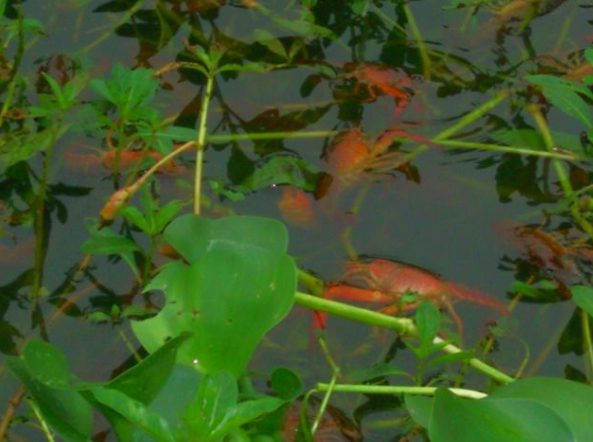
“Whether crayfish are good depends on whether there is grass in the pond. Whether crayfish are big depends on the grass in the pond.” Aquatic plants occupy a pivotal position in crayfish farming. First, aquatic plants can fill the gap when crayfish feed intake is insufficient and supplement a large amount of vitamins; second, they can break wind and waves, absorb some harmful substances in the water, purify water quality, and balance the water environment; third, they can provide hiding and resting places for juvenile shrimp and molting shrimp, reducing bullying of the weak by the strong. Generally, the planted area of aquatic plants should be about half of the total pond area. Species can be selected: low-stem reed, Potamogeton crispus, Vallisneria, Ceratophyllum demersum, wild water caltrop, wild rice stem, yellow grass, Potamogeton malaianus, Elodea, Hydrilla verticillata, etc. If conditions permit, some empty cans, bamboo tubes, tree roots, and other waste can also be placed at the bottom of the water body; these are all favorite resting places for crayfish.
Fertilizing the Shrimp Pond
Some people think it does not matter whether the pond for farming crayfish is fertilized. In fact, before stocking crayfish, applying an appropriate amount of organic fertilizer to the shrimp pond to cultivate feed organisms can directly provide natural feed after the shrimp enter the pond. Use 400 kg of fermented organic fertilizer per mu to maintain the corresponding fertility of the pond water. During the rearing process, as the water level gradually deepens, apply decomposed organic fertilizer as a top dressing. The amount and timing should be chosen according to whether the water is rich or poor, and generally no more than 80 kg each time is suitable. The transparency of the pond water should be maintained at about 35 cm.
Stocking Crayfish
Crayfish seedling stocking is divided into spring stocking and autumn stocking. Requirements are uniform size, complete appendages, no disease or injury, and sufficient stocking at one time. Before stocking, bathe in 5% salt water for 5-10 minutes to kill parasites and pathogenic bacteria. For purchased shrimp seed, due to long-distance transport out of water, before entering the pond the seedlings should be soaked in pond water for 1 minute, lifted and set aside for 2-3 minutes, then soaked again for 1 minute, repeating this 2-3 times, so that the body surface and gill cavity of the seedlings absorb enough water before stocking, which can increase the survival rate. Based on many years of experience from farmers, externally transported shrimp seedlings have a very low survival rate after long-distance transport. Properly polyculturing some silver carp and bighead carp in the pond can improve water quality and make full use of feed resources.
1. Spring stocking for grow-out shrimp: in mid-March, stock 5000-6000 juvenile shrimp with a body length of 3-5 cm.
2. Autumn stocking for broodstock rearing: around September, stock 500 manually selected crayfish broodstock per mu, with a male-to-female ratio of 3:1.
Feed Selection
Crayfish are omnivorous. Animal feed, plant feed, and various artificial feeds should be used in combination at different stages. Animal feed mainly includes small fish pieces, dried fish meal, snail and mussel meat, and various animal offal scraps; plant feed mainly includes rapeseed cake, soybean meal, wheat bran, wheat, corn, pumpkin, and various vegetables and aquatic and terrestrial grasses.
Feeding Management
Crayfish mostly hide by day and come out at night; moving and foraging at night is their habit. For feeding, persist in feeding once each at 10 a.m. and 4 p.m. every day, with the afternoon feeding amount accounting for about 70% of the whole day's feeding amount.
The suitable water temperature for rapid growth of crayfish is 22-32°C. From June to October, the food intake of crayfish gradually increases. The daily feeding amount can be adjusted appropriately according to the actual situation already harvested, and at the same time appropriately increased or decreased according to weather, water quality conditions, and shrimp activity and foraging conditions. Farming proverb: when the green shell molts into a red coat, diverse feed varieties are good. On cloudy and rainy days with dense water, feed less; on sunny days when shrimp are lively, feed them all until full.
Daily Management
Crayfish farming also requires patrolling the pond every day, paying attention to changes in water color and crayfish activity. If shrimp are found going ashore or climbing on aquatic plants and refusing to enter the water when driven, check whether the water body is lacking oxygen or whether water quality has deteriorated, and take corresponding measures such as increasing oxygen and changing water. The pH value should be maintained at about 7.5, and transparency at about 35 cm. In April, May, and June, change the water once every half month; in July, August, and September, change the water once every ten days, changing 1/3 each time. Splash quicklime water once every 20 days, using 10 kg of quicklime per mu each time. The water level gradually rises from spring to midsummer, with the deepest not exceeding 1.5 m. Maintain normal growth of aquatic plants and a certain coverage area. Try to keep the surrounding environment quiet when crayfish concentrate on molting, and after molting increase feeding of palatable animal feed to reduce mutual killing. Compared with other aquatic products, crayfish diseases are much fewer, but they should not be underestimated; daily management should focus on prevention. Liking to escape is the nature of crayfish, especially during flood season, so inspection should be strengthened to strictly prevent shrimp escape.
Crayfish Harvesting
The main harvesting tool for crayfish is the ground cage. The specific operation method is to set the ground cage in the pond near aquatic plants, tie both ends of the ground cage tightly, and the next day collect crayfish that have reached commercial specifications from the ground cage. In addition, crayfish can be caught with a hand dip net or by hand after draining the pond water. Crayfish harvesting can adopt the method of catching large ones and leaving small ones, and rotational harvesting and restocking, which helps increase yield. Harvesting starts in May and ends completely by the end of September.