Detailed Explanation of Key Points for Crayfish Artificial Farming Techniques
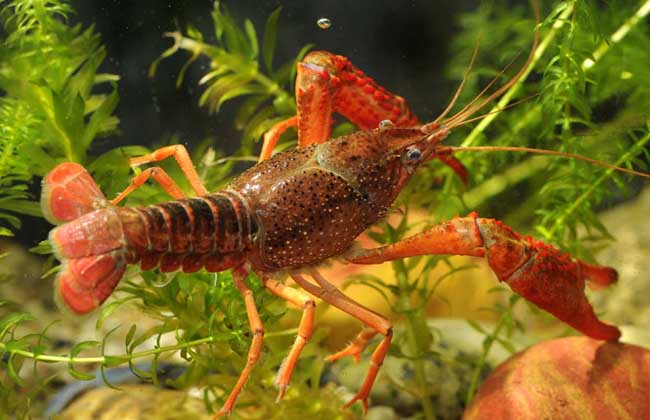
Crayfish, scientifically known as Procambarus clarkii, also called red swamp crayfish, belongs to the phylum Arthropoda, class Crustacea, order Decapoda, suborder Astacidea, family Cambaridae, genus Procambarus. It is native to North America, was introduced from the United States to Japan in 1918, and was introduced from Japan to China in 1929. It is now mainly distributed in the middle and lower reaches of the Yangtze River. In recent years, this crayfish has been in hot market demand, with rising prices and supply falling short of demand, offering broad development prospects.
Farming Prospects
Procambarus clarkii has strong adaptability to the environment, few diseases, and tolerance to low oxygen. It can grow and reproduce in ponds, rivers, lakes, rice fields, swamps and other water bodies, and can survive out of water or in burrows for relatively long periods. It has strong tolerance to adverse environments, is convenient to transport, and has a high transport survival rate. This is unmatched by other shrimp species. At the same time, Procambarus clarkii seedlings are easy to breed and can be self-bred and self-raised without complex equipment. The technology is simple, feed is easy to obtain, and it is suitable for artificial farming. Generally, intensive pond farming yields 400 kg per mu, with profits above 1,600 yuan.
Market Prospects
At present, artificial farming of Procambarus clarkii is limited, and the market mainly relies on wild capture. Its natural resources are far from meeting the consumer demand of international and domestic markets. European and American countries are the main consumers of Procambarus clarkii. In the United States, this crayfish is not only an important edible shrimp but also important bait for fishing, with annual consumption of 60,000-80,000 tons and self-sufficiency of less than 1/3. The European Union and the United States import up to 20,000 tons of crayfish from China each year. Sweden is an especially enthusiastic consumer of crayfish. Every year Sweden holds a 3-week crayfish festival, during which the whole country not only eats crayfish but also draws crayfish patterns on tableware and clothing. The scene is very grand, and Sweden alone imports 50,000-100,000 tons of Procambarus clarkii each year. The Western European market consumes 60,000-80,000 tons of Procambarus clarkii a year, while Western Europe's self-sufficiency accounts for only 20% of total consumption.
In recent years, domestic consumption of Procambarus clarkii has surged, and it has become a common dish for most families in urban and rural areas. In large and medium-sized cities such as Wuhan, Nanjing, Shanghai, Changzhou, Wuxi, Suzhou, Huai'an and Hefei, annual consumption is above 10,000 tons. In these large and medium-sized cities, the sales volume of Procambarus clarkii in restaurants and food stalls across the city in one evening is about 15,000 kg. According to relevant data, in Hefei there are more than 30 restaurants and food stalls that can sell more than 150 kg of crayfish per night; more than 100 that sell 50 kg per night; and countless small stalls that sell 10-20 kg per night. In Nanjing, from June to September each year, daily consumption of crayfish reaches 70-80 tons. Judging from the current consumption level, there is a huge shortfall in Procambarus clarkii in domestic and international markets, and developing artificial farming has great "money" prospects.
Processing Prospects
Procambarus clarkii meat is delicious and nutritious, with a protein content of 16%-20%. The protein content of dried shrimp meat is as high as more than 50%, higher than that of general fish and exceeding the protein content of eggs. The content of trace elements such as zinc, iodine and selenium in shrimp meat is also higher than in other foods, and the muscle fibers are fine and tender, making it easy for the human body to digest and absorb. Moreover, the meat yield of this crayfish is about 20%, and it can be processed into shrimp meat and shrimp tails. In addition, industrial raw materials such as chitin, chitosan and glucosamine extracted from the shell are widely used in agriculture, food, medicine, tobacco, papermaking, printing and dyeing, daily chemicals and other fields, with great potential for value-added processing.
Morphological Characteristics
Crayfish have a robust body, thick shell and dark red color. The body surface is covered with a layer of hard, pointed chitinous shell. The body consists of 21 segments in total, including the cephalothorax and abdomen. The cephalothorax is slightly larger. The head has 3 pairs of antennae; the antennae are thick near the head and small and pointed at the tips. The thorax has 5 pairs of walking legs; the ends of the 1st-3rd pairs of walking legs are pincer-like, and the ends of the 4th-5th pairs are claw-like. The 2nd pair of walking legs is especially developed into very large chelae; the chelae of male crayfish are more developed than those of females. The tail of the crayfish has 5 powerful tail fan pieces. During the egg-bearing and hatching periods, the tail fan of the female crayfish curves inward - when crawling or under attack by enemies, it protects the fertilized eggs or young crayfish from harm.
Living Habits
Crayfish do not have strict requirements for the aquatic environment. They can survive in water with a pH of 5.8-8.2, a temperature of -15°C to 40°C, and dissolved oxygen not lower than 1.5 mg/L, and can overwinter naturally in most areas of China. The most suitable water body for crayfish growth has a pH of 7.5-8.2, dissolved oxygen of 3 mg/L, and water temperature of 20-30°C.
Crayfish prefer warmth and fear light, and show obvious diurnal vertical movement. When light is intense, they sink into the water body or hide in burrows; when light is weak or dark, they begin to move. They usually hold aquatic plants or suspended matter in the water body, lying on their sides at the water surface, and have the habit of digging burrows. The burrows they dig are 50-80 cm deep.
Feeding Habits
Crayfish are omnivorous animals. Various fresh and tender aquatic plants, benthic animals in water bodies, mollusks, large zooplankton, dead fish and shrimp, and dead bodies of the same species are all favored foods, and they also readily eat artificially supplied feed. After the first molting, larvae begin to feed on phytoplankton, small cladoceran larvae, rotifers, and so on. Crayfish are rather voracious. When food is insufficient, they will cannibalize one another, with the large eating the small. Soft-shelled crayfish that are molting or have just molted are most easily eaten.
Reproductive Habits
Crayfish spawn multiple times a year. In the natural environment, they reach sexual maturity at 9-12 months of age, and sexually mature individuals generally weigh 30-100 g. The mating season is generally from late April to July, with the peak group mating period in May. They can spawn 3-4 times a year, with 300-800 eggs each time. Before mating, the female crayfish first undergoes reproductive molting, and the molting process can be completed in about 2 minutes. During mating, the female lies on her back at the water surface, the male positions himself above her, grips the female's front chelae with his chelae, holds the female with his walking legs, and inserts the gonopods into the female body. Mating lasts 10-30 minutes. Three to ten hours after mating, the female begins to spawn, and the fertilized eggs adhere to the abdominal appendages for development. The length of embryonic development is closely related to water temperature: higher water temperature shortens the hatching time, while lower water temperature prolongs it. Generally, larvae hatch after 5-8 weeks.
Molting and Growth
Crayfish achieve growth in body weight and body length through molting. After molting, the new shell hardens within 12-24 hours. Molting is closely related to water temperature, nutrition and individual developmental status. Larvae generally molt once every 4-6 days. If the water temperature is high and food is sufficient, the molting interval is short. Under conditions of suitable water temperature and sufficient bait, after 3-4 months of growth, crayfish seedlings can reach a body length of 8-12 cm and a body weight of 15-20 g, with a maximum of more than 30 g.