Can the Atergatis integerrimus be eaten? An article answering the question
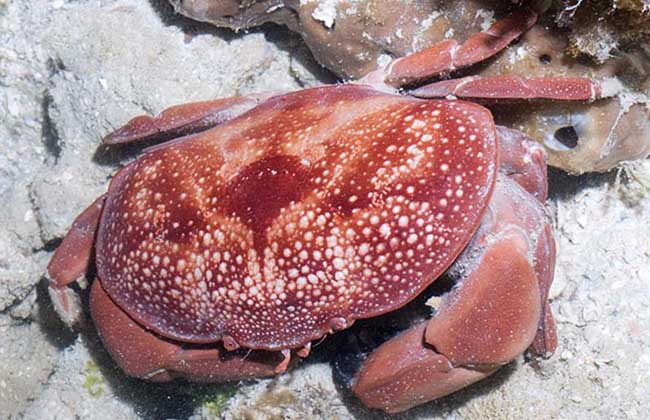
The Atergatis integerrimus is an animal of the genus Atergatis in the family Xanthidae. It generally inhabits the seabed with rocks at a depth of 10-30 m. It is distributed in Japan, the Philippines, Singapore, India, Sri Lanka, Mauritius, East Africa, and China's Guangdong, Hainan Island and other places. Let's take a look below at whether the Atergatis integerrimus can be eaten!
Can the Atergatis integerrimus be eaten?
The Atergatis integerrimus cannot be eaten. The Atergatis integerrimus is the crab that has killed the most people, and it can produce tetrodotoxin. Tetrodotoxin is one of the most toxic neurotoxins found in nature. It is an amino perhydroquinazoline compound and was once considered the most toxic non-protein toxin in nature. The toxin has a local irritating effect on the intestines. After absorption, it quickly acts on nerve endings and the nerve center, and can block sodium ion channels on nerve excitable membranes with high selectivity and high affinity, hindering nerve conduction, thereby causing nerve paralysis and death.
Is the Atergatis integerrimus poisonous?
The Atergatis integerrimus is poisonous. Although the name Atergatis integerrimus sounds very upright, this crab is poisonous and not suitable for eating. It can produce tetrodotoxin in its body. As for whether it is upright and whether it loves cleanliness, who knows. What matters is to remember what this guy looks like and never eat it by mistake.
Which crabs are highly poisonous?
1. Atergatis floridus: The carapace of Atergatis floridus is horizontally oval, with the back raised and clearly divided into regions, and the surface is smooth. The entire back is blue-green to purple-brown, with irregular white, brown, and yellow-orange patterns, forming a special mottled color. The carapace is about 5 cm long and about 10 cm wide. It is distributed in tropical and subtropical waters such as the Indian Ocean and the Western Pacific, in rocky reefs or coral reef areas. It is found in Hengchun, Xiaoliuqiu, and Lanyu in southern Taiwan, China.
2. Atergatis reticulatus: The carapace of Atergatis reticulatus is horizontally oval, with the back very raised and the surface smooth. The whole body is tea-brown to purple with green, and the back of the carapace has light brown or brass-colored cloud-like markings. The carapace is about 3 cm long and about 5 cm wide. It is distributed in tropical and subtropical waters such as the Indian Ocean and the Western Pacific, in rocky reefs or coral reef areas. Its traces are commonly seen in rocky reef waters along the southern coast of Taiwan, China.
3. Lophozozymus pictor: The carapace of Lophozozymus pictor is horizontally elliptical, with a smooth surface. The finger joints of the chelipeds are black, the legs are wide and flat, and each segment has bundles of setae. The whole body has a red-and-white reticulated pattern. The carapace is about 5 cm long and about 9 cm wide. This crab has been reported in Singapore and the Philippines to cause death after accidental consumption. It is distributed in coastal areas of Southeast Asian countries, the South Pacific islands, Japan, and other places. It can be caught year-round along the northern coast of Taiwan, China.
4. Demania reynaudi: The carapace of Demania reynaudi is pentagonal, the front is divided into two lobes with an inverted triangular notch, and the surface of the chelipeds and carapace has scale-like or bluntly rounded granules. The overall background color of the back is beige or light orange, with irregular chestnut-colored patches of varying sizes. The finger joints of the chelipeds are white. The carapace is about 4 cm long and about 6 cm wide. It is distributed in coastal areas of Southeast Asian countries, the South Pacific islands, Japan, and other places. It is also found in nearshore coral reefs and rocky reefs in Taiwan, China. The 3 species of Demania produced in the Philippines have all been confirmed to be toxic species.
5. Atergatis subdentatus: The carapace of Atergatis subdentatus is oval, and the shell surface is densely covered with granules and short setae. The back is red-orange to dark red. The fingers of the chelipeds are black. It is distributed in coastal areas of Vietnam, the Philippines, New Guinea, Japan, Taiwan, China, and other places. It inhabits rocky reefs or coral reefs from below the low tide line to a water depth of 30 m. It can be caught year-round along the northern and southern coasts of Taiwan, China.
6. Xanthias lamarckii: The carapace, chelipeds, and walking legs of Xanthias lamarckii are smooth. The carapace is horizontally elliptical, and the front two-thirds of the surface is relatively raised. The background color of the back of the carapace, chelipeds, and walking legs is beige, mixed with coffee-colored patterns or patches of varying shades. The fingers of the chelipeds are black, and the setae of the walking legs are golden yellow. The carapace is about 3 cm long and about 5 cm wide. It is distributed in coastal areas of Japan, Taiwan, China, the Marshall Islands, Sumatra, the Chagos Islands, Mauritius, Reunion, and other places. It inhabits coral reefs in the intertidal zone.