How many legs does a normal crab have in total?
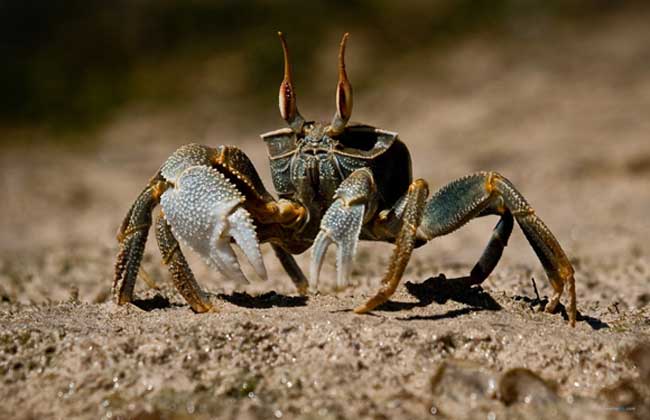
Crabs are crustaceans, their bodies protected by a hard shell, breathing through gills, and taxonomically they belong to the same group of animals as shrimp, lobsters and hermit crabs. The vast majority of crab species live in the sea or in coastal waters, while some inhabit freshwater or land. There are many species, and in China alone there are more than 600 species of crabs. Let us take a look below at how many legs a normal crab has!
How many legs does a normal crab have?
A normal crab has eight walking legs, plus two chelipeds (claws) that do not serve a walking function. A crab's thorax has five pairs of appendages called pereopods (thoracic legs). The front pair of appendages is equipped with strong claws, which can be used for foraging, while the remaining four pairs of appendages are the crab's legs, and walking and moving depend on these four pairs of appendages. The way it walks is unique and interesting, mostly moving sideways rather than straight forward.
What food do crabs eat?
Crabs are omnivorous with very varied feeding habits, eating both meat and plants, and they like to eat animal-based foods such as fish, shrimp, snails, worms, earthworms, insects and their larvae. They also scavenge on injured or newly molted members of their own species, and egg-bearing crabs will even eat their own eggs when hungry. In the natural environment, what crabs can easily obtain is mostly aquatic plants, so their diet is mainly plant-based. Crabs are very greedy eaters with large appetites and strong digestive capacity. When food is abundant they can eat a great deal, and when there is no food they can go several days or even a month without eating and not starve to death. Only during the wintering period in their burrows do crabs stop or reduce feeding. They also have the habit of snatching food and being aggressive, and often kill one another in fights over a good meal.
Common species of crabs
1. River crab: River crabs breed in seawater and grow in freshwater. They like to dig burrows and live in them, often hiding on the banks of rivers, lakes and ponds, or concealed among gravel and aquatic plants.
2. Stone crab: Stone crabs are freshwater and brackish-water crab species, namely stream crabs, formerly called stone crabs, inhabiting the sides of streams or under stones in streams.
3. Mud crab: The mud crab's shell is oval, its body flat and hairless, with a well-developed head and thorax, powerful claws, and its rear legs are shaped like oars, hence it is also called the "oar crab".
4. Flower crab: The carapace is about 2 times as wide as it is long, spindle-shaped, with a rough, granular surface; the granules of females are more prominent than those of males.
5. Red crab: The red crab has a smooth surface, a reddish-brown carapace, with a yellow cross-shaped marking at the front of the middle part; the claws are red with yellow stripes, and the tips of the two fingers are dark brown.
6. Spanner crab: The spanner crab has a bizarre appearance, looking like both a shrimp and a crab. It is produced in the greatest quantity in Penghu, with a thin shell and abundant meat and a delicious flavor.
7. Brown crab: The brown crab's carapace is very convex on the back, with soft hair on the sides; its claws are asymmetrical in shape, with the right finger joint being more robust, and when the claws are retracted they press tightly against the forehead.
8. Crystal swimming crab: The crystal swimming crab's carapace is bare and hairless, with fine granules and transverse ridges; the front lateral margin has 6 teeth, the first to fifth teeth gradually increasing in size, and the last tooth being the smallest and spine-shaped.
9. Three-spot crab: The three-spot crab's carapace is spindle-shaped; the carapace and claws are greenish-yellow, the movable finger of the claw has a red mark, and the walking legs are roughly pale blue.
10. Swimming crab: The swimming crab is so named because its carapace is spindle-shaped. There are three protrusions in the center of its shell, so it is also called the “three-spot swimming crab”.