Why Do Hermit Crabs Change Shells? Uncovering the Secret Behind It
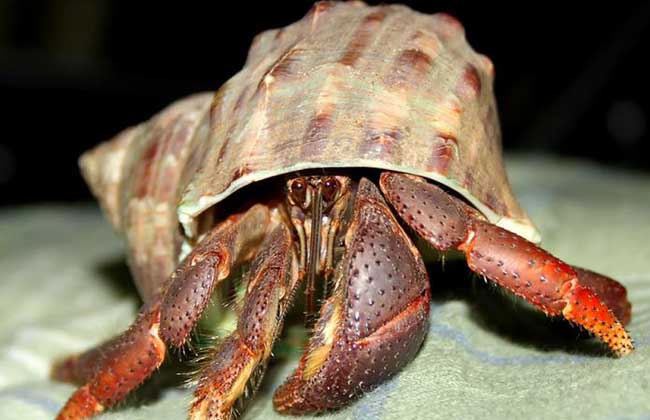
Hermit crabs are crustacean marine animals that live on sandy and muddy bottoms, and occasionally on land or in trees. They are also known as white dwellers, dry dwellers, and so on. They often use their claws to eat the flesh of mollusks and take over their shells as their own. Their homes include sea snail shells, seashells, and snail shells, and even, due to harsh ecological conditions, bottle caps serving as homes. Let's take a look together at the secret of hermit crabs changing shells!
Two Crabs Fight Over One Shell
Although hermit crabs are crustaceans, they are not born with a shell of their own, and instead rely on living inside snail shells to protect themselves. They often use force to drive out the snail and seize its shell. But in most cases, they take shells from other hermit crabs by force. At the start of a fight, the attacker first swings its large cheliped to clamp down on the defender, then uses the shell on its own back to ram the defender's shell. As the fight intensifies, the two shells clash with a loud crack, and the defender, battered and exhausted, concedes defeat. The attacker then flips the opponent over completely, leaving the loser lying on its back. At this point, the attacker carefully examines the opponent's shell to see whether it suits its own needs. If it likes it, it will pull the loser out of the shell and move in itself. The loser has no choice but to temporarily settle for the winner's discarded shell, and the battle comes to an end.
It Is Both a Fight and a Trade
“Born of the same water, why the rush to attack one another?” Why do they fight each other? After research, scientists believe that fights like those of hermit crabs are both a struggle and a trade. This kind of trade is a typical example of mutually beneficial behavior in animals. To a hermit crab, a snail shell is like clothing to a human. Clothes that are too tight cannot be put on, and clothes that are too loose do not fit well and make movement difficult. Likewise, if a snail shell is too narrow and small, the hermit crab cannot fit inside; if the shell is too large, although it can fit inside, it is heavy to carry and hard to walk with. Who would not want a shell of the most suitable size to live in? If a large snail shell contains a small hermit crab, and a small snail shell contains a large hermit crab, and the two happen to meet and fight, then through collision and friction the large hermit crab gets a large shell and the small hermit crab gets a small shell. The trade is completed, and both are satisfied.
Scientists have also observed that if the defender's shell does not suit its own size, the fight will be very short, and it will give up the shell more easily; the shell-swapping battle will end quickly. Although the weaker one is the loser in the fight and is left with a discarded shell, most discarded shells are of suitable size. There is loss and gain, with neither profit nor loss overall.
Trend-Chasing Hermit Crabs
Of course, hermit crabs' shell-swapping battles are not based only on the size or weight of the shell; most of the time they focus on the shell's newness and completeness. Scientists have found that hermit crabs also seem to “follow trends.” They care not only about the size of the “clothing” on their bodies, but even more about the style. No matter how well it fits, if the style is old, they will still change it, and especially for damaged shells with holes or cracks, they are even more eager to swap them out early.
Hermit crabs also have different preferences for snail shells. Generally speaking, most hermit crabs prefer round-opening snail shells, which are round at the opening, light in weight, and convenient for entering and exiting. Some hermit crabs, however, prefer flat-opening or oval-opening snail shells, and once accustomed to them, they are unwilling to take round-opening ones. That is because when they moved into flat-opening snail shells after molting, their bodies were soft, and they themselves grew into a flattened shape. Short and stout hermit crabs simply cannot fit into flat-opening snail shells.
There is a kind called the “transverse hermit crab” that insists on living in fence snail shells. Although fence snail shells are large and heavy, their shell openings are flat and suit their body shape. In particular, the surface of fence snail shells is smooth and novel, making them very popular among the occupants. Carrying one on its back, the hermit crab strides briskly across the beach, looking dashing before the other crabs, feeling infinitely glorious.
Fresh, intact, beautiful, and well-fitting shells are not readily available everywhere; they must be won through fighting. When a strong hermit crab encounters an ideal snail shell, it is absolutely unyielding and always seizes it without scruple. The weak, however, can never keep their own snail shells; they either pick up discarded shells or temporarily lose their “house.”