What are the efficient methods for raising crabs in rice paddies?
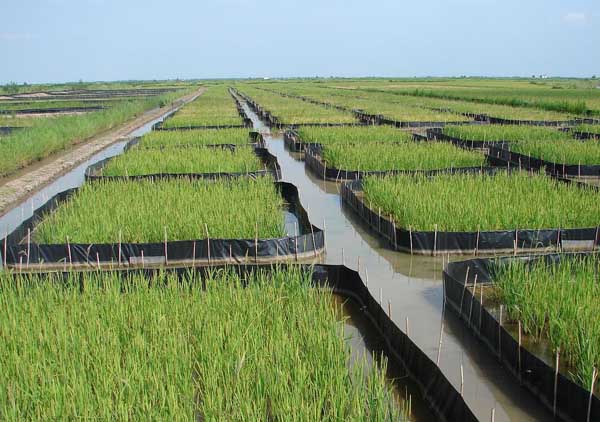
Raising crabs in rice paddies is a highly profitable fishery-agriculture integrated production model. The densely clustered rice plants not only form a place for crabs to hide while molting, but also provide an excellent living and habitat environment. Not only can crab seedlings be stocked, juvenile crabs can be raised into crab seed stock, and adult crabs can also be farmed. In 1996, in Shuyang County, Jiangsu Province, raising adult crabs in rice paddies had already reached a production level of 500 kg of rice per mu and 30 kg of crabs, with an income of about 5,000 yuan per mu, which is 2-4 times the income from conventional rice.
Preparation of rice paddies for crab farming
Rice paddies used for crab farming need anti-escape facilities. The field ridges should be 60 cm high and 40-50 cm wide, and covering the ridges with double-layer plastic film is sufficient. Smooth asbestos tiles or polyethylene mesh can also be installed around the rice paddy to prevent escape. Anti-escape screens should also be installed at the water inlet and outlet. Dig a ring ditch 3 m from the field ridge. For raising crab seedlings and crab seed stock, a ring ditch 1 m wide and 0.8 m deep is sufficient. For raising adult crabs, the ring ditch should be 2-3 m wide and 1 m deep. Ditches and pits (crab ponds) should also be dug in the middle of the field. The ditches should be 50-60 cm wide and 50 cm deep; for raising adult crabs, they can be widened to 1 m and deepened to 60 cm. The pits should have an area of 8-10 sq m and a depth of 1 m. The ditches and pits account for about 30% of the total rice paddy area. For crab farming, it is advisable to use 2-3 mu as one farming unit.
Stocking of seedlings and seed stock
For cultivating crab seed stock, stock 0.5 kg of crab seedlings per mu. For farming adult crabs, 1,500-2,000 crab seed stock with an individual weight of 10-15 grams can be stocked per mu. Early-bred crab seedlings of the same year can also be used, placed in a greenhouse for intensive cultivation, and then released into the rice paddy in May, which can shorten the farming cycle.
Feeding and management of crabs
Feed 1-2 times a day, generally at 8-9 a.m. and 4-5 p.m. Especially when farming adult crabs, feeding is mainly done in the evening, with a daily feeding rate of 3%-5%. The feeding points should be on pre-set feeding platforms or on the banks on both sides of the crab ditches. When feeding, pay attention to checking whether there are holes in the field ridges, because river crabs have a burrowing habit; any holes found should be plugged in time. During heavy rain, pay attention to preventing waterlogging and crab escape; in dry seasons, pay attention to water shortage. Under normal conditions, keep the water depth in the rice paddy at 6-10 cm. To keep the water quality fresh, change the water frequently. From June to July, change the water once a week; from August to September, change the water 2-3 times a week; after September, change the water once every 5-10 days. Each time, change 1/3-1/5 of the water. In addition, during the feeding period, apply quicklime once every 10 days in the ditches and pits to make the water reach 5-10 mg/L.