What are the common species of crabs in China?
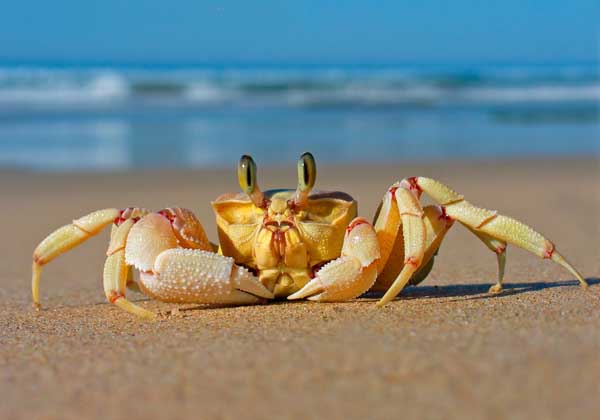
There are many species of crabs. In China alone, there are about 600 species of crabs, including swimming crabs, mud crabs, frog crabs, Guan Gong crabs, and so on. Because they are distributed in different geographical locations, they are also graded: first grade is lake crabs, such as those from Yangcheng Lake and Jiaxing Lake; second grade is river crabs, such as those from Jiujiang and Wuhu; third grade is stream crabs; fourth grade is brook crabs; fifth grade is ditch crabs; sixth grade is sea crabs.
River crab
The river crab, whose scientific name is Chinese mitten crab (Eriocheir sinensis), is a crustacean and taxonomically belongs to Arthropoda, Crustacea, Grapsidae. It reproduces in seawater and grows in freshwater. It likes to dig burrows and live in them, often hiding along the banks of rivers, lakes, and ponds, or concealed among gravel and aquatic plants.
Stone crab
The stone crab, also known as the bamboo-splitter crab or stream crab, is a freshwater and brackish-water crab in Crustacea, Decapoda, Potamidae. It inhabits beside streams or under stones in streams.
Mud crab
The mud crab, whose scientific name is Scylla serrata, has an oval carapace, a flat and hairless body, a well-developed cephalothorax, and strong chelipeds. Its rear legs are shaped like oars, hence the name "oar crab."
Flower crab
The flower crab is also called the distant swimming crab. Its carapace is about 2 times as wide as it is long, spindle-shaped, and its surface has rough granules; the granules of females are more prominent than those of males. The forehead has 4 teeth; the middle pair of frontal teeth is shorter and smaller, sharper in adults and more rounded and blunt in juveniles. The anterolateral margin has 9 sharp teeth, and the last tooth is much larger than the preceding teeth and projects toward both sides.
Swimming crab
The swimming crab is named for its spindle-shaped carapace. There are three protrusions in the center of the shell, so it is also called the "three-spot swimming crab."
Red crab
The red crab is also called the cross crab. Its carapace is about 1.6 times as wide as it is long, and its surface is smooth. The forehead has 6 teeth; the middle 4 teeth are similar in size, and the outer teeth are narrow and sharp. The anterolateral margin has 6 teeth; the first tooth is flat and blunt, the middle of the front margin is concave, and the last tooth is smaller than the other teeth but sharper and projecting. The chelipeds are rather stout and symmetrical left and right; the dorsal surface of the palm segment has 4 spines; the inner margin of the merus has 3 sharp spines. The carapace is reddish brown with yellow stripes, and there is a yellow cross-shaped marking in the middle front. The chelipeds are red with yellow markings, and the front ends of the two fingers are dark brown.
Brown crab
The brown crab is also called the bread crab or wandering bread crab. The dorsal surface of its carapace is very convex and has 5 longitudinal rows of wart-like protrusions, with soft hair on the sides. The forehead is narrow, and its front margin is concave and divided into 2 teeth. The eye sockets are small. The anterolateral margin has granular teeth. The posterolateral margin has 3 teeth. The middle of the posterior margin has 1 rounded blunt tooth, and each side has 4 sharp triangular teeth. The chelipeds are asymmetrical in shape; the fingers on the right side are thicker, and when the chelipeds are folded they press tightly against the forehead. The walking legs are slender and smooth. The male abdomen is elongated; the third to fifth segments are fused, with visible sutures, the sixth segment is nearly rectangular, and the seventh segment is a sharp triangle. The female abdomen is broadly elongated; the sixth segment is nearly rectangular, and the seventh segment is triangular.
Crystal swimming crab
The carapace of the crystal swimming crab is bare and hairless, but it has fine granules and transverse ridges. The forehead has 6 teeth; the middle 4 teeth are similar in size, and the outer teeth are narrow and sharp. The anterolateral margin has 6 teeth; the first to fifth teeth gradually increase in size, and the last tooth is the smallest and spine-shaped.
Three-spot crab
The three-spot crab is also called the red-spotted swimming crab. Its carapace is spindle-shaped and about 2 times as wide as it is long. The front part of the carapace surface has granules, and the rear part is smooth. The forehead is divided into 4 teeth; in adults they are spine-shaped, and in juveniles they are blunter. The lateral teeth are larger than the central teeth but do not project more. The anterolateral margin has 9 teeth; the first tooth is longer and sharper than the following 7 teeth, and the last tooth is the largest and projects toward both sides. The length of the chelipeds is slightly greater than the width of the carapace, and the front margin of the merus has 3-4 spines; the fingers are very long. The surface of the last walking legs has soft hair, while the rear surface is smooth and spineless. The carapace and chelipeds are greenish yellow, and the rear part of the carapace has 3 round red spots edged in white. The movable finger of the cheliped has a red mark, and the walking legs are roughly pale blue.
Spanner crab
Its long shape is bizarre, resembling both a shrimp and a crab. In Taiwan, China, Penghu has the highest production. The shell is thin and the meat is plentiful, and the taste is delicious. Because it habitually hides in the rocky reef areas on both sides, in the sandy trench area in the middle, with only its orange-red forehead exposed, it is named after the rising sun.