Detailed Explanation of Key Points for Efficient Swimming Crab Aquaculture Techniques
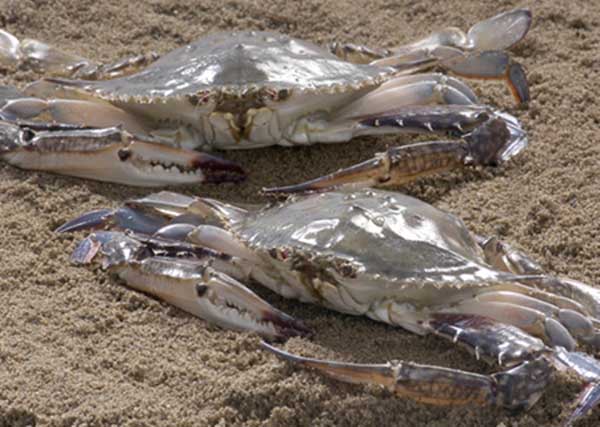
The swimming crab has plump, delicious meat and high nutritional and economic value, and is suitable for temporary fattening in seawater. The carapace is spindle-shaped, nearly twice as wide as it is long; the surface of the carapace is covered with fine granules, with 2 transverse granular ridges and 3 wart-like protrusions; the forehead has 2 sharp teeth; the anterolateral margin has 9 sharp teeth, with the last tooth being long and spine-like, projecting outward. The chelipeds are robust, longer than the width of the carapace; the merus is prismatic, with the male merus being more slender and having 4 sharp spines on the anterior margin.
Pond Conditions
Ponds for swimming crab aquaculture are best with a sandy-mud substrate, with a pond area of 10-25 mu being suitable, a water depth of 1.5-2.0 m, a 4 m wide and 0.5 m deep circular ditch dug around the pond, the pond ridge raised by 1.2 m, each pond equipped with 1 inlet and 1 outlet culvert, and each two rows of ponds provided with 1 inlet and 1 outlet channel; ponds are best located in positions with a relatively large tidal range, smooth tidal flow, relatively stable salinity, and convenient water intake and drainage. The most ideal location is in the intertidal zone, using the tidal range to take in water; where these conditions are absent, water is pumped in.
Stocking Patterns
1. Preparation before stocking: After the autumn and winter swimming crab harvest, close the sluice gates and dry the pond; after drying, form the pond bottom into slopes and ridges. In mid-to-late March, use a 60-mesh inlet net to take in water to 10 cm, and apply 75 kg of quicklime per mu, slaking it with water into lime slurry and splashing it over the whole pond. After pond clearing, the calcium content in the soil and water of the crab pond will increase, which is beneficial to the growth and development of swimming crabs. After filling with water to 50 cm, apply 20-25 mg/L of tea seed cake to eliminate harmful fish.
2. Stocking quantity: According to the pond's water exchange conditions, water quality, water depth, feed supply, and technical level, generally stock 800-1,000 stage II juvenile crabs per mu, 5,000 Chinese prawn seedlings, and 50 kg of shellfish such as variegated clams. It is best to partition the pond in the very middle with 20-30 mesh Yuhua netting to carry out separate culture of females and males.
Daily Management
1. Feed feeding: The feeding amount is closely related to conditions such as culture density, the size of the swimming crab, and temperature. Under normal circumstances, the daily feeding amount is 5-10% of crab body weight, fed twice a day. The feeding amount must follow the "four fixeds," namely: fixed time, fixed quantity, fixed location, and fixed quality. Fixed time means feeding 30% of the daily ration in the morning and 70% in the evening; fixed quantity means regularly measuring the number and weight of the swimming crabs to determine a reasonable feeding amount; fixed location means feeding at fixed locations, generally scattering the feed on fixed slopes around the pond; fixed quality means ensuring the feed is fresh and live and guaranteeing its quality. Note that the feeding amount is generally measured by the feeding situation 3 hours after feeding, and adjusted promptly. When the weather is dull or there is heavy rain, feed should be reduced or not given.
2. Water quality and water temperature regulation: Strengthen water quality management and persist in water exchange. Properly grasp the relationship between water color, transparency, and water exchange volume. Before July, transparency can be controlled at about 30 cm, with a daily water exchange volume of 10-20%; after July, pond water transparency can be controlled at about 40 cm, with a daily water exchange volume of 20-30%. Throughout the entire culture process, the water temperature requirement is 17-30°C.
Key Points and Precautions in Aquaculture Management
1. Daily observation: Strengthen daily observation. Conduct biological observation once every 15 days, measuring shell length, shell width, and body weight, and checking their growth to assess the culture effect. For water temperature, salinity, pH, dissolved oxygen, and other items, also regularly measure hydrochemical indicators and keep records.
2. Disease prevention and control: Adhere to the principle of "prevention first, combining prevention and treatment, and comprehensive management," maintain good water quality, feed high-quality bait, and regularly mix in vitamins during high-temperature periods.
3. Separate culture of female and male crabs: This is beneficial to the growth of female crabs, avoids casualties caused by male crabs mating during molting, helps increase the survival rate, and improves the feed conversion ratio. After mid-December, male crabs can be harvested and marketed.
4. Regular pond patrols: Do a good job in preventing escape and theft.