What are the common methods of crab farming?
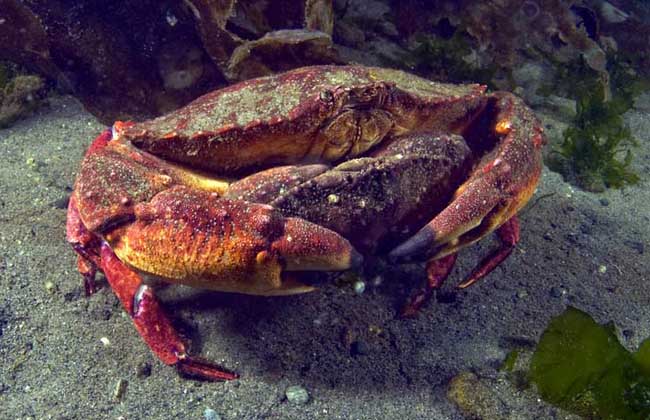
Grow-out crab farming refers to raising crab seed to edible size for market. In the Yangtze River basin, this usually takes 2 years. Depending on the water body and the degree of manual control, grow-out crab farming can be divided into the following forms:
Pond crab farming
Raising crabs to market size in ponds allows the entire farming process to be controlled manually, with a relatively high recapture rate, but the size at harvest and the meat quality are inferior to crabs raised in larger water bodies. By farming method, it can be further divided into:
1. Pond monoculture: mainly crabs, with some fish added. Generally the yield is about 50-75 kg per mu, and high-yield ponds can reach 200 kg of grow-out crabs per mu.
2. Fish-crab polyculture: mainly fish, with some crab seed added. Generally the yield of grow-out crabs is about 15 kg per mu, and high-yield ponds can reach 40 kg.
3. Temporary holding in ponds: this involves green crabs caught from natural water bodies or other ponds that have not yet grown to full size. Because they are lean and have soft shells, their price is low, but they have all completed their maturity molt and will not molt again during the holding period, so they will not kill one another. Thus, the survival rate of green crabs held temporarily in ponds is relatively high. After 2 to 3 months of feeding, the green crabs become plump and their gonads full, and the market price rises significantly. The gross yield per mu can reach more than 500 kg, with notable returns. However, this farming method can only be carried out in areas where grow-out crab resources are very abundant.
Crab farming in lakes and river channels
Raising crab seed to grow-out crabs in natural water bodies offers better environmental conditions, abundant natural food, and low costs, and the harvested crabs are large in size and good in quality. However, the recapture rate is relatively low. Based on current farming methods, it can be divided into:
1. Stocking of crab seed in lakes and river channels: this farming method has a history of several decades. In the 1960s to 1970s, crab larvae were released into lakes and river channels; in the 1980s, this was changed to stocking juvenile crabs; in recent years, in addition to juvenile crabs, one-year-old crab seed has also been stocked, all with obvious results. However, this farming method usually involves no feeding, and its production results are greatly affected by natural factors, so it still counts as extensive farming. The water body stocked must have good water quality, lush aquatic plants, gentle flow, and few openings connected to the outside for better returns. Generally, the recapture rate of grow-out crabs is only 0.5%-5%.
2. Crab farming in lake net enclosures: in a lake, choose waters with lush aquatic plants, good water quality, gentle flow, and moderate depth, and use netting to enclose a certain area (ranging from several dozen mu to several hundred mu), and feed intensively according to the growth requirements of Chinese mitten crabs. This farming method draws on the advantages of both pond and lake crab farming: the water quality is good, the activity space is large, food is abundant, and the density is relatively low, so the harvested Chinese mitten crabs are large in size and good in quality, with a recapture rate of 40%-60%, low costs, and high returns. Generally, 15-30 kg of grow-out crabs can be produced per mu, and high-yield net-enclosure crab farming can reach 65 kg per mu.
Crab farming in grass marshes and reed flats
Grass marshes and reed flats suit the ecological requirements for Chinese mitten crab growth, with low production costs, large size at harvest, and good quality, but their recapture rate is relatively low.
Crab farming in rice paddies
Using rice paddies to raise grow-out crabs is an emerging aquaculture industry developed in recent years. This method can reduce fertilizer application in the rice paddies, kill insect pests, and clear weeds, while also increasing the thousand-grain weight of rice. With slight modification of the paddy environment, it also suits grow-out crab growth. Generally, rice in crab-farming paddies yields slightly more than rice in paddies without crabs, with 20-30 kg of grow-out crabs per mu, and high-yield paddies can reach 50-75 kg of grow-out crabs per mu, with extremely notable returns.