Detailed Explanation of Key Technical Points for Spring Farming of River Crabs
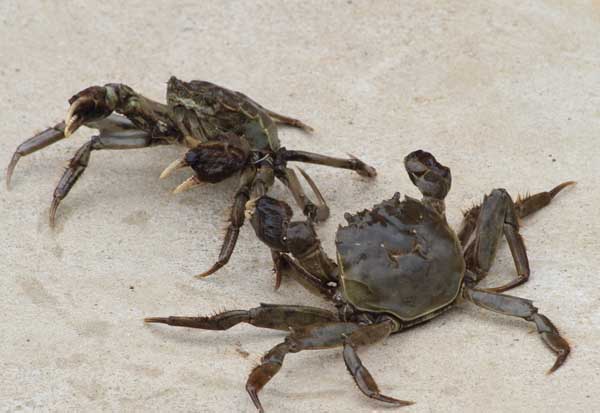
Currently, water temperatures are gradually rising, and doing a good job of spring river crab production is the first step toward achieving a high yield of river crabs for the whole year.
Pond Clearing and Disinfection
After a year of farming, a certain amount of silt accumulates at the bottom of the pond. This silt will become the best place for various pathogens and parasites to reproduce. Therefore, before stocking crab seed, use the idle winter and spring period to thoroughly clear and disinfect the pond. The specific method is: completely drain the pond water, let the bottom mud freeze thoroughly, and expose it to full sunlight to achieve the purpose of killing pathogens. In addition, use quicklime (60~75kg/mu) dissolved in water and evenly splash it over the whole pond while hot. The next day, use a long-handled rake to thoroughly stir the bottom mud and lime slurry to completely kill pathogens. At the same time, raise and reinforce the embankments to prevent large water from overflowing the pond during the summer flood season and causing escape.
Timely Stocking
The crab seed stocking work should be completed before the end of March. Select authentic Yangtze River strain juvenile crabs with a strong physique, no disease or injury, and complete appendages, with a size of about 200 crabs/kg, and stock about 800 crabs per mu.
Control Water Level
In order to encourage river crabs to feed early and grow early, the pond water should be lowered to about 30 cm on sunny days. Under sunlight, the water temperature rises faster, which is beneficial for river crab feeding and growth. If continuous rainy weather occurs, appropriately increase the pond water depth to prevent excessive fluctuations in pond water temperature.
Timely Feeding ⟧11⟧From mid to late March, water temperature in some areas can reach above 10°C, and river crabs begin to feed. Their feed intake gradually increases as water temperature rises, and feeding should follow the principle of going from less to more. In spring, generally use fine feed as the main component, supplemented by 15~20% coarse feed. Note: moldy feed must never be fed.
From mid to late March, water temperatures in some areas can reach above 10°C, and river crabs begin feeding. Their feed intake gradually increases as the water temperature rises, so feeding should follow the principle of going from less to more. In spring, fine feed is generally the mainstay, supplemented by 15-20% coarse feed. Note: moldy feed must never be fed.
Timely Stocking of Snails and Transplanting Aquatic Plants
Before Qingming Festival, snails should be stocked into the pond, because snails reproduce around Qingming and can provide high-quality, suitably sized animal feed for crab seed after they are put into the pond. The stocking amount of snails is 500 kg/mu. In March, some aquatic plants should be transplanted or planted. The aquatic plant area should preferably cover 20~30% of the pond area. Hydrilla verticillata is best, followed by Elodea and Vallisneria.
Timely Removal of Moss
In spring, water temperature is low and water quality is relatively lean, which is suitable for moss growth. Once moss reproduces in large amounts, it will be harmful to river crab growth. The following methods can be used for removal:
1. When a small amount of moss appears, manual removal or raising the water level and fertilizing the pond water can be adopted so that the moss cannot reproduce;
2. When a large amount appears, drugs such as moss-killing agents can be used to kill it, but avoid the peak molting period of river crabs.
Do a Good Job in Disease Prevention and Control
From April onward, disease prevention should be done well. At this time, diseases such as rotten limbs, shell ulcers, and ciliates are most likely to occur. The following methods can be used to prevent these diseases.
1. Splash disinfectant drugs over the whole pond about once every 15 days to prevent massive breeding of pathogens. Drugs include: bromochloro hydantoin, dibromo hydantoin, etc.
2. Use insecticidal drugs once a month. Drugs include: crab safety, ciliate killer, ciliate clean, etc.
3. Around April, use one course of oral drugs mixed into feed; in May, it is best to use once every half month. Specific drugs include: enteritis violent kill, norfloxacin, etc.