What are the causes of death during the temporary holding of river crabs?
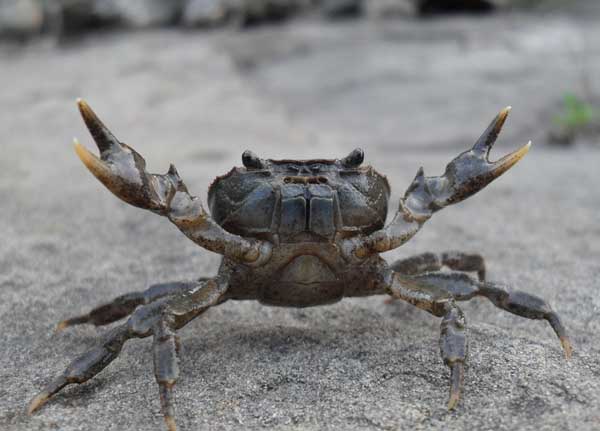
Temporary holding of river crabs serves two purposes: one is to allow some "yellow crabs" to fully mature into "green crabs"; the other is to wait for a better price and fully exploit regional and seasonal price differences to obtain higher profits. However, many farmers one-sidedly pursue the scale of temporary holding while neglecting the improvement of river crab temporary holding techniques, which easily causes large numbers of temporarily held crabs to die and results in considerable economic losses.
Causes of death
1. Physiological death: After the gonads of river crabs mature, they need to enter the brackish water area at the junction of sea and river for reproductive migration. If they continue to be temporarily held in fresh water, the internal osmotic pressure will become too high and they will die.
2. Poor quality of river crabs: Temporarily held river crabs of different sizes, high holding density, and excessively long holding time easily lead to mutual killing, with small-sized crabs having a high mortality rate; if there are diseased crabs or crabs with incomplete limbs among the temporarily held crabs, disease is easily transmitted, and the temporarily held crabs die from disease; some farmers purchase river crabs and then temporarily hold them, and because the crabs have been out of water for a long time, the gill chambers and gill filaments suffer serious damage from prolonged respiration, and excessive water loss leads to massive death of the river crabs.
3. Too many temporary holding steps: When some holders catch river crabs, they first temporarily hold them in closed net cages, and later transfer them into earthen ponds for temporary holding. Because the mesh of the net cage provides attachment surfaces for the crabs to climb, when density is high, the crabs' appendages are easily broken, and some crabs die because damaged walking legs cause them to lose their protective ability.
4. Poor ecological conditions: Some holders focus only on preventing escape and ignore the river crabs' requirements for the ecological environment. For example, if the temporary holding pond is too small, the coverage of aquatic plants is low, and there are no artificial burrows for the crabs to hide in, the crabs' ability to complete their final molt is greatly reduced; shallow water levels cause rapid changes in water quality and low dissolved oxygen, making the crabs frequently come ashore and consume much physical energy; inadequate dredging of the temporary holding pond makes the water body acidic and the temporarily held crabs poor in disease resistance; fertile water and high holding density can also cause suffocation and death of the temporarily held crabs. Under such harsh environmental conditions, the above causes lead to an increased mortality rate of temporarily held crabs.
5. Insufficient feeding: When the water temperature is above 4°C, river crabs will still feed. If the feeding amount is insufficient, and in addition there is little natural food organism in the temporary holding pond, the river crabs will kill each other over limited food, and some will die from incomplete molting or escape while searching for food.
Notes on temporary holding
1. Selection of the temporary holding pond. Taking into comprehensive account conditions such as water source, water quality, silt, and water exchange, choose a pond near a source of abundant water, with unpolluted water quality and rich dissolved oxygen and slight water flow, with little silt deposition, aquatic plant coverage above 40%, in a quiet location, and convenient for filling and draining, with an area of 3-5 mu and a water depth of 1.5-1.8 m. Half a month before the temporarily held crabs are put into the pond, thoroughly clear the pond, using 100 kg of quicklime per mu, which can both kill pathogens and provide ca2+ to raise the pH.
2. Requirements for temporarily held crabs. Temporarily held crabs should be robust in constitution, uniform in size, with complete carapace and appendages, free of disease and injury, and should be stocked all at once in sufficient quantity. Selected river crabs should be soaked and washed in 4% salt water for 10-15 minutes for disinfection and sterilization. During stocking, if soft-shelled crabs or crabs about to shed their shells are found, they should be picked out separately and temporarily held until the shell hardens, then placed into the temporary holding pond.
3. Reduce temporary holding steps. It is best not to use net cages to temporarily hold river crabs. If the holding time is short, water peanut can be laid around the cage body for temporary holding in net cages. The temporary holding density should depend on the holding conditions, management level, and length of holding time, generally controlled at 150-200 kg per mu; for river crabs that have been transported for a long time, each one should be checked before entering the pond, and injured, crippled, dying, dead, and diseased crabs should be removed. It is best to hold them separately by grade in different ponds to facilitate catching and sale.
4. Prevention and treatment of diseases during temporary holding. During temporary holding of river crabs, regularly splash 0.5 mg/L of strong chlorine disinfectant to disinfect the water body, and every half month feed bait mixed with oxytetracycline for 5 consecutive days to prevent crab diseases; if symptoms appear such as rotting appendages on the crab abdomen, red and swollen anus, and refusal to eat, bait mixed with 2 mg/L oxytetracycline and Xiekangning No. II can be fed; if water rats, water snakes, frogs, etc. are found, they can be eliminated by drugs (catching and killing), tools, or manual capture.
5. Temporary holding management measures. If the goal is to obtain high profits, choosing green crabs as the temporary holding subject will reduce mortality, because they do not need to complete reproductive molting and have a stronger ability to adapt to the environment. The temporary holding time for river crabs is generally preferably 1.5 to 2 months, especially when the water body area is small, water quality is poor, water exchange is slow, and the temporary holding density of river crabs is relatively high, the holding time should be shortened even more. After the temporarily held river crabs are put into the pond, scientific management must be strengthened in a timely manner. Daily management mainly consists of maintaining fresh water quality, changing water once every 5-7 days at noon, each time changing 15-25 cm, splashing quicklime once every 20-30 days to increase the calcium content of the pond water, and removing residual bait, debris, dead crabs, etc. from the pond every day; feed once a day, with the feeding amount being 3%-5% of the temporarily held crab quantity, of which animal-based bait accounts for 60%, ensuring that the river crabs are healthy for market.