How to prevent and treat crab trembling disease? Introduction to practical methods
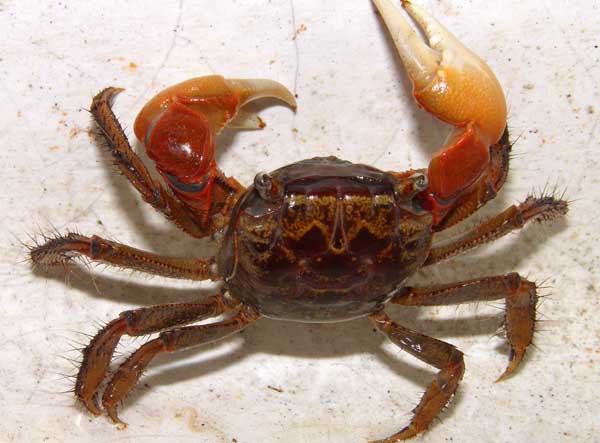
Symptoms of crab trembling disease
In the early stage of trembling disease, affected crabs reduce or stop feeding, have difficulty molting, and show weakened activity or a state of stupor. As the disease progresses, the finger joints turn red and the redness keeps spreading upward. The walking legs easily fall off, the claws droop weakly, the walking legs tremble continuously, the crab foams at the mouth, and it cannot crawl, which is why it is called “trembling disease”. Sometimes affected crabs can be seen with their walking legs drawn in and huddled against the cephalothorax, or with their claw tips spread out and touching the ground; if the walking legs are straightened and then released, they immediately retract, which is why some people also call it “leg-circling disease”. When the crab body is dissected, water accumulation inside the body, muscle atrophy, blackened or yellow gill filaments, edema of the triangular membrane with a pink color, and no food in the stomach and intestines can be seen.
Prevention and treatment methods for crab trembling disease
Prevention first, prevention more important than treatment, and combining prevention with treatment, with ecological disease prevention as the main approach and drug treatment as a supplement, focusing on improving the quality of the farming environment. Affected crabs are treated comprehensively with external disinfection and oral medication. For external disinfection, use disinfectants such as 0.3mg/L dibromohydantoin; for oral administration, use Xiaodouling, etc., with 7 days as one treatment course; splash quicklime over the whole pond to adjust the pond water to weakly alkaline.