Does black guinea pig farming really have a future? Market prospect analysis
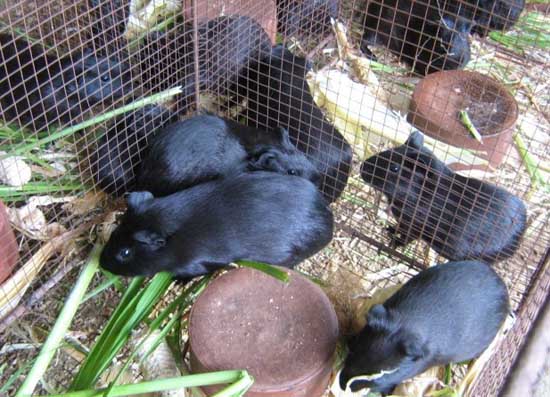
Does black guinea pig farming really have a future
Many wild animals are banned from being farmed and eaten, but wild animals have always been delicacies that people pursue, and market demand is growing day by day. Compared with those farming projects with high feeding costs, great technical difficulty and long payoff periods, black guinea pig farming has obvious advantages.
1. The black guinea pig is a wild economic animal that the state permits to be farmed and whose market is open, so it can circulate smoothly in the market.
2. The meat of the black guinea pig is delicious, on a par with that of the masked palm civet. In particular, the black guinea pig is a herbivore, making it a green food, and market demand is constantly rising.
3. Black guinea pigs have low feeding costs and are not very technically difficult to raise. The feeding cost is only one-sixth that of the masked palm civet, and the technical difficulty is one-tenth. Raising one commercial black guinea pig weighing 500-800 grams has a comprehensive cost of only about 4 yuan.
4. Black guinea pig farming is not technically difficult, with few diseases and no plagues. Even with extremely simple farming, the survival rate is above 90%. Unlike raising rabbits, chickens, ducks and other economic animals, where an outbreak of plague means heavy losses.
5. Farming black guinea pigs brings quick results and good returns: 10 pairs of black guinea pigs can breed more than 300 offspring in a year, with a net profit of more than 3000 yuan, and one person's management capacity can raise 400 pairs of breeding guinea pigs. The daily feed cost for 200 pairs is only the daily food intake of one sow, and the rest is all grass feed.
The black guinea pig is a herbivorous animal. Its diet is mainly green and coarse fodder, with an appropriate small amount of concentrate added. It does not compete with people for grain or with grain for land. Raising black guinea pigs is a typical grain-saving farming industry. The feed is easy to obtain, and feeding and management are also relatively easy, so the elderly, the weak, women and children can all raise them. The farming scale can be large or small, and the raising methods are diverse. They can not only be produced in factory-style, intensive operations, but also raised on a small scale, and are even more suitable for household farming by thousands of families. Developing the black guinea pig farming industry requires little investment, brings quick results and yields large returns, making it a relatively ideal household farming business.
In our country, black guinea pig farming can be developed not only in pastoral areas, but agricultural areas also have good raising conditions. Agricultural areas have a certain area of hilly and ridge land, vast coastal tidal flats, and abundant forage resources. In particular, the western ethnic regions are especially suitable for using grassland to develop black guinea pig farming. With the development of our country's foreign trade and the improvement of domestic people's living standards, developing black guinea pig farming production has immeasurable prospects.
“Things are precious when rare, and foods are nourishing when black”. Since the 1990s, a wave of eating black foods has swept the globe. Black foods have been listed as the fourth generation of natural functional foods after green foods, and will become the food people like most. Modern scientific research has proved that black foods not only have high nutritional value, but also have the special functions of clearing free radicals in the human body, resisting oxidation, lowering blood lipids, resisting tumors, supporting yang, and resisting aging. The black guinea pig is a high-protein, low-fat, low-cholesterol food. The melanin it contains can clear free radicals in the human body and prevent lipid peroxidation, thereby playing a role in delaying aging; the iron it contains is 3 times that of soft-shelled turtle, and it is also rich in the anti-cancer and cancer-fighting elements zinc and selenium, while its content of cholesterol and saturated fatty acids is very low. It is an ideal nutritional and tonic health food, in line with the new 21st-century consumption trend of natural health black foods. Because black guinea pig meat is almost entirely muscle, its fibers are more tender than rabbit meat, and it has no gamy or muttony odor, so it has the characteristics of being easy to cook through, easy to soften, and suitable for quick cooking. Black guinea pig meat is sweet in taste and neutral in nature, with the effects of tonifying qi and nourishing blood and removing toxins, and is used to treat weakness, kidney deficiency in the elderly, postpartum anemia and other conditions. The testicles of the black guinea pig can be used to produce drugs for treating epilepsy, and guinea pig blood can be used to extract the drug raw material serotonin.
At the same time, the fur of the black guinea pig is a very good processing material for fur clothing and handicrafts. Its processing performance and decorative performance can rival mink fur, and it can be used to make fur clothing, shawls, gloves and a series of guinea pig fur toys. The black guinea pig can also serve as an ornamental animal, providing a beloved pet for pet breeders, especially children.
The black guinea pig is a small animal with a gentle temperament and is easy to restrain. Its blood has high utilization value and is relatively convenient to collect, so it can be widely used in experiments in physiology, medicine, immunology, reproduction and bioengineering. According to reports, Japan, South Korea, China and other countries all select black guinea pigs as experimental animals, with annual demand at more than hundreds of thousands, and domestic demand in the future will far exceed hundreds of thousands. Therefore, the black guinea pig is an ideal experimental animal with wide applications.
Black guinea pig manure and urine are high-quality organic fertilizer. One adult black guinea pig accumulates 90-120 kg of fertilizer per year. The content of the three elements nitrogen, phosphorus and potassium in black guinea pig manure is far higher than that in the manure of other livestock and poultry. According to estimates, 100 kg of black guinea pig manure is equivalent in fertilizer effect to 10.92 kg of ammonium sulfate and 1.97 kg of potassium sulfate, and black guinea pig fertilizer can improve soil structure, increase organic matter and raise soil fertility. Tests in the yellow mud (acidic) soil of Fenghuang Mountain in Chengdu, Sichuan Province showed that yellow mud soil treated with black guinea pig manure increased organic matter by 42.3% and nitrogen content by 43.86%, significantly improving the soil quality and soil structure.
The black guinea pig industry conforms to our country's national conditions. Our country has a relatively large land area, but a relatively small proportion of arable land, accounting for about 7% of the world's arable land, while its population accounts for 22% of the world's, making it a major grain-deficient country. At present, our country's annual per capita grain availability is less than 400 kg. By the end of the 20th century, with the population controlled at 1.25 billion, per capita grain availability would still not exceed 400 kg. This means that, without a reduction in land and with population growth brought under control, it could only be achieved under normal weather conditions without major disasters. Our country's per capita grain availability is far behind that of developed countries in the world. Therefore, our country cannot use large amounts of grain to develop livestock and poultry that consume more grain.
Looking further at our country's people's consumption habits for animal foods, our country is a multi-ethnic country, and among animal foods pork accounts for about 90%. This food structure is extremely unreasonable, as it not only consumes large amounts of grain to raise pigs, but is also unfavorable to people's physical fitness. In terms of productivity per unit area, the black guinea pig is also an animal with relatively high production capacity. At present, many countries in the world believe that developing black guinea pig production is a shortcut to solving the human meat food problem.
In summary, according to our country's national conditions and the advantages of the black guinea pig industry, vigorously developing the grain-saving Chinese black guinea pig has important strategic significance. The most crucial thing is correct guidance. Speculating in breeding stock is not real ability; developing a commodity economy is the future.